

The most consequential documents in global affairs are not read. They are filed. Governments commission them. Central banks circulate them. Multinational boards receive them in quarterly information packs, where they occupy the lower rungs of an overcrowded agenda before being consigned to the archived recesses of institutional memory. This is the defining strategic error of our time, and its consequences compound with every quarter that passes unremedied.
The architecture of power in the twenty-first century does not reside in the speeches of heads of state, nor in the quarterly earnings calls of Fortune 500 corporations. It lives, with remarkable precision, inside the institutional reports produced by the International Monetary Fund, the World Bank, the World Economic Forum, the United Nations, McKinsey & Company's McKinsey Global Institute, the BCG Henderson Institute, Bain & Company, Deloitte, and Accenture. These are not passive commentaries on the condition of the world. They are active instruments of agenda formation, designed not merely to describe reality but to restructure it. To read them superficially is to mistake a surgical instrument for an ornament.
The real question, therefore, is not what these reports say. Every senior leader can extract the headline figures: the GDP forecasts, the risk indices, and the productivity gaps. The real question, the question that separates those who command global systems from those who merely participate in them, is this: what strategic signals are embedded inside these documents for those responsible for steering nations, corporations, and capital through the most turbulent decade since the Cold War? The answer, for those disciplined enough to seek it, is one of the most consequential competitive advantages available to leadership today.
The Illusion of the Summary: Why Surface Reading Is Strategic Negligence
There is a comfortable myth that pervades boardrooms and policy chambers alike, namely that a well-constructed executive summary captures the full strategic value of an institutional report. It does not. The executive summary is a concession to time pressure, not an instrument of strategic intelligence. It presents the sanitised, consensus-approved surface of a document whose true force lies in the structural tensions, the methodological footnotes, the dissenting appendices, and the calibrated language deployed in the body of the text. To rely upon the summary alone is to mistake the menu for the meal.
Consider the IMF's World Economic Outlook, published twice annually and consumed by finance ministries, central banks, and sovereign wealth funds on six continents. The headline figures, global growth projections, trade volume revisions, and inflation corridors receive the preponderance of media and institutional attention. Yet the WEO's most strategically consequential content frequently resides in its analytical chapters, which deploy sophisticated econometric frameworks to interrogate structural vulnerabilities invisible to conventional macroeconomic surveillance. The October 2023 WEO, for instance, contained a chapter on the labour-market implications of artificial intelligence that pre-positioned the intellectual architecture subsequently adopted by multiple G20 finance ministers in their domestic AI governance frameworks. Organisations that read only the headline growth figures missed the signal entirely.
The World Bank's Global Economic Prospects operates under an identical dynamic. Its headline growth forecasts are widely reported; its granular analysis of developing-economy debt-service constraints, supply-chain reconfiguration pressures, and climate-related fiscal vulnerabilities is almost universally underutilised. For South African institutions in particular, this asymmetry is strategically costly. South Africa's sovereign debt trajectory, its energy infrastructure deficit, and its exposure to commodity-cycle volatility are each addressed, directly or analogously, in the structural frameworks embedded within consecutive Global Economic Prospects editions. The leaders of Eskom, the National Treasury, and the major South African banks would find, upon disciplined reading, not merely commentary on their circumstances but calibrated frameworks for restructuring their strategic response to those circumstances.
The discipline required to move beyond the summary is, in essence, the discipline of distinguishing between information and intelligence. Information is abundant, democratised, and of declining competitive value. Intelligence is scarce, structurally embedded, and available only to those with the methodological sophistication to extract it. Institutional reports are dense intelligence repositories. The failure to read them as such is not merely an intellectual oversight; it is a strategic dereliction that cedes competitive ground to the organisations and governments that do.
One must acknowledge the counterargument: that institutional reports are inherently constrained by their consensus-building mandates, that multilateral organisations produce documents designed for political palatability rather than analytical sharpness. This objection has merit but arrives at the wrong conclusion. The very constraints of consensus production are themselves informative. The language deployed in the IMF's Fiscal Monitor to describe a member state's debt sustainability framework, chosen after negotiation amongst shareholder governments, carries interpretive freight that no press release replicates. The gap between what a report says and what it conspicuously does not say is frequently the most important signal of all. Silence, in institutional documents, is not absence; it is architecture.
Documents That Quietly Direct Power as Instruments of Agenda Formation: The Political Economy of Institutional Reports
Strategic reports produced by global institutions do not merely reflect the world as it is. They actively constitute the world as it is becoming. This is the foundational misunderstanding that separates passive consumers of institutional content from those who engage with it as a tool of strategic positioning. The World Economic Forum's Global Risks Report does not simply survey risk perceptions; it curates the vocabulary through which risk is discussed at the highest levels of global governance. When the 2024 Global Risks Report elevated misinformation and disinformation to the top of its five-year risk horizon, it did not merely catalogue a trend. It signalled to governments, technology companies, regulatory bodies, and institutional investors the precise terrain on which policy contests would subsequently be fought.
McKinsey Global Institute reports function with equivalent agenda-setting force within the corporate sphere. The MGI's analyses of automation, talent markets, and productivity frontiers have, over two decades, shaped the strategic frameworks adopted by boards of directors across industries and geographies. The MGI's 2023 report on generative artificial intelligence, which estimated that the technology could add between two point six trillion and four point four trillion dollars in annual value across use cases, did not merely describe a technological possibility. It established the analytical benchmark against which corporate AI investment decisions were subsequently justified or challenged in boardrooms from Seoul to Johannesburg. To read the MGI report as a passive technology commentary is to misunderstand its function; it is a strategic permission structure, a document that legitimises ambition and calibrates competitive expectation.
The BCG Henderson Institute performs a comparable function at the intersection of corporate strategy and economic theory. Its reports on industrial ecosystems, competitive dynamics, and strategic resilience consistently introduce conceptual frameworks that migrate, within twelve to eighteen months, into the strategic planning vocabularies of leading corporations worldwide. BCG's work on adaptive strategy and portfolio resilience during periods of structural uncertainty provided the intellectual scaffolding for a generation of post-pandemic corporate restructuring decisions. Organisations that encountered these frameworks through secondary citation, rather than primary engagement, operated at a structural disadvantage; they received pre-digested conclusions without the contextual rigour required for disciplined adaptation.
Bain & Company's Global Private Equity Report exemplifies a more specialised but equally consequential form of agenda formation. Private equity, as an asset class and as a governance philosophy, has migrated from the institutional periphery to the centre of global capital allocation over the past two decades. The Bain Private Equity Report does not simply chronicle this migration; it calibrates the expectations of the limited partners, general partners, pension funds, and sovereign wealth funds whose combined capital steers the trajectory of entire industries. For South African pension funds navigating the intersection of domestic infrastructure requirements, ESG mandates, and return-on-capital pressures, the Bain report's analysis of global PE exit environments and sector rotation patterns constitutes essential intelligence. The failure to engage with it is the failure to understand the capital market in which South African institutional investors must compete.
Deloitte's Global CEO Outlook and sector-specific reports illuminate the intersection between executive sentiment and strategic intention, a conjunction of enormous predictive value. When Deloitte's research reveals that a majority of global CEOs plan to increase technology investment whilst simultaneously restructuring workforce composition, this is not anecdotal survey data. It is a leading indicator of the talent market conditions, technology procurement cycles, and competitive capability shifts that will characterise the subsequent two to three years of corporate competition. South African human resource executives, technology procurement officers, and competitive intelligence functions that integrate this data into their planning frameworks will navigate the coming cycle with materially superior foresight.
The Logic of Embedded Codes: How to Read What Is Actually Being Said

The discipline of reading institutional reports strategically requires a methodology, not merely an attitude. The first principle of this methodology is the primacy of language over data. Data points in institutional reports are selected, sequenced, and framed by editorial choices that carry interpretive significance beyond the numbers themselves. When the United Nations Department of Economic and Social Affairs' World Economic Situation and Prospects 2026 projects developing-economy growth at a rate persistently below the threshold required for meaningful poverty reduction, this is not presented as a policy failure. It is presented as a structural observation. The strategic reader, however, recognises the embedded normative claim: that current policy architectures are structurally insufficient, and that the gap between aspiration and trajectory constitutes a systemic risk requiring deliberate intervention.
The second principle is the analytical significance of revision. Institutional reports derive much of their strategic value not from their point-in-time projections but from their revisions to prior projections. When the IMF successively revises its growth forecast for a specific economy downward over three consecutive editions of the World Economic Outlook, whilst simultaneously upgrading its assessment of structural reform requirements, the sequential signal is unambiguous: the institution has concluded that policy inadequacy is structural rather than cyclical. For South African investors and policymakers, the IMF's treatment of South African growth, energy security, and state-owned enterprise reform across consecutive editions of the WEO constitutes a sustained, if diplomatically restrained, indictment of reform velocity. To read each edition in isolation, rather than as an element of a longitudinal signal sequence, is to systematically underestimate the severity of the institutional verdict.
The third principle concerns the strategic value of what institutions choose to measure. The WEF's decision, beginning with its 2022 Global Competitiveness framework revision, to incorporate institutional quality, regulatory agility, and innovation ecosystem depth as core competitiveness dimensions alongside traditional factor productivity metrics was not a neutral methodological choice. It reflected a substantive analytical judgement that the sources of national competitive advantage were undergoing structural reconfiguration. Countries and corporations that registered this methodological shift, and repositioned their strategic investments in governance capacity, regulatory technology, and innovation infrastructure accordingly, gained a period of structural advantage over those that interpreted the WEF report as a static ranking exercise.
The fourth principle, and the one most consistently neglected, is cross-institutional triangulation. No single institutional report possesses complete analytical authority. The IMF's macroeconomic framework, the World Bank's development finance perspective, the WEF's multi-stakeholder risk architecture, and the consulting-house analyses of corporate strategy and operational transformation each illuminate distinct facets of a complex, interdependent global system. The strategic value of any one report is multiplied when it is read in deliberate dialogue with the others. When the IMF's WEO and the World Bank's GEP simultaneously identify infrastructure deficit as a binding constraint on emerging-market growth, whilst McKinsey's infrastructure productivity analysis identifies the specific operational failures that generate cost overruns, the combined signal constitutes a complete diagnostic architecture. A South African infrastructure minister, a development finance institution board, or a construction sector CEO who triangulates across all three sources does not merely understand the problem; they possess a multi-dimensional framework for designing a solution.
Cross-institutional triangulation is not an abstract intellectual exercise. It is a practical strategic tool with demonstrable return on investment. Organisations that systematically triangulate across institutional report signals spend less on reactive strategy reformulation, experience fewer strategic surprises, and allocate capital with greater precision. The cost of this discipline is time and analytical capability. The cost of its absence is strategic obsolescence. This is not a counsel of perfection; it is a description of the competitive minimum required to operate with sovereign-level strategic intelligence in the contemporary global economy.
The South African Strategic Reality: Reading Global Intelligence Through a Local Strategic Lens
South Africa occupies a position of structural paradox in the global institutional intelligence ecosystem. It is sufficiently significant, as the continent's most sophisticated financial market, a G20 member state, and a regional anchor economy, to feature with regularity in the analytical frameworks of every major institutional report. It is simultaneously sufficiently peripheral to the central preoccupations of the international institutional community that the signals relevant to its specific circumstances require active extraction rather than passive reception. A South African corporate executive who reads the IMF's WEO for its global headline figures will encounter South Africa as a data point. A South African executive who reads it as a strategic instrument will encounter South Africa as a case study in the precise structural vulnerabilities that the global institutional community considers most consequential.
The World Bank's assessment of South Africa's infrastructure financing gap, its analysis of public-private partnership frameworks in comparable emerging-market contexts, and its evaluation of energy transition financing mechanisms in countries navigating comparable fiscal constraints all constitute directly applicable strategic intelligence for South African infrastructure developers, project finance practitioners, and public-sector planners. The Bain Global Private Equity Report's analysis of African private equity market depth, deal flow quality, and exit environment constraints translates, with modest analytical adaptation, into a forward-looking assessment of the capital available to South African growth companies seeking institutional investment. These connections are not automatic; they require the analytical discipline to recognise transferable frameworks, and the intellectual ambition to apply them with rigour.
South African financial institutions, in particular, operate in a context where global institutional intelligence carries exceptional strategic value. The divergence between South Africa's domestic interest rate environment and the global monetary policy cycle, the rand's structural exposure to commodity price volatility and emerging-market risk sentiment, and the complex interaction between domestic fiscal consolidation requirements and growth imperatives, each of these dynamics is illuminated, from multiple angles, by the combined analytical output of the institutions discussed in this article. The Monetary Policy Committee of the South African Reserve Bank would find, in the combined reading of the IMF's WEO, the IMF's Global Financial Stability Report, and the BIS Quarterly Review, a richer analytical context for its deliberations than any single domestic data source provides.
The WEF's Global Risks Report carries particular relevance for South African boards of directors navigating an environment of compounding systemic risks. The report's 2024 identification of energy supply security, state fragility, and erosion of social cohesion as interconnected, mutually reinforcing risks was not an abstract global observation. It was a precise characterisation of the South African risk environment, articulated within a comparative global framework that renders South Africa's specific vulnerabilities both legible and strategically addressable. Boards that used this framework to structure their enterprise risk management reviews in 2024 entered the planning cycle with a materially superior understanding of the systemic risks embedded in their operating environment than those that commissioned bespoke domestic risk analyses in isolation.
The McKinsey Global Institute's work on Africa's economic potential, most comprehensively articulated in its Lions on the Move series and its subsequent analyses of the African Continental Free Trade Area, provides South African corporations with a strategic map of the continent's most significant commercial opportunities. The MGI's identification of infrastructure, financial services, agribusiness, and retail as sectors with the highest productivity-uplift potential in sub-Saharan Africa constitutes a sector-selection framework directly applicable to the portfolio decisions of South African conglomerates, development finance institutions, and private equity houses seeking to expand their continental footprint. Organisations that have integrated these frameworks into their continental strategy have, in several documented cases, achieved first-mover advantages in markets whose growth potential the wider investment community recognised only after subsequent, heavily publicised institutional validation.
Practical Case Studies in Strategic Report Reading: From Code To Strategic Action
The strategic value of institutional report reading is not theoretical. It is demonstrable through the examination of organisations that have converted institutional intelligence into competitive advantage, and through the examination of those whose failure to do so resulted in strategic disruption. The contrast between these two categories of organisation is instructive.
Consider the trajectory of a major South African commercial bank, which shall remain unnamed, that integrated systematic WEF Global Risks Report analysis into its enterprise risk management framework beginning in 2018. The 2018 report identified cyberattack and data fraud as top-five global risks for the first time, positioned alongside geopolitical fractures and environmental crises. The bank's risk committee, operating through a disciplined process of institutional signal extraction, translated this into a three-year investment programme in cybersecurity infrastructure and digital resilience capability. When the wave of sophisticated cyberattacks targeting South African financial institutions intensified between 2020 and 2022, the bank experienced materially lower operational disruption and reputational damage than several of its peers, which had treated the WEF signal as a global abstraction rather than a local strategic imperative. The difference in outcome was not primarily a function of technological capability; it was a function of intelligence discipline.
At the global level, consider the strategic positioning of certain sovereign wealth funds that systematically integrated MGI analysis of automation's labour-market implications into their asset allocation frameworks in the period between 2017 and 2019. The MGI's A Future That Works report provided, with considerable analytical precision, a sectoral decomposition of automation vulnerability across major economies. Sovereign wealth funds that used this framework to reduce portfolio exposure to automation-vulnerable manufacturing sectors and increase allocations to technology-enabled service industries, education infrastructure, and healthcare systems, achieved superior risk-adjusted returns through the pandemic period, during which the structural automation of routine cognitive and physical labour accelerated by an estimated decade. The MGI report did not predict the pandemic. It accurately identified the structural forces that the pandemic would accelerate, and those funds that read it as a strategic asset allocation framework rather than as an academic technology commentary were positioned to benefit.
The BCG Henderson Institute's work on corporate resilience and strategic agility during periods of market disruption provides another instructive case. Organisations in multiple sectors that integrated BCG's framework for distinguishing structural from cyclical market changes into their strategic planning processes during the 2020 to 2022 period navigated post-pandemic normalisation with considerably greater strategic coherence than those that relied upon internal scenario planning alone. The BCG framework provided a rigorous analytical language for the distinction between temporary demand disruption and permanent structural reconfiguration, a distinction of enormous consequence for capital allocation, workforce planning, and competitive positioning decisions. Those who possessed this language made better decisions, at speed, in conditions of genuine uncertainty.
For South African infrastructure developers and energy sector participants, the World Bank's Tracking SDG7: The Energy Progress Report and its associated analytical work on energy access, transition financing, and utility reform constitutes a strategic intelligence resource of the first order. South Africa's energy transition, arguably the most consequential single policy challenge facing the South African economy in the current decade, is analogous in multiple structural respects to energy transition challenges that the World Bank has analysed in comparable emerging-market contexts. The sequencing of renewable energy procurement, the management of state-owned utility reform, and the mobilisation of blended finance for infrastructure investment are each addressed with analytical rigour in World Bank publications that South African energy sector participants have, with notable exceptions, underutilised.
The implementable lessons from these cases converge upon a single strategic imperative: the transformation of institutional report reading from a passive, episodic activity into an active, systematic intelligence function. This transformation requires three organisational capabilities. The first is dedicated analytical capacity: the assignment of qualified analysts whose explicit mandate includes the extraction, contextualisation, and distribution of strategic signals from institutional report streams. The second is a structured integration protocol: formal processes through which extracted signals are incorporated into strategic planning cycles, risk management frameworks, and investment committee deliberations. The third is cross-functional distribution: the routing of relevant institutional intelligence to the specific executives and functions with the authority and context to act upon it. Organisations that possess all three capabilities do not merely read institutional reports; they derive sustainable competitive advantage from their content.
The Consulting-House Dimension: Reading Tier-One Firms as Intelligence Systems

The major consulting houses, McKinsey, BCG, Bain, Deloitte, and Accenture, occupy a unique position in the global intelligence ecosystem. Unlike multilateral institutions, they operate with full commercial sensitivity to the strategic needs of the corporations and governments they serve. Unlike academic research institutions, they deploy empirical frameworks directly connected to operational reality. Their published reports represent the distilled, commercially calibrated intelligence generated by consulting relationships with the world's most sophisticated organisations, filtered through methodological rigour and presented for maximum strategic applicability. They are, in the precise sense of the term, intelligence products.
The Accenture Technology Vision, published annually, performs a function that extends beyond technology trend identification. It maps the intersection between emerging technological capabilities and their most commercially consequential applications, drawing upon Accenture's direct engagement with technology deployment across hundreds of client organisations in multiple sectors and geographies. For South African technology executives and digital transformation leaders, the Accenture Technology Vision constitutes a calibrated signal about the technological capabilities that leading organisations globally are actively deploying, not merely contemplating. The gap between global deployment leading practice and South African adoption rates, readable through a disciplined engagement with the Accenture Vision, is simultaneously a diagnostic of competitive vulnerability and a roadmap for strategic catch-up.
Deloitte's Global Human Capital Trends report provides equivalent intelligence at the intersection of talent, organisation, and leadership. Its annual identification of the workforce dynamics commanding the most attention from chief human resources officers globally, combined with its empirical analysis of the relationship between specific organisational practices and business performance outcomes, constitutes a strategic benchmarking framework directly applicable to South African organisations navigating the talent scarcity, skills development imperative, and organisational redesign requirements that characterise the current South African labour market. South African HR executives who read the Deloitte report as a global benchmarking instrument rather than as a catalogue of international best practice receive materially different, and materially more useful, strategic guidance from the same document.
The distinction between reading consulting-house reports as catalogues of best practice and reading them as intelligence systems is not semantic; it is structural. A catalogue of best practice invites imitation. An intelligence system invites analysis, contextualisation, and strategic adaptation. The former produces lagging capability development. The latter produces anticipatory competitive positioning. This distinction is particularly consequential for South African organisations, which operate in an environment where the direct importation of global best practice frequently fails to account for the structural, regulatory, and cultural specificities that determine operational effectiveness in the South African context. The MGI's analysis of manufacturing productivity in middle-income economies is not a recipe for South African industrial policy; it is a comparative framework within which South Africa's specific productivity constraints can be diagnosed and its specific improvement opportunities can be identified. The analytical leap from framework to application is the responsibility of the South African strategist, not the MGI.
Building the Institutional Intelligence System: A Strategic Implementation Architecture
The conversion of institutional report reading from individual discipline to organisational capability requires a systematic implementation architecture. The following framework, distilled from observation of the organisations that extract the most consistent value from institutional intelligence, provides a practical roadmap for the executive who is serious about this transformation.
The first component is an institutional report calendar. The major multilateral and consulting-house reports follow predictable publication rhythms, and the construction of an annual calendar aligned with these rhythms constitutes the foundational organisational discipline. The IMF's World Economic Outlook and Fiscal Monitor are published in April and October. The World Bank's Global Economic Prospects appears in January and June. The WEF's Global Risks Report precedes Davos in January. The MGI, BCG Henderson Institute, Deloitte, and Accenture publish their major research outputs throughout the year, with clustering in the first and third quarters. An organisation that maps these publication dates against its own strategic planning cycle, risk review calendar, and investment committee schedule is positioned to ensure that institutional intelligence is available at the precise moments when strategic decisions are being made.
The second component is a reading protocol that distinguishes between primary, secondary, and tertiary engagement. Primary engagement, reserved for the reports of highest strategic relevance, requires full methodological analysis: the examination of data sources, the interrogation of assumptions, the identification of dissenting footnotes, and the extraction of embedded signals through disciplined close reading. Secondary engagement, appropriate for the broader range of institutional publications relevant to the organisation's strategic context, requires structured summary and cross-referential annotation. Tertiary engagement, covering the wider institutional output environment, requires systematic monitoring for signals requiring elevation to primary or secondary engagement status. This tiered protocol prevents the cognitive overload that discourages serious institutional reading, whilst ensuring that the most consequential signals receive the analytical attention they warrant.
The third component is an analytical translation function: the capacity to move from global institutional framework to locally applicable strategic insight. This function requires analysts who combine macroeconomic literacy, sector-specific expertise, and deep knowledge of the South African operating environment. The translation function is where the greatest competitive value resides, and where the greatest analytical skill is required. The IMF's framework for assessing debt sustainability in middle-income economies with constrained fiscal space is a general analytical instrument; its translation into a specific assessment of the strategic options available to South African municipalities operating under fiscal stress requires a combination of global framework literacy and local contextual depth that is genuinely scarce. Organisations that develop this capability internally, or access it through structured analytical partnerships, acquire a durable competitive advantage.
The fourth component is a signal distribution mechanism: the systematic routing of extracted and translated intelligence to the executives and functions with the authority and context to act upon it. The most common failure point in institutional intelligence systems is not the quality of the analysis but the inadequacy of the distribution architecture. Strategic signals extracted by a central intelligence function and distributed through a quarterly research digest that arrives in the inboxes of senior executives already drowning in information do not change strategic decisions. Signals integrated into the briefing packs of executive committees, investment committees, and risk committees, presented with explicit strategic implications and clear decision-forcing questions, do. The difference is architectural, not analytical.
The fifth and most demanding component is feedback integration: the systematic capture of the relationship between institutional signals acted upon and subsequent strategic outcomes. This is the mechanism through which an organisational intelligence system learns, improves its signal extraction, refines its translation methodology, and builds the evidential case for continued executive investment in institutional intelligence capability. Organisations that close this feedback loop develop, over time, an institutional intelligence capability that constitutes a genuine and defensible strategic asset. Organisations that treat institutional report reading as a self-contained episodic activity forfeit this compound learning effect and remain perpetual beginners, regardless of the seniority of the individuals involved.
The Calibration of Scepticism: Reading Institutional Reports Without Being Captured by Them
The counsel to read institutional reports with greater discipline and sophistication is not a counsel of institutional deference. The organisations that extract the most value from the WEF's risk frameworks, the IMF's economic projections, and the MGI's productivity analyses are not those that accept their conclusions uncritically. They are those who engage with their frameworks rigorously, test their assumptions against local contextual evidence, identify the structural biases embedded in their methodological choices, and extract the analytical value whilst resisting the tendency to mistake consensus institutional opinion for settled analytical truth. Institutional scepticism, applied with precision, is not the antithesis of institutional intelligence. It is its highest expression.
The multilateral institutions, for all their analytical sophistication, operate under governance constraints that shape their outputs in ways that require active decoding. The IMF's policy recommendations are structured around the interests and preferences of its shareholder governments. The World Bank's development frameworks reflect the ideological evolution of its leadership and the negotiating positions of its major donors. The WEF's risk reports are shaped by the survey responses of an elite constituency whose risk perceptions are themselves products of specific ideological and economic positions. None of this invalidates the analytical content of these reports. It contextualises it. The strategic reader who understands the institutional incentive structures that shape report content is equipped to extract the analytical signal whilst discounting the advocacy dimension, a distinction of considerable practical importance.
The consulting-house reports require a different calibration of scepticism. McKinsey, BCG, Bain, Deloitte, and Accenture publish research that is, without exception, of high analytical quality. They also publish research that is structurally designed to identify problems whose solutions lie within the capabilities of their advisory practices. This is not a critique; it is a description of an entirely rational commercial orientation. The strategic reader, however, recognises that a report co-authored by a consulting firm with a substantial practice in, for example, digital transformation, may systematically identify digital transformation as the strategic priority whilst underweighting alternative responses to the same structural challenge. Reading consulting-house reports with an awareness of the commercial incentives that shape their framing is not paranoia; it is analytical discipline.
The productive integration of scepticism and engagement produces what might be termed calibrated institutional literacy: the capacity to extract the genuine analytical value from institutional reports whilst maintaining the intellectual independence required to contextualise, challenge, and selectively apply their conclusions. This is the intellectual posture of the sovereign strategist, as opposed to the institutional follower. The institutional follower receives the report's conclusions as strategic guidance. The sovereign strategist uses the report's frameworks as analytical instruments for the construction of independent strategic judgement. The difference in strategic outcome, over a planning horizon of five to ten years, is the difference between reactive adaptation and deliberate competitive advantage.
The Doctrine of Strategic Intelligence: What the Authors of Power Know That Others Do Not

There is a hierarchy of strategic actors in the contemporary global economy that is rarely discussed with the candour it deserves. At its apex stand the individuals and organisations who not only read the reports of the world's most powerful institutions but who actively participate in shaping them; who sit on the advisory panels of the IMF and the World Bank; who contribute to the research programmes of the McKinsey Global Institute and the BCG Henderson Institute; who provide the empirical inputs that calibrate the WEF's risk frameworks. These individuals and organisations do not read institutional reports for information. They read them to verify the extent to which their own strategic intelligence has shaped the institutional consensus, and to identify the gaps between institutional consensus and structural reality that represent the most significant opportunities for competitive repositioning.
Below this apex stands a second tier of strategic actors, equally sophisticated in their institutional intelligence practice, though operating as consumers rather than co-producers of institutional frameworks. These are the chief economists of the world's largest financial institutions, the heads of strategy of leading multinationals, the investment committees of sovereign wealth funds, and the policy chiefs of the governments most deeply integrated into the global institutional order. They read institutional reports as what they are: policy instruments, agenda-setting documents, and early-warning systems for the structural shifts that will reshape the competitive landscape of the following three to five years. They act on this intelligence with speed and conviction, and their institutional intelligence advantage translates directly into competitive advantage.
Below these two tiers stands the vast majority of senior executives, policymakers, and institutional leaders, including, with notable exceptions, the majority of South African corporate and government leadership, who read institutional reports, if at all, as background information rather than as primary strategic intelligence. They receive the summary. They register the headline figures. They file the full report for future reference that never arrives. They make strategic decisions in conditions of self-imposed intelligence scarcity, and they attribute the resulting strategic surprises to the complexity of the environment rather than to the inadequacy of their intelligence practice.
The gap between these tiers is not primarily a function of analytical capability. It is a function of strategic discipline, organisational architecture, and intellectual ambition. The analytical talent required to read institutional reports as strategic intelligence exists within most significant South African corporations and government departments. What is absent is the organisational commitment to deploying that talent in a systematic, disciplined intelligence practice, and the strategic ambition to use the resulting intelligence as a genuine source of competitive advantage rather than as a post-hoc justification of decisions already made on the basis of conventional wisdom.
The authors who most influence global strategy are not the authors of books, however brilliant. They are the authors of the documents that land on the desks of presidents, central bankers, and chief executives. They are the economists who draft the WEO's analytical chapters. The strategists who design the MGI's productivity frameworks. The risk analysts who structure the WEF's interconnected risk taxonomy. To read those documents as they deserve to be read, with methodological rigour, cross-institutional contextualisation, and disciplined analytical translation, is to enter, as a reader, the room where the real decisions about the global economy are made. It is to acquire, at the cost of intellectual discipline alone, the strategic intelligence that others pay billions for the privilege of generating.
South African leaders, corporate and governmental alike, confront a structural moment of exceptional consequence. The global institutional intelligence ecosystem is producing, in real time, frameworks for understanding and navigating the energy transition, the artificial intelligence disruption, the reconfiguration of global supply chains, and the restructuring of the international economic order. These frameworks, available in their primary form at no cost beyond the investment of serious intellectual engagement, constitute the most accessible and underutilised strategic resource available to South African leadership today. The choice to engage with them seriously, or to continue the comfortable practice of superficial engagement and executive summary dependency, is a choice about the future competitiveness of South African institutions in a global economy that will not wait for those who are not paying attention.
The Mandate for the Serious Reader: A Challenge to Global Leaders
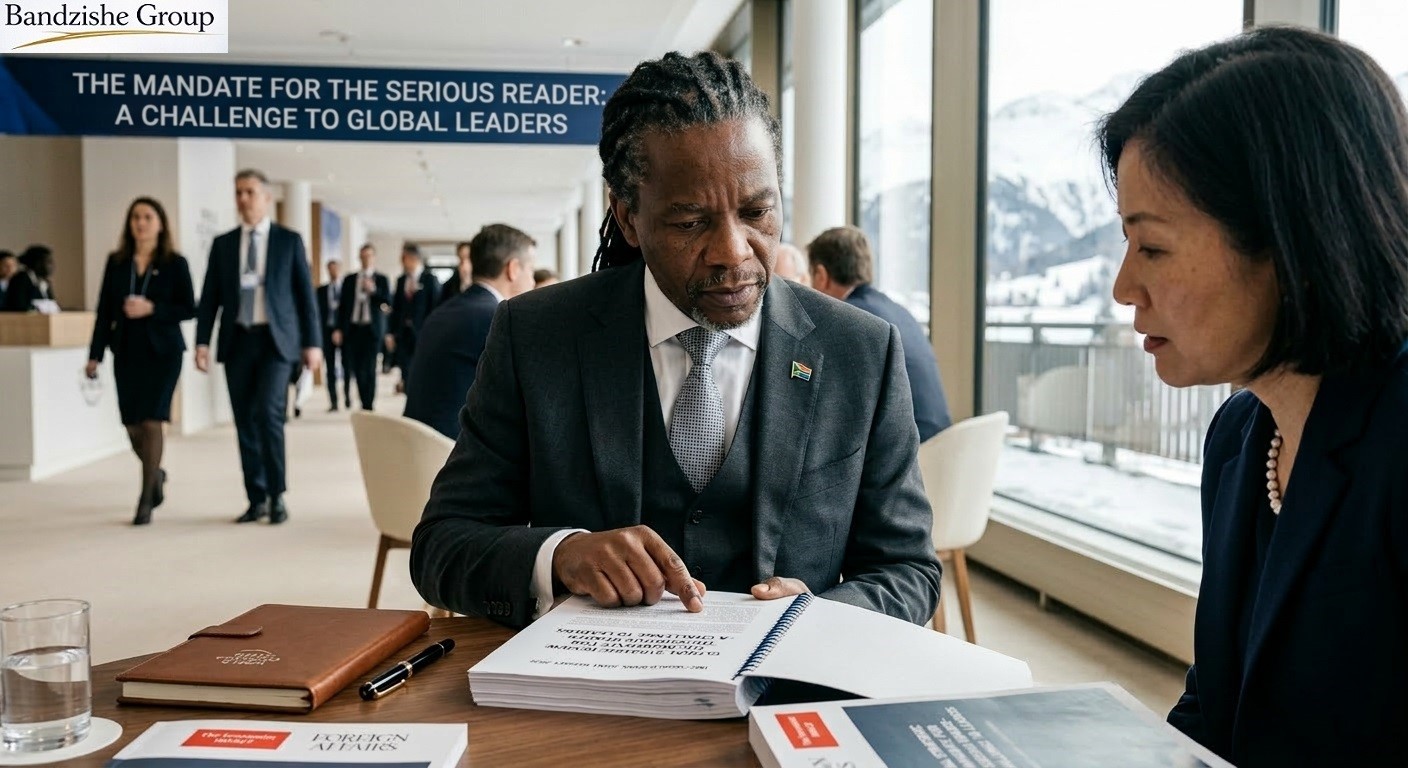
This is the final provocation, and it is addressed directly to you, the executive who has read this far. You have, in the course of this article, encountered evidence that the world's most consequential strategic intelligence is embedded, in accessible form, inside documents that your organisation almost certainly receives and almost certainly underreads. You have encountered frameworks for extracting that intelligence with systematic rigour. You have encountered case studies of organisations, South African and global, that have converted institutional intelligence discipline into measurable competitive advantage. The question you now face is not whether this discipline is valuable. The evidence is unambiguous. The question is whether you possess the strategic ambition to institutionalise it.
The organisational changes required are not trivial. They require the reallocation of analytical capacity, the restructuring of intelligence distribution architectures, and the sustained commitment of senior leadership to a practice whose returns are compound and long-term rather than immediate and linear. They require the intellectual courage to admit that current strategic intelligence practices are insufficient, and the organisational will to replace them with something more demanding and more consequential. They require, in short, the precise qualities that distinguish leaders who design the future from leaders who are surprised by it.
The institutions whose reports are discussed in this article, the IMF, the World Bank, the WEF, the UN, McKinsey, BCG, Bain, Deloitte, and Accenture, will continue to produce, with extraordinary analytical sophistication, the strategic intelligence required to navigate the most consequential decade in global economic history. The signals they embed in their publications will continue to be available, in full, to any organisation with the discipline to read them seriously. The only question is who reads them as instruments of strategic advantage and who reads them as background noise.
The architecture of global power is written in documents that most people file. Read them. Read them in full. Read them in sequence. Read them in cross-institutional dialogue. Build the organisational capacity to extract their embedded signals, translate their global frameworks into local strategic intelligence, and integrate their findings into the decision-making processes where competitive futures are determined. The reports are already on your desk. The intelligence is already within reach. The only constraint that remains is the decision to treat it as such.
Leaders who read strategically govern strategically. Leaders who govern strategically shape the world. The rest merely inhabit it.
Images by Bandile Ndzishe of Bandzishe Group
About bandile ndzishe

Bandile Ndzishe is the CEO, Founder, and Global Consulting CMO of Bandzishe Group, a premier global consulting firm distinguished for pioneering strategic marketing innovations and driving transformative market solutions worldwide. He holds three business administration degrees: an MBA, a Bachelor of Science in Business Administration, and an Associate of Science in Business Administration.
With over 30 years of hands-on expertise in marketing strategy, Bandile is recognised as a leading authority across the trifecta of Strategic Marketing, Daily Marketing Management, and Digital Marketing. He is also recognised as a prolific growth driver and a seasoned CMO-level marketer.
Bandile has earned a strong reputation for delivering strategic marketing and management services that guarantee measurable business results. His proven ability to drive growth and consistently achieve impactful outcomes has established him as a well-respected figure in the industry.
As an AI-empowered and an AI-powered marketer, I bring two distinct strengths to the table: empowered by AI to achieve my marketing goals more effectively, whilst leveraging AI as a tool to enhance my marketing efforts to deliver the desired growth results. My professional focus resides at the nexus of artificial intelligence and strategic marketing, where I explore the profound and enduring synergy between algorithmic intelligence and market engagement.
Rather than pursuing ephemeral trends, I examine the fundamental tenets of cognitive augmentation within marketing paradigms. I analyse how AI's capacity for predictive analytics, bespoke personalisation, and autonomous optimisation precipitates a transformative evolution in consumer interaction and brand stewardship. By extension, I seek to comprehend the strategic applications of artificial intelligence in empowering human capability and fostering innovation for sustainable societal advancement.
In essence, I explore how AI augments human decision-making and strategic problem-solving in both marketing and other domains of life. This is not merely an interest in technological novelty, but a rigorous investigation into the strategic implications of AI's integration into the contemporary principles of marketing practice and its potential to reshape decision-making frameworks, rearchitect strategic problem-solving paradigms, enhance strategic foresight, and influence outcomes in diverse areas beyond the marketing sphere.