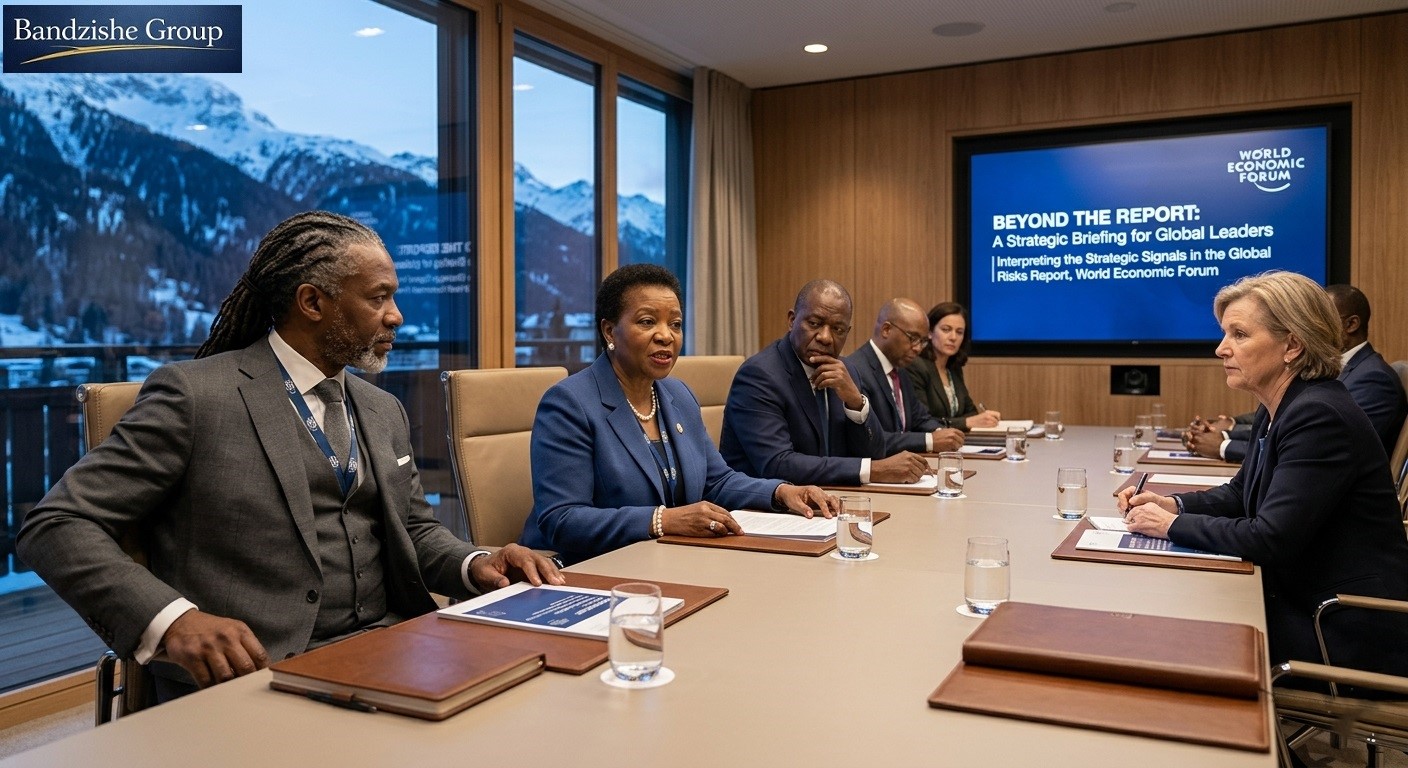

Most analysts who encounter the Global Risks Report 2026 will summarise it. A smaller number will critique it. Almost none will perform the most consequential intellectual task the document demands: strategic translation, the discipline of reading an institutional report and converting its findings into the uncompromising boardroom intelligence that heads of state, finance ministers, chief executives, and sovereign wealth fund strategists actually need in order to make decisions commensurate with the scale of what is coming. This briefing performs precisely that function.
The most consequential global documents are rarely the ones that dominate headlines. They are the ones quietly circulating inside ministries of finance, central banks, corporate strategy units, sovereign wealth funds, and intelligence agencies. The World Economic Forum Global Risks Report belongs to precisely that category. The Global Risks Report 2026 is not merely an annual catalogue of anxieties. It is a strategic barometer of elite consensus within the global governance ecosystem. It forms a rare synthesis of institutional intelligence that influences the agenda of the World Economic Forum Annual Meeting and, by extension, the strategic orientation of global decision-makers.
The World Economic Forum's twenty-first annual risk synthesis, drawing on over 1,300 global experts and 11,000 business executives across 116 economies, delivers a verdict that its institutional mandate prevents it from stating with full confrontational force: the post-1945 international order is not merely fraying; it is being deliberately dismantled, and the competitive transition now under way will define the operating environment for global enterprise, sovereign governance, and capital allocation for at least a decade, and possibly for a generation. Geoeconomic confrontation has ascended to the apex of the global risk hierarchy for the first time in the report's history. The multilateral system is collapsing with a speed that the report's own data confirms, but its diplomatic register struggles to fully convey. And the adverse outcomes of artificial intelligence, barely registering in the two-year horizon, will become the defining systemic risk of the coming decade.
The report describes the landscape of danger with admirable precision. What follows is what the report cannot tell you: what it means, what it demands, and what it will cost you to remain unprepared for it.
Why does this matter? Because the architecture of power in the twenty-first century increasingly flows through networks of institutional knowledge. Reports shape narratives. Narratives shape policy. Policy reshapes markets.
The real question, therefore, is not what the report says. The real question is this: what strategic signals are embedded inside it for those responsible for steering nations, corporations, and capital through the most turbulent decade since the Cold War?
The Entire Global Risks Report in One Paragraph: The Compressed Strategic Diagnosis
The Global Risks Report 2026 argues that the world has entered an “age of competition” characterised by escalating geopolitical rivalry, erosion of multilateral cooperation, technological disruption, and deepening social fragmentation. Drawing upon the Global Risks Perception Survey and interdisciplinary analysis, the report identifies geoeconomic confrontation, misinformation, cyber insecurity, economic instability, and the unintended consequences of emerging technologies as dominant risks across the next decade. It further highlights a structural paradox: while environmental risks remain the most severe long-term threats, short-term political competition is diverting global attention away from collective climate action. The strategic objective of the report is to help governments and corporations navigate an increasingly fragmented world order in which global interdependence persists, yet trust between nations is rapidly eroding.
Six Findings Global Leaders Must Absorb: Strategic Signals Hidden in Plain Sight
Finding One: Geoeconomic Confrontation Has Become the Master Risk of Our Era
Geoeconomic confrontation has ascended to the summit of the Global Risks Perception Survey for the first time in the report's history, rising eight positions from 2025 to rank first over both immediate and two-year horizons. This is a categorical transformation, not a marginal statistical movement. Trade, finance, technology, and infrastructure have been formally conscripted into the service of geopolitical strategy. Sanctions, export controls, investment screening, supply-chain weaponisation, and capital-flow restrictions are no longer exceptional measures; they are standard instruments of statecraft. Every enterprise operating across borders, every sovereign wealth fund with international allocations, and every government dependent upon integrated supply chains must treat geoeconomic confrontation not as background noise but as the primary variable in its strategic calculus. The question is not whether your operations will be affected, but whether you will have designed your response before or after the disruption arrives.
Finding Two: The Multilateral System Is Collapsing in Real
Time
Sixty-eight per cent of respondents describe the future global political environment as a multipolar or fragmented order; only 6 per cent expect the rules-based international order to be reinvigorated. The World Trade Organisation's dispute-settlement mechanism has received approximately one-third of its pre-2019 case volume since its Appellate Body was disabled, rendering it functionally inadequate as an arbiter of commercial disagreement. The World Justice Project Rule of Law Index 2025 records that 68 per cent of 143 surveyed jurisdictions experienced a decline in rule-of-law scores in 2025, a pace described as sharp and demonstrating that slow, painstaking progress in establishing the rule of law can be reversed with alarming speed. These are not trends; they are trajectories, and their compound effect is the progressive dissolution of the normative infrastructure upon which liberal capitalism depends. Leaders who persist in operating as if Bretton Woods retains its former authority are committing a category error with material consequences.
Finding Three: Economic Risk Has Re-Entered the Critical Zone with Dangerous Velocity
Economic downturn, inflation, and asset-bubble collapse each rose eight, eight, and seven positions respectively in the two-year severity ranking, the largest collective category surge in the survey's history. Accumulated stablecoin holdings in developing economies are projected to reach USD 1.22 trillion by end-2028, compared with approximately USD 173 billion as of October 2025, a velocity of monetary disruption at the periphery of the formal financial system that demands immediate sovereign-risk reassessment. High debt-refinancing needs, potential AI-inflated industrial bubbles, and the prospect of boomerang inflation induced by tariff cascades constitute a trifecta of economic vulnerability not witnessed simultaneously in a generation. The decision calculus for capital allocation, sovereign-debt management, and corporate treasury strategy must be recalibrated without delay.
Finding Four: Artificial Intelligence Is the Defining Risk of the Coming Decade
Adverse AI outcomes register the single largest upward movement across the entire ten-year horizon, ascending from rank thirty over the next two years to rank five over the next decade. This trajectory is not a commentary on current capabilities; it is a forward-projection of what generalised AI deployment will mean for labour market disruption, informational integrity, autonomous weapons proliferation, and the concentration of technological power within a vanishingly small number of sovereign and corporate actors. The interaction between advancing AI and accelerating quantum computing is identified as a compounding threat: as each technology accelerates the other, the combined risk profile acquires non-linear characteristics that defy conventional risk modelling. Leaders who treat artificial intelligence as a productivity tool rather than a civilisational variable are misreading the magnitude of the strategic transformation under way.
Finding Five: Inequality Is the Most Interconnected Risk in the Global System
For the second consecutive year, inequality is identified as the most interconnected global risk, functioning as a structural amplifier of virtually every other risk category, from economic downturn and societal polarisation to state fragility and climate inaction. Permanently K-shaped economies, in which the gains from technological productivity accrue overwhelmingly to capital owners whilst the costs of disruption fall disproportionately upon labour, are not merely an ethical concern; they are a systemic risk multiplier. The social contract is fracturing with measurable velocity, as evidenced by political upheavals in Nepal, Bangladesh, and Sri Lanka, the intensification of anti-elite narratives across advanced economies, and the documented deterioration of institutional trust across the full range of political systems. Inequality is not an externality to be addressed after growth is secured; it is a precondition for the durable stability upon which growth depends.
Finding Six: Environmental and Climate Risk Remains the Most Existentially Severe Threat in the Global System
Environmental and climate risks occupy a paradoxical and deeply alarming position within the Global Risks Report 2026, and that paradox is itself the most consequential environmental finding the report delivers. In the short-term horizon, environmental risks have experienced their sharpest collective decline in ranking in the survey's two-decade history: Extreme weather events fell from second to fourth position, Critical change to Earth systems fell seven positions, and Biodiversity loss fell five positions, with every environmental risk also declining in absolute severity score. In the ten-year horizon, however, environmental risks reassert their dominance with unambiguous force: Extreme weather events ranks first, Biodiversity loss ranks second, Critical change to Earth systems ranks third, and five of the top ten long-term risks are environmental in nature. Close to three-quarters of respondents selected a turbulent or stormy outlook for environmental risks over the next decade, the most pessimistic assessment of any risk category in the entire survey. The strategic signal embedded in this divergence is not that environmental risks have diminished; it is that the institutional attention, political will, and fiscal capacity required to address them are being systematically consumed by the geoeconomic and economic crises dominating the near-term horizon. For every board, government, and institutional investor treating climate risk as a long-horizon consideration to be addressed after immediate crises are resolved, the report delivers a single unambiguous verdict: the immediate crises and the long-horizon catastrophe are not sequential problems. They are the same problem, compounding simultaneously, and the decision to defer one in favour of the other is not a strategic prioritisation. It is a strategic abdication.
Contextual Architecture
The Geopolitical and Economic Moment: A World Balanced on a Precipice

The Global Risks Report 2026 arrives at a juncture in world history that defies comfortable categorisation. The post-Cold War liberal international order, constructed upon the twin foundations of economic interdependence and institutional multilateralism, is undergoing deliberate strategic deconstruction by the very great powers whose interests it was principally designed to serve. The United States has progressively retreated from the normative commitments that underpinned the Bretton Woods institutions, deploying tariffs, export controls, investment-screening regimes, and secondary sanctions as instruments of strategic rivalry rather than mechanisms of multilateral governance. China, simultaneously, is constructing alternative institutional architectures, from the Asian Infrastructure Investment Bank to the expanding BRICS framework, that reflect a different vision of global order organised around sovereignty, non-interference, and the primacy of development finance over conditionality.
The report's emergence in January 2026 coincides with tariff escalation between major economies at levels not witnessed since the interwar period, sovereign-debt distress spreading across both advanced and emerging market economies, and the number of state-based armed conflicts at its highest point since the conclusion of the Second World War. The technological dimension of this moment is equally consequential: artificial intelligence is transitioning from a domain of promise to a domain of power, as sovereign governments recognise that computational supremacy constitutes a form of strategic advantage equivalent in transformative significance to nuclear capability in the mid-twentieth century. It is within this configuration of simultaneous economic, geopolitical, and technological forces that the twenty-first edition of the Global Risks Report must be situated and interpreted.
Analytical Deconstruction
The Central Thesis: Competition as the Organising Principle of Global Risk
The report's central thesis is encapsulated in its thematic title, The Age of Competition. Geoeconomic confrontation does not merely rank first in the risk hierarchy; it functions as the master variable from which the majority of secondary and tertiary risks are derived. The causal logic is rigorous: as multilateral institutions weaken, the normative constraints upon unilateral action diminish; as those constraints diminish, the incentive to exploit economic tools for strategic advantage increases; as those tools are deployed, the interconnected global economy sustains structural damage across supply chains, capital flows, technological ecosystems, and the collaborative mechanisms required to address shared challenges. The consequential risks of economic downturn, societal polarisation, and infrastructure vulnerability are therefore not independent phenomena; they are downstream manifestations of the same upstream structural failure. What the report documents, with admirable empirical rigour, is not a cluster of simultaneous misfortunes but the architecture of a systemic competitive transition.
Internal Tensions and What the Report Leaves Unresolved: Strategic Contradictions Inside the Global Risk Narrative and the Unanswered Questions Behind the Global Risk Landscape
The most significant internal tension within the report is the disjunction between its diagnosis and its prescriptions. The diagnosis is acute: the multilateral system is eroding, geoeconomic confrontation is intensifying, inequality is compounding every other risk, and environmental risks are being systematically deprioritised in the short term despite their existential significance in the long term. The prescriptions, however, are notably cautious, calling for coalitions of the willing, public-private consultation mechanisms, and minilateral agreements. There is a material gap between the scale of the systemic challenge the report identifies and the institutional ambition of the responses it recommends. A second tension emerges from the environmental domain: the report correctly identifies that environmental risks have experienced their sharpest relative decline in the short-term ranking in the survey's history, yet the structural logic of its own framework implies that short-term economic and geopolitical instability will further erode the institutional capacity required to address the long-term environmental catastrophe the survey simultaneously identifies as the most existentially severe. The report presents these as parallel concerns; a more analytically confrontational reading identifies them as a compounding trap.
Strategic Implications by Domain
Implications for Corporate Strategy in A Fragmenting Global Economy: The End of Naive Globalisation in an Age of Weaponised Economics
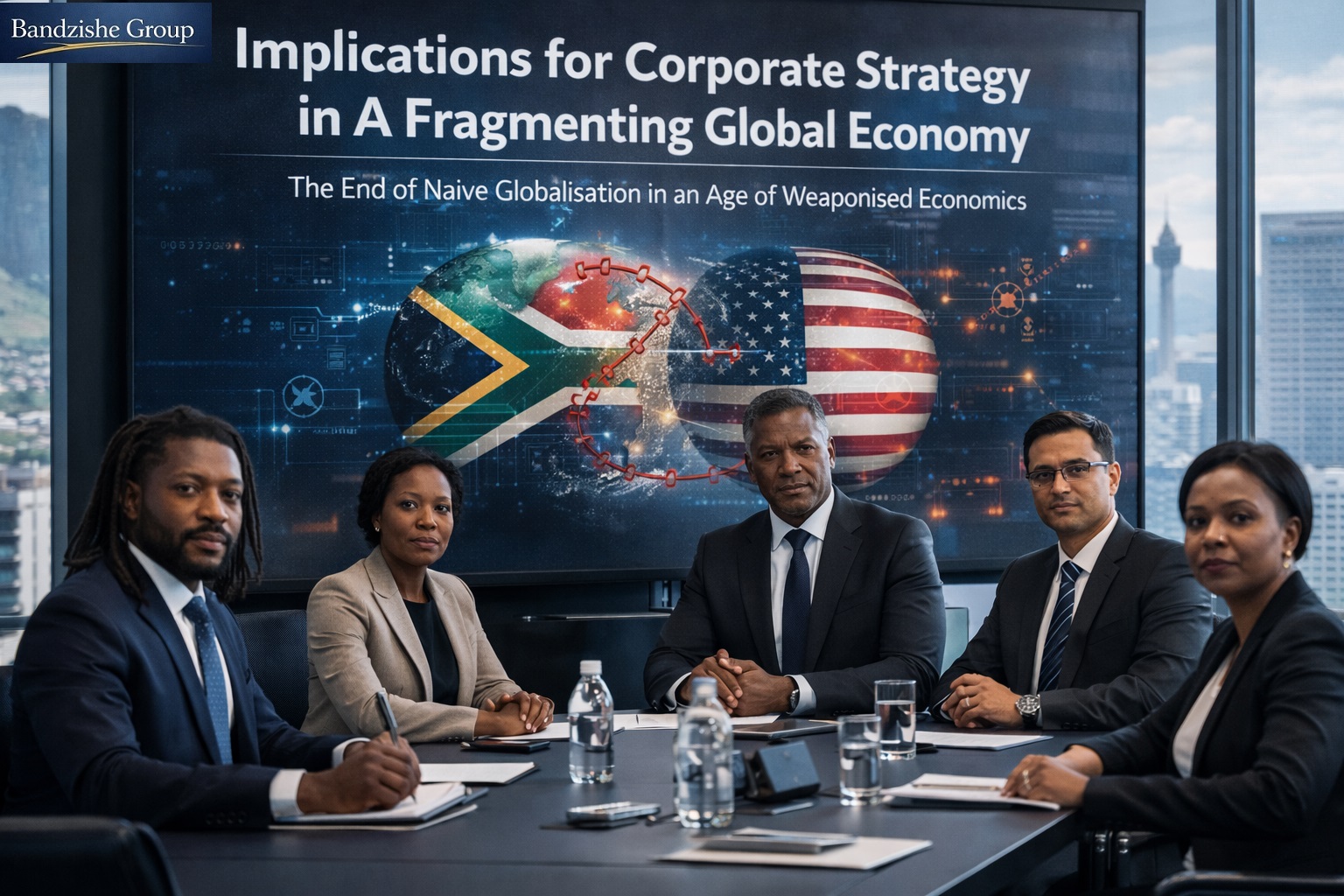
The elevation of geoeconomic confrontation to the apex of the global risk hierarchy is not a signal for incremental adjustment; it is a mandate for architectural transformation of corporate strategy. Every multinational enterprise must conduct a comprehensive reassessment of its exposure to the economic weaponry that major powers are deploying with increasing frequency: tariffs, export controls, investment-screening regimes, secondary sanctions, and supply-chain weaponisation are the new instruments of a structurally competitive international order that will define the operating environment for at least a decade.
The most urgent boardroom imperative is supply-chain sovereignty architecture: a comprehensive cartography of every tier of the supply chain, with specific attention to single points of failure, concentration in geopolitically contested geographies, and dependency upon components subject to export controls or sanctions regimes. Taiwan Semiconductor Manufacturing Company's multibillion-dollar geographic diversification, including the construction of advanced fabrication plants in Arizona and Japan in direct response to escalating US-China technology competition, provides the definitive practical template. This is not merely risk management; it is a strategic repositioning of the enterprise's relationship with sovereign power, acknowledging that in an age of geoeconomic confrontation, the physical location of productive capacity carries geopolitical significance equivalent to its economic value.
Industry structure itself is being reshaped at speed. The technology sector is bifurcating into Eastern and Western ecosystems with diminishing interoperability, creating competitive threats and strategic opportunities for enterprises positioned at their interface. Financial services face a fragmented global payments architecture as stablecoin adoption reaches USD 1.22 trillion in developing-market holdings by end-2028. The value created by AI deployment will accrue primarily to enterprises with the data infrastructure, computational resources, and talent ecosystems to deploy it at scale, intensifying within the corporate competitive landscape the same K-shaped dynamics the report identifies at the macroeconomic level. Boards that have not yet stress-tested their business model against each of these structural scenarios are operating on assumptions that the report has formally invalidated.
Implications for National Policy Strategy: The Sovereign Strategic Agenda in a Post-Multilateral World
For national governments, the report's findings converge upon a single foundational question: how does a sovereign state protect its citizens' welfare and advance its strategic interests in a world where the institutional frameworks designed to manage international competition are losing their authority? The answer requires a fundamental reorientation of national economic strategy, away from the assumption of liberal-international partnership and towards a posture of strategic resilience that acknowledges the reality of weaponised interdependence. Industrial strategy must be reconceived through the lens of strategic sovereignty. The report's identification of the concentration of strategic resources and technologies as a rising long-term risk is a direct signal that governments must identify the critical inputs upon which their economies depend and develop contingency architectures for each, with particular force applying to semiconductors, rare-earth minerals, energy systems, pharmaceutical supply chains, and digital infrastructure.
The report's findings on the deteriorating rule of law carry an additional strategic dimension for policymakers. As 68 per cent of surveyed jurisdictions experienced rule-of-law declines in 2025, governments that invest in institutional quality, in the independence and efficiency of their judicial systems, the transparency of their regulatory frameworks, and the credibility of their enforcement mechanisms, are creating a form of sovereign competitive advantage that will become increasingly valuable as institutional reliability becomes an increasingly scarce resource globally. This is an argument not merely for good governance as an ethical aspiration but for institutional excellence as a strategic investment with measurable returns in the form of foreign direct investment attraction, credit-rating differentiation, and the social stability that sustains productive economic activity.
Implications for Investment and Capital Allocation: Capital Navigating the Fractured Landscape of Systemic Risks
The simultaneous elevation of geoeconomic confrontation, economic downturn, inflation, and asset-bubble risk in the near-term horizon creates an investment environment characterised by correlated tail risks that historically benign correlation assumptions fail to capture. Sovereign wealth funds, institutional investors, development finance institutions, and private equity managers must recalibrate their risk models to account for the possibility that diversification benefits historically derived from geographic and sectoral spread are diminished in a world where geoeconomic confrontation transmits systemic shocks across previously uncorrelated asset classes. The clean-energy transition and critical-mineral supply chains are simultaneously the domain of greatest long-term opportunity and the arena of most intense geoeconomic contestation. The Democratic Republic of Congo's cobalt reserves, South Africa's platinum-group metal deposits, and Chile's lithium production are not merely commodity assets; they are strategic resources attracting great-power competition, and their valuation must incorporate a geopolitical-risk premium commensurate with the strategic intensity of that competition.
The projected growth of stablecoin holdings in developing economies, from USD 173 billion in 2025 to USD 1.22 trillion by 2028, represents a signal of profound significance for investors with emerging-market sovereign-debt exposure. The monetisation of local economies through dollar-pegged stablecoins represents a de facto dollarisation of financial systems and a potential mechanism of capital flight that bypasses conventional monetary-policy instruments. For investors in emerging-market government bonds, this trajectory introduces a monetary-sovereignty risk that must be incorporated into credit analysis and portfolio-construction frameworks. Enterprises and funds positioned in the interface between these dynamics, rather than in any single pole of the bifurcating global system, will be the structural beneficiaries of the next decade's volatility.
Implications for Technology and Digital Strategy: The Dual Sovereignty of AI and Quantum
The report's treatment of technology risk is analytically distinguished by its recognition that artificial intelligence and quantum computing are not merely industrial innovations; they are sovereignty contests. The observation that advancements in the quantum field risk becoming another facet of strategic rivalry, economic bifurcation, and political polarisation reflects an emerging strategic consensus that technological supremacy is the twenty-first century's equivalent of nuclear deterrence: a form of power that both enables and constrains the exercise of every other dimension of strategic influence. For enterprise digital strategy, the most immediate operational implication is the inadequacy of current cybersecurity frameworks in the face of both AI-enabled threat capabilities and the approaching commercial deployment of quantum computing. Enterprises and governments that have not yet initiated a transition to post-quantum cryptographic standards are accumulating a form of technological debt that will become critically expensive to service as quantum capability approaches commercial viability, a transition the report's experts anticipate accelerating markedly within the decade.
The practical strategic response requires a three-horizon technology governance framework. In the immediate horizon, enterprises must invest in AI-augmented threat detection and response capabilities, recognising that adversaries already deploy AI to exploit vulnerabilities at a velocity that exceeds human-managed security operations. In the medium horizon, enterprises must develop post-quantum cryptographic migration roadmaps and begin piloting quantum-safe encryption for their most sensitive data and transaction infrastructure. In the long horizon, they must engage proactively with the emerging architecture of AI governance, including both national regulatory frameworks and nascent international standards bodies, and position themselves as architects of those frameworks rather than passive recipients of their requirements. The enterprises and governments that have invested in AI governance capability will possess a structural competitive advantage in the regulatory environment that is, with certainty, approaching.
Implications for Africa and South Africa: The African Strategic Imperative in the New Risk Order, Reading Strategic Global Signals for South African Leadership

No strategic reading of the Global Risks Report 2026 is complete without a dedicated interrogation of its implications for Africa and, within the African context, for South Africa's distinctive position as the continent's most systemically diversified and institutionally anchored economy. The signals the report transmits at the global level do not arrive neutrally on the African continent; they interact with structural realities that amplify certain risks, create specific vulnerabilities, and present strategic opportunities that no other region of comparable scale possesses.
The first signal of decisive relevance for Africa is the report's identification of great-power competition over critical resources as a rising risk. Sub-Saharan Africa is home to the majority of the world's strategically critical mineral deposits: the Democratic Republic of Congo holds approximately 70 per cent of global cobalt reserves; South Africa commands over 75 per cent of the world's platinum-group metal deposits, a third of its manganese, and significant gold, chrome, and vanadium resources; Zimbabwe holds the world's second-largest lithium reserves; and the continent's aggregate endowment in rare-earth minerals, copper, nickel, and uranium makes it indispensable to the energy transition and to the digital economy that AI and quantum computing will accelerate. The report's warning that intense commercial, diplomatic, or even military pressure could be applied to resource-holding governments is not a hypothetical for Africa; it is a description of dynamics already discernible in the competition between Chinese infrastructure investment, American diplomatic re-engagement, European critical-raw-material partnerships, and Gulf sovereign wealth fund positioning across the continent.
African governments that approach these dynamics reactively, negotiating individual transactions with individual counterparties without a coherent continental critical-mineral strategy, will find that they have monetised their resource endowment at prices that reflect their leverage deficiency rather than the strategic value of the assets. The African Union's Agenda 2063, the Accelerated Industrial Development for Africa framework, and the African Continental Free Trade Area all provide institutional platforms for a different approach: one that collectivises African negotiating leverage, develops beneficiation capacity domestically, and positions Africa not as a raw-material exporter to great-power supply chains but as a sovereign participant in the governance of those supply chains. Botswana's Debswana arrangement with De Beers, which retained domestic value-addition as a sovereign condition of mining access, provides an immediately applicable template. The translation of this strategic aspiration into commercial reality requires institutional coherence, political will, and technical capacity, but the report's findings make the imperative for its pursuit unambiguous.
The intersection of climate vulnerability and economic fragility creates a compounding risk profile for Africa that the report's environmental findings illuminate with particular severity. Africa contributes less than 4 per cent of global cumulative greenhouse gas emissions yet bears a disproportionate share of climate change's most destructive consequences: erratic rainfall patterns disrupting agricultural systems upon which the majority of the continent's population depends for food security and livelihoods, rising sea levels threatening coastal urban infrastructure from Lagos to Dar es Salaam to Cape Town, and extreme heat events reducing outdoor labour productivity across economies where informal and agricultural employment dominate. The report's finding that environmental risks are being systematically deprioritised in the short-term horizon by the global expert community, precisely because geoeconomic and economic anxieties are consuming institutional attention, is a finding with direct and dangerous implications for Africa.
The multilateral climate finance architecture, including the Loss and Damage Fund established at COP27 and the broader commitments of the Paris Agreement, depends upon the sustained political will of advanced economies whose attention the report documents as being progressively redirected towards geoeconomic confrontation and domestic economic instability. For African governments, the strategic implication is unambiguous: the external climate finance upon which continental adaptation strategies depend cannot be assumed to arrive at the scale or pace that the severity of Africa's climate exposure requires. Domestic climate resilience investment, regional early-warning infrastructure, agricultural system diversification, and the accelerated development of renewable energy capacity are therefore not merely environmental policy priorities; they are sovereign risk-management imperatives that must be financed and executed regardless of the trajectory of multilateral climate commitments.
The Middle East Conflict as Live Case Study: The Report's Most Vivid Embodiment
The Middle East conflict is not a peripheral illustration of the Global Risks Report 2026's findings. It is arguably their most vivid live embodiment, and its conspicuous absence as a named category within the report is itself a finding of strategic significance. The Forum's institutional mandate requires it to speak in systemic categories rather than name live conflicts involving its members and partners, a diplomatic constraint that is entirely understandable institutionally and entirely inadequate strategically. What the report's neutrality prevents it from stating directly, this briefing states without reservation: the Middle East conflict is the single most instructive contemporary case study for understanding how the report's risk categories interact, compound, and materialise in real time across multiple domains simultaneously.
Consider what it concretely demonstrates across the report's own risk architecture. It demonstrates geoeconomic confrontation in action: the Houthi disruption of Red Sea shipping lanes has rerouted a significant proportion of global container traffic around the Cape of Good Hope, directly affecting South African port infrastructure at a moment of acute strategic relevance, adding cost and time to European-Asian trade, and exposing with brutal clarity the fragility of the maritime supply chain architecture upon which global commerce depends. It demonstrates the collapse of multilateral governance in real time: the inability of the United Nations Security Council to produce a binding ceasefire resolution, vetoed repeatedly by permanent members pursuing competing strategic interests, is the most visible contemporary illustration of the multilateral paralysis that the report documents through survey data but cannot name through diplomatic convention. It demonstrates the interconnection between state-based armed conflict and geoeconomic confrontation: Iran's strategic positioning, the involvement of proxy forces across Lebanon, Yemen, Syria, and Iraq, and the competition between the United States, China, Russia, and Gulf states for regional influence are precisely the kind of great-power competition over strategic geography and resources that the report identifies as a compounding systemic risk of rising severity. And it demonstrates infrastructure vulnerability with a specificity that the report's Infrastructure Endangered chapter anticipates but the diplomatic register of institutional publishing cannot fully convey: undersea cable disruptions in the Red Sea region, attacks on energy infrastructure, and the systematic targeting of port facilities are not hypothetical scenarios drawn from risk-modelling exercises; they are events that have already occurred, with measurable consequences for the global supply chains upon which every economy in this briefing's readership depends.
For South Africa specifically, the Middle East conflict is not peripheral at all. It is a live strategic variable with direct operational consequences. The rerouting of shipping traffic around the Cape of Good Hope has materially increased vessel traffic through South African waters and ports, creating simultaneously an infrastructural pressure on port capacity that has exposed the chronic underinvestment in Transnet's port and rail infrastructure, and a strategic opportunity of considerable significance that South African logistics, port governance, and maritime strategy must account for with far greater urgency than current policy frameworks reflect. A South Africa with world-class port infrastructure at Durban, Cape Town, and Ngqura, positioned at the intersection of rerouted global shipping lanes at a moment of permanent Red Sea instability, would occupy a maritime strategic position of exceptional commercial value. The question is whether South African leaders will treat the current traffic increase as a temporary windfall or as the signal for a long-overdue infrastructural transformation that converts geographic fortune into durable strategic advantage.
The second Africa-specific implication concerns the intersection of demographic expansion and economic risk. Africa is simultaneously the world's youngest continent, with a median age of approximately 19 years, and the region most acutely exposed to the debt sustainability concerns, asset-bubble risks, and potential economic downturn that the report identifies as sharply rising in severity. Sixty per cent of African Union member states are classified by the International Monetary Fund as at high risk of debt distress or already in debt distress, and the combination of rising global interest rates, geoeconomic confrontation's disruption of commodity export revenues, and the fiscal costs of climate adaptation create a compound fiscal vulnerability that demands proactive sovereign-debt management, domestic revenue mobilisation, and strategic engagement with the architecture of international debt restructuring. For African finance ministers and central bank governors, these are not background considerations; they are immediate operational challenges whose deferral carries compound costs.
The third dimension of Africa-specific strategic interpretation concerns the continent's positioning within geoeconomic confrontation. Africa's non-alignment has historically been characterised as a source of vulnerability; in the current environment, it is a source of structural leverage. In a world in which both the United States and China are competing for access to African minerals, infrastructure networks, digital markets, and diplomatic support, African governments that present themselves credibly as sovereign strategic partners rather than peripheral dependencies have the leverage to demand genuinely reciprocal terms of engagement. The report's documentation of the competitive order's intensification is, for Africa, simultaneously a warning and an invitation.
South Africa occupies a specific and consequential position within this continental strategic architecture. It is simultaneously a national economy exposed to every risk the report identifies, including geoeconomic contestation over its mineral resources, fiscal vulnerability through its sovereign-debt trajectory, societal polarisation through its extreme inequality, and technological disruption through the rapid evolution of its financial services and telecommunications sectors; and a continental strategic anchor whose institutional capacity, financial market depth, and diplomatic credibility make it indispensable to the broader project of African strategic cohesion. South Africa's electricity infrastructure crisis, its persistently elevated unemployment rate approaching 33 per cent on the broad definition, and the fragility of its coalition governance arrangements are not merely domestic policy challenges; they are continent-wide strategic liabilities, because a South Africa mired in structural dysfunction cannot serve as the continental anchor that Africa's strategic positioning requires.
Conversely, a South Africa that resolves its energy transition, reforms its state-owned enterprise architecture, attracts strategic investment in critical-mineral beneficiation, and restores fiscal credibility becomes not merely a more prosperous domestic economy but a continental multiplier of strategic capacity. In the critical-minerals domain, the Minerals Council of South Africa, the Department of Mineral Resources and Energy, and the major mining corporations must develop a coherent beneficiation strategy that captures a greater share of the value chain from platinum-group metals, manganese, chrome, and the emerging battery-metals sector. In the AI and digital infrastructure domain, South Africa's position as Africa's most advanced financial technology ecosystem and its role as a regional data-centre hub create strategic opportunities that the report's technology findings directly illuminate: investment in AI talent development, regulatory clarity for fintech innovation, and proactive engagement with both African digital infrastructure governance and global AI standards bodies are not optional enhancements but essential competitive positionings for the decade ahead.
The Strategic Briefing Verdict
The Single Most Important Insight: The Irreversibility of the Competitive Turn, Competition Has Replaced Consensus
If a global leader could retain only one insight from the Global Risks Report 2026, it should be this: the transition from a cooperative to a competitive international order is not a cyclical perturbation from which the world will return to a liberal-international baseline; it is a structural transformation that will define the operating environment for at least a decade, and possibly for a generation. Geoeconomic confrontation is not a phase; it is a regime change. The WTO, the IMF's consensus governance, the United Nations' deliberative processes, and the multilateral development banks' lending frameworks will not disappear, but they will operate in an environment of eroded authority and contested legitimacy that fundamentally alters their strategic significance. Leaders who plan on the assumption that the liberal-international order will reassert itself are committing a category error with material consequences.
The Strategic Imperative for the Next 12 to 36 Months: Five Non-Negotiable Priorities

Priority One: Supply-Chain Sovereignty Architecture
Within twelve months, every enterprise and government must complete a comprehensive supply-chain vulnerability audit identifying all single points of failure, all dependencies upon geopolitically contested channels, and all exposures to export controls or sanctions regimes. The output must be a prioritised remediation roadmap that includes geographic diversification of critical sourcing, inventory-buffer strategies for strategic inputs, and contractual frameworks that account for geoeconomic force-majeure. This is not a risk-management exercise; it is a strategic-survival exercise, and the distinction matters.
Priority Two: Balance-Sheet Resilience for the Economic Reckoning
The simultaneous rise of economic downturn, inflation, and asset-bubble risk is a signal to governments and enterprises alike to pursue balance-sheet conservatism that may sacrifice short-term return for structural resilience. Governments should accelerate domestic revenue mobilisation, extend debt maturity profiles, and establish macroprudential frameworks capable of detecting asset-price inflation in property, equity, and technology markets before it reaches systemic scale. Enterprises should review leverage levels, stress-test liquidity positions against both inflationary and deflationary shock scenarios, and defer capital commitments whose investment thesis depends upon a benign macroeconomic baseline that the report's findings have formally contested.
Priority Three: AI Governance as Strategic Positioning
The report's finding that adverse AI outcomes will reach fifth position in the ten-year risk hierarchy is a signal to treat AI governance not as a compliance burden but as a strategic asset. Organisations that develop credible, transparent, and institutionally robust AI governance frameworks will be positioned to attract talent, secure regulatory approval for AI deployment, build customer trust, and engage constructively with the emerging architecture of international AI standards. The enterprises and governments that have invested in this capability will have a structural advantage in the regulatory environment that is, with certainty, approaching.
Priority Four: Inequality as an Operational Risk, Not an Ethical Abstraction
The identification of inequality as the most interconnected global risk must be translated from macroeconomic abstraction into operational strategy. For governments, this means designing economic policy that measures success not merely by aggregate growth but by its distribution across income quintiles, geographic regions, and generational cohorts. For enterprises, it means recognising that the social licence to operate in an environment of extreme inequality is increasingly fragile, and that investments in workforce development, fair-wage structures, and tax compliance are not ethical obligations alone but strategic investments in the operational stability and reputational capital upon which long-term enterprise value depends.
Priority Five: Proactive Engagement with Emerging Multilateral Architectures
The erosion of the existing multilateral order creates a governance vacuum that will be filled by new institutions, new standards bodies, and new normative frameworks. The entities that engage proactively in their design will have disproportionate influence over the rules they embody. Enterprises should identify the emerging standards bodies relevant to their sectors, from AI governance to digital trade to critical-mineral certification, and invest in the technical and policy capacity to engage with them substantively. Governments should identify the coalitions of the willing within which their strategic interests can be most effectively advanced, and invest in the diplomatic capacity to be genuine architects of those coalitions rather than marginal participants in them.
Final Assessment: The Verdict of a Trusted Strategic Adviser
The Global Risks Report 2026 is essential reading for every global leader, not because it will surprise with revelations unavailable elsewhere, but because it performs the indispensable function of consolidating expert consensus around a risk framework at a moment when the absence of such a framework would be strategically disorienting. Its most significant intellectual contributions are the empirical confirmation that geoeconomic confrontation has displaced armed conflict as the premier near-term systemic risk, and that adverse AI outcomes will displace geoeconomic confrontation as the premier long-term risk. These are the benchmarks against which strategic roadmaps must now be calibrated. The report does not change what is happening in the world; it confirms, with the institutional weight of the World Economic Forum behind it, that what thoughtful analysts have observed in emerging form is now a confirmed structural reality demanding a transformed strategic response.
Its limitations are real but contextually understandable: the institutional constraints of its production environment preclude the degree of analytical confrontation that its own findings logically warrant, and its prescriptions are more diplomatically conservative than strategically ambitious. Read it as what it is, the most credible empirical survey of global expert-community risk perception available, and then do the analytical work its institutional mandate prevents it from doing itself: translate its findings into the uncompromising strategic intelligence that the moment demands. The report describes the landscape of danger with admirable precision. What it cannot do, by institutional design, is tell you what it will cost you to remain in it without moving.
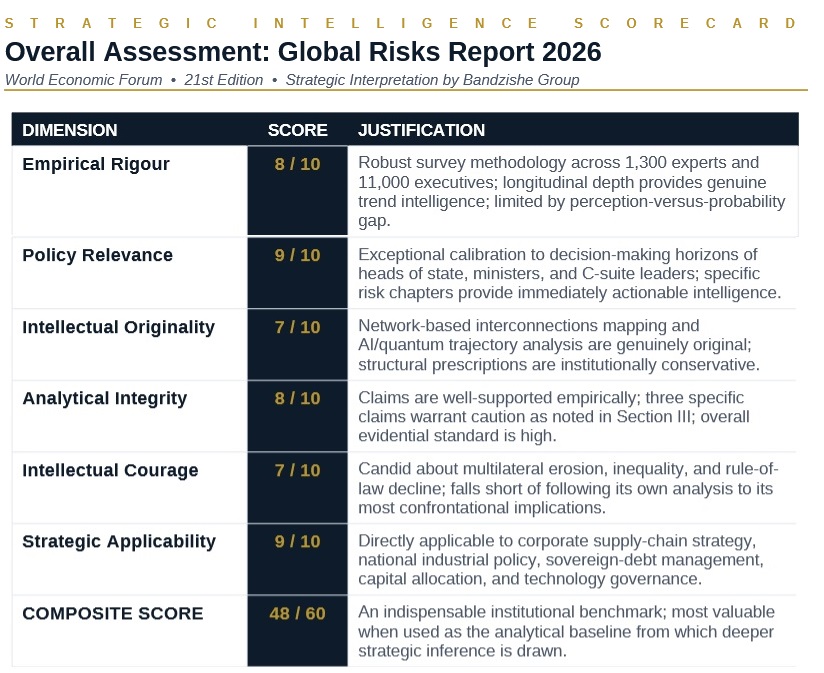
Overall Strategic Intelligence Scorecard
THE STRATEGIC ULTIMATUM
There exists a specific, identifiable category of leader who will read the Global Risks Report 2026, nod in recognition of its findings, circulate it to their strategy team, and then return to the operational priorities that were consuming their attention before they opened it. This leader is not ignorant; they are busy. They understand, at an intellectual level, that geoeconomic confrontation is intensifying, that multilateral governance is eroding, that artificial intelligence will transform every industry, and that inequality is corroding the social contracts upon which commercial civilisation depends. But understanding these things at an intellectual level and recalibrating one's strategic architecture in response to them are acts of entirely different orders of magnitude. The first requires intelligence. The second requires will.
The question the Global Risks Report 2026 ultimately poses is the question that every genuine strategic brief poses to its reader: what are you going to do with this? Will you redesign your supply chains before they are disrupted, recapitalise your balance sheet before the reckoning arrives, build your AI governance framework before the regulation demands it, and invest in the institutional architecture of a more equitable society before the inequality fractures that sustain your enterprise? For South African leaders, the stakes carry an additional dimension. South Africa operates at the intersection of every risk this report identifies, and the great-power competition reshaping critical-mineral supply chains, digital infrastructure investment, and geopolitical alliance will not pause to await South African institutional readiness. It is already under way.
The leaders who position South Africa strategically now, in the architecture of critical-mineral beneficiation, continental digital infrastructure, and sovereign AI governance, will determine whether this country enters the next decade as a sovereign strategic actor or as a terrain upon which other powers' strategies are executed. The same choice confronts every leader reading this briefing, in every boardroom, every treasury, and every cabinet room in which these words will eventually arrive. Those who interpret the signals others merely observe do not merely survive the turbulence; they design the order that follows it. That is the irreducible obligation of every leader who reads these pages, and the standard against which their stewardship will ultimately be measured.
Images by Bandile Ndzishe of Bandzishe Group
About bandile ndzishe

Bandile Ndzishe is the CEO, Founder, and Global Consulting CMO of Bandzishe Group, a premier global consulting firm distinguished for pioneering strategic marketing innovations and driving transformative market solutions worldwide. He holds three business administration degrees: an MBA, a Bachelor of Science in Business Administration, and an Associate of Science in Business Administration.
With over 30 years of hands-on expertise in marketing strategy, Bandile is recognised as a leading authority across the trifecta of Strategic Marketing, Daily Marketing Management, and Digital Marketing. He is also recognised as a prolific growth driver and a seasoned CMO-level marketer.
Bandile has earned a strong reputation for delivering strategic marketing and management services that guarantee measurable business results. His proven ability to drive growth and consistently achieve impactful outcomes has established him as a well-respected figure in the industry.
As an AI-empowered and an AI-powered marketer, I bring two distinct strengths to the table: empowered by AI to achieve my marketing goals more effectively, whilst leveraging AI as a tool to enhance my marketing efforts to deliver the desired growth results. My professional focus resides at the nexus of artificial intelligence and strategic marketing, where I explore the profound and enduring synergy between algorithmic intelligence and market engagement.
Rather than pursuing ephemeral trends, I examine the fundamental tenets of cognitive augmentation within marketing paradigms. I analyse how AI's capacity for predictive analytics, bespoke personalisation, and autonomous optimisation precipitates a transformative evolution in consumer interaction and brand stewardship. By extension, I seek to comprehend the strategic applications of artificial intelligence in empowering human capability and fostering innovation for sustainable societal advancement.
In essence, I explore how AI augments human decision-making and strategic problem-solving in both marketing and other domains of life. This is not merely an interest in technological novelty, but a rigorous investigation into the strategic implications of AI's integration into the contemporary principles of marketing practice and its potential to reshape decision-making frameworks, rearchitect strategic problem-solving paradigms, enhance strategic foresight, and influence outcomes in diverse areas beyond the marketing sphere.