

Global growth of 3.2 per cent sounds, to the untrained ear, like tolerable stability. It is not. It is the arithmetic of managed decline: a number that conceals the cumulative erosion of productive capacity, the gradual seizure of investment confidence, and the slow asphyxiation of multilateral trust that has underwritten seventy years of shared prosperity. The world is not recovering. It is recalibrating to a structurally inferior equilibrium, and the International Monetary Fund has said so, in the most diplomatically restrained language available to an institution whose mandate forbids it from naming the actors its own data implicates. The October 2025 World Economic Outlook, subtitled Global Economy in Flux, Prospects Remain Dim, is not a routine surveillance publication. It is, when read without the filter of institutional neutrality, a forensic account of an international economic order in active dissolution; one in which the rules that governed seven decades of trade, finance, and multilateral cooperation are being dismantled with the measured deliberateness of sovereign policy, not the chaotic randomness of crisis. Global growth was projected at 3.2 per cent in 2025 and 3.1 per cent in 2026, decisively below the pre-pandemic average of 3.7 per cent, and the medium-term trajectory through 2030 offers no reprieve. This is not a cyclical trough from which recovery is imminent. This is a secular plateau, and the leaders who mistake it for the former will allocate capital, design strategy, and construct policy on a model that the evidence has already invalidated.
The report's title reveals its deepest conclusion without announcing it. Flux is not neutral; it is directional. The direction is downward, fragmented, and structurally constrained. Every chapter, every projection table, every risk scenario in this document points towards a single, irreversible reality: the integrated global economy that generated the productivity miracle of the post-Cold War era is giving way to something less efficient, less cooperative, and less prosperous. The leaders who understand what this means before their competitors do will define the next decade. The leaders who do not will be defined by it.
Five forces converge in this report with the precision of a controlled demolition. The tariff shock administered by the United States in early 2025 is not over; its full inflationary and recessionary impact remains in the pipeline, absorbed temporarily by corporate margin compression and inventory front-loading that cannot be sustained. The artificial intelligence investment boom carries simultaneously the world's largest near-term economic upside and its most potent financial stability threat, with a correction of dot-com proportions explicitly acknowledged as a plausible downside scenario. Fiscal trajectories in the world's major economies are on paths that the institution's own models classify as unsustainable, with US public debt projected to reach 143 per cent of GDP by 2030, a figure that would trigger emergency restructuring discussions in any emerging market that presented it. Industrial policy is returning globally as the preferred instrument of national competitiveness, yet the IMF's most comprehensive empirical assessment of its effectiveness concludes that its aggregate returns are modest, its misallocation costs are high, and its benefits accrue disproportionately to advanced economies with the institutional capacity to implement it with discipline. And beneath all of this, geopolitical fragmentation is severing the development finance architecture that sustained the world's most demographically vital region, precisely when Africa needs it most.
The Report in One Paragraph: Strategic Essence, Growth Without Convergence, Stability Without Progress
The IMF's October 2025 World Economic Outlook presents a global economy that entered 2025 with apparent resilience but is revealing structural fragility as temporary buffers erode. Global growth was projected to decelerate from 3.3 per cent in 2024 to 3.2 per cent in 2025 and 3.1 per cent in 2026, a cumulative 0.2 percentage point below pre-policy-shift forecasts, with the medium-term trajectory through 2027 to 2030 averaging 3.2 per cent annually against a pre-pandemic norm of 3.7 percent. The primary drivers of this dimmer outlook are elevated and persistent trade policy uncertainty following unprecedented US tariff escalation, restrictive immigration policies that constitute negative supply shocks in advanced economies, fiscal positions that are deteriorating across the largest economies, and a proliferation of industrial policy whose empirical effectiveness the report itself places firmly in question. The report identifies the AI investment boom as simultaneously a potential productivity catalyst and a systemic financial stability risk of historical magnitude, calibrates a 30 per cent probability of US recession in 2026, and documents the erosion of central bank independence across 134 politically motivated governor transitions globally since 2000, quantifying the macroeconomic cost of each. Its policy prescriptions are coherent, cautious, and almost certainly insufficient given the political dynamics its own analysis implies. The world's most important institutional intelligence document has delivered, with forensic precision, a verdict it is constitutionally unable to declare: the post-Cold War economic order is ending, and its successor has not yet been designed.
What the Numbers Conceal: Resilience as Illusion, Stability as Risk
The global economy is not stabilising; it is stabilising into weakness. Short-term resilience coexists with long-term erosion, a pattern that presents strength as fragility and momentum as exhaustion. The latest signals reveal a system that grows while decaying, adapts while fragmenting, and expands while losing coherence. This is not a cyclical slowdown; it is a structural recalibration of power, productivity, and geopolitical alignment.
Global leaders now confront a paradox of managed decline and engineered resilience. Policy interventions sustain activity, yet those same interventions distort markets and compress long-term growth potential. Trade remains active, yet trade itself is being dismantled through protectionist design. Capital continues to flow, yet its allocation increasingly reflects geopolitical allegiance rather than economic efficiency.
The October 2025 World Economic Outlook presents a global economy characterised by short-term resilience masking long-term deterioration. Growth persists, yet medium-term prospects have weakened significantly, with global output projected to expand at approximately 3.2 percent annually through 2030, below pre-pandemic norms. Trade fragmentation, protectionist policies, and technological decoupling are constraining productivity and limiting knowledge diffusion, thereby suppressing future growth potential. Emerging markets face sharper downward revisions, threatening income convergence and amplifying inequality between advanced and developing economies. The report’s central objective is to advocate policy coherence, fiscal discipline, and renewed multilateral cooperation to mitigate downside risks, which remain dominant amid elevated uncertainty, rising debt burdens, and fragile financial conditions.
Six Findings Global Leaders Must Absorb: Stability That Weakens, Growth That Divides
1. The Calm Is Borrowed Time: Tariff Pass-Through Has Not Yet Arrived
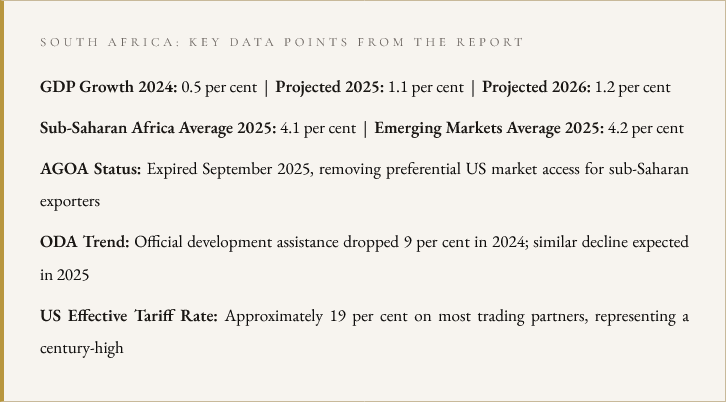
The absence of acute inflationary pain in 2025 has led financial markets and executive planning committees to a conclusion the IMF's data does not support: that the tariff shock has been absorbed. It has not. What has occurred is the sequential deployment of one-time buffers. Corporations front-loaded inventories, absorbed costs into margins rather than prices, and benefited from temporary implementation pauses and trade route diversions. The IMF's own modelling shows that pass-through from tariffs to US consumer prices has been minimal across most categories; household appliances have been repriced, but food, clothing, automobiles, and numerous consumer durables have not. Japanese car export prices to North America have fallen more than 20 per cent since April 2025, a compression that exporters cannot maintain indefinitely. The US effective tariff rate remains approximately 19 per cent. The decision calculus for global executives must shift from “the tariff shock is behind us” to “the tariff shock has been deferred, and its reckoning is accumulating.” Every supply chain that has not been stress-tested against accelerated pass-through in 2026 represents an unpriced risk on the balance sheet of whoever manages it.
2. Structural Decline, Not Cyclical Trough: The Growth Premium of Globalisation Has Been Consumed
The IMF's medium-term projections carry a finding of civilisational significance that the institution presents with statistical composure: world output is projected to expand at an average annual pace of 3.2 percent from 2027 to 2030, a persistently lackluster performance against the pre-pandemic historical average of 3.7 percent. Medium-term growth prospects are now deteriorating for approximately two-thirds of the world economy as measured by purchasing power parity. More profoundly, the stronger downward revisions are concentrated in emerging market and middle-income economies, which signals not merely slower global growth but the reversal of the income convergence story that defined the post-Cold War development narrative. The efficiency premium generated by integrated global supply chains, the productivity dividend of open trade, and the capital allocation efficiency of multilateral frameworks are being consumed in real time. Any investment model, corporate strategy, or national development plan that is predicated on a return to 3.5 to 4 percent global growth within the current decade is operating on an assumption that the IMF's own most comprehensive dataset has invalidated.
3. The AI Paradox: The World's Greatest Opportunity Is Its Most Dangerous Risk
The report deploys an intellectual honesty that is unusual in institutional publications when it positions artificial intelligence simultaneously as the world's most consequential upside scenario and its most potent financial stability threat. Under optimistic assumptions, AI productivity gains could add 0.4 per cent to near-term global output; a 0.8 per cent increase in global total factor productivity over a ten-year period lies within a plausible range. The IMF notes explicitly that this would represent a transformative productivity dividend. Yet the same report documents that the AI investment boom carries structural parallels with the dot-com bubble of the late 1990s, that AI-linked equity valuations are stretched relative to realised productivity evidence, that private credit markets are funding much of the AI capital expenditure at scale in less-regulated channels, and that a significant market repricing could rival the dot-com correction of 2000 to 2001 in severity. The IMF quantifies a 30 per cent probability of US recession in 2026. What it does not say, but what its analysis implies, is that an AI correction and a tariff-induced stagflation could occur simultaneously, compounding into a shock for which fiscal space is already dangerously constrained. No board that is currently treating AI investment as a macroeconomic tailwind without modelling the correction scenario has completed its fiduciary duty.
4. The Quantified Cost of Political Interference: Central Bank Independence Under Siege
Chapter 2 of the report contains what may be the most consequential empirical finding in the entire document, presented with careful institutional restraint in a chapter ostensibly about emerging market resilience. The IMF documents 134 politically motivated central bank governor exits since 2000. Six months after such transitions, real interest rates fall by 1.6 percentage points, exchange rates depreciate by 3.1 per cent, and inflation and inflation expectations rise by 1.7 percentage points, relative to comparable economies that did not experience such interference. These are not correlations; they are causal estimates derived from difference-in-differences local projections controlling for country and time fixed effects. The institution has produced, with academic rigour, a quantitative indictment of political interference with monetary institutions. It cannot name the jurisdictions where such pressure is most acute today; the reader who has followed international monetary policy developments through 2025 does not require the naming. The investment implication is direct and immediate: sovereign debt portfolios and currency exposures in jurisdictions with deteriorating central bank independence carry systematically mispriced risk, and the IMF has now provided the empirical basis for that repricing.
5. Industrial Policy's Uncomfortable Truth: The Evidence Does Not Match the Political Enthusiasm
Chapter 3 constitutes the most comprehensive empirical assessment of modern industrial policy ever produced by a multilateral institution, covering 58 countries and 732 sectors from 2009 to 2021. The findings are, by any honest reading, sobering. Direct support industrial policy measures are associated with approximately 0.5 per cent higher value added and 0.3 per cent higher total factor productivity in targeted sectors three years after implementation. Against a baseline in which industry value added grows 6.5 per cent annually and total factor productivity grows 4 per cent annually, these are marginal returns at significant fiscal cost. More tellingly, subsidised financing industrial policy is associated with a reduction in allocative efficiency in emerging market and developing economies, where the temptation to deploy such instruments is highest, and the institutional capacity to implement them rigorously is lowest. The case study contrast between Brazil's industrial policy failure and Korea's conditional success illuminates the institutional prerequisites that most countries attempting to replicate the developmental state model cannot yet meet. Governments are expanding industrial policy programmes regardless of this evidence. The strategic intelligence for executives is twofold: state industrial support is inherently time-limited and governance-contingent, and companies whose competitive advantage depends upon it are building on foundations that the institution most qualified to assess has identified as structurally unreliable.
6: Emerging Markets Face Divergence, Not Convergence: The Collapse of Assumed Economic Convergence
The IMF will not tell you this. Its mandate forbids it. But the empirical architecture of Chapter 2 of the October 2025 WEO, read without institutional deference, delivers a verdict that every finance minister, sovereign wealth fund strategist, and emerging market investor must confront without the comfort of diplomatic softening: the emerging market asset class, as a unified investment and policy category, is functionally dead. What exists in its place are two distinct civilisational trajectories, diverging in real time, and the window for crossing from the deteriorating trajectory to the ascending one is closing faster than any institutional publication will acknowledge.
The IMF documents that emerging markets with strong monetary policy frameworks, credible fiscal rules, and genuine central bank independence weathered risk-off episodes with materially less output loss and currency damage than those without. This is presented as an encouraging finding about institutional quality. It is not. It is a map of which sovereigns are approaching systemic vulnerability and which are consolidating competitive advantage. Read it as the former, and you find reassurance. Read it as the latter, and you find an actionable intelligence assessment of where the next sovereign stress event will originate. The candidates are not obscure. They are the economies where central bank independence has been politically compromised, where fiscal rules exist on paper but are suspended in practice, and where the political incentive to maintain institutional credibility is weaker than the political incentive to finance short-term consumption. In Sub-Saharan Africa alone, at least six sovereigns meet this description. In Latin America, two major economies are actively testing the boundaries of monetary credibility under electoral pressure. In South Asia, the fiscal consolidation arithmetic does not close without assumptions about growth that the WEO itself has rendered implausible.
Here is the strategic intelligence the report cannot deliver, but the evidence demands: the next emerging market crisis will not announce itself as a crisis. It will present as a manageable financing gap, a temporary deviation from fiscal targets, a one-off central bank intervention justified by exceptional circumstances. These are precisely the early-stage signals that the WEO's own empirical framework identifies as precursors to sudden stops, and they are currently visible in multiple jurisdictions simultaneously. The sovereign debt distress that the IMF documents as a risk is not a future possibility; it is an early-stage present reality in a subset of emerging markets whose institutional frameworks have deteriorated below the threshold at which market confidence can be sustained without external support. The question is not whether these stress events will occur. It is whether the policymakers and investors with exposure to these jurisdictions will act before the market delivers its own verdict, at a price that leaves no room for strategic response.
For the boardroom, the translation is this: any institutional investment mandate that allocates to emerging markets on the basis of regional indices, income classifications, or historical yield spreads, without conducting a granular institutional quality audit of each sovereign, is generating exposure that its risk models have not priced. The divergence the WEO documents is not a nuance to be noted in an appendix; it is the primary structural variable determining emerging market returns over the next decade. The funds that disaggregate by institutional quality, identify the sovereigns on the ascending trajectory, and build positions ahead of the rerating that institutional improvement eventually produces, will generate alpha that index-following mandates cannot replicate. The funds that do not will discover, when the next risk-off episode arrives, that they owned not a diversified emerging market portfolio but a concentrated bet on institutional fragility, priced as if it were institutional strength.
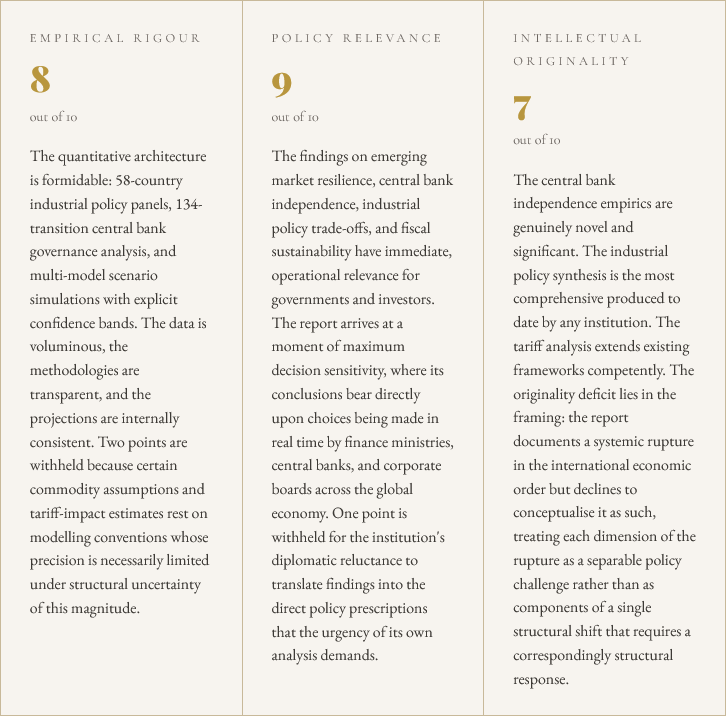
Strategic Intelligence Quotient: Rating the Report
Contextual Architecture
The Geopolitical and Economic Moment: Integration In Retreat, Power In Reconfiguration
Context is not preamble. It is an analysis. The October 2025 World Economic Outlook arrives at a moment without a precise historical parallel: a moment in which the world's largest economy is simultaneously the primary source of trade disruption, fiscal instability, and institutional erosion that the report's own findings document. The United States imposed tariffs in early 2025 that lifted effective rates to levels not seen in a century. Subsequent partial retreats and bilateral deals reduced rates from their April peaks but left the global effective tariff environment dramatically elevated relative to 2024. Trade policy uncertainty, as measured by the IMF's composite index, remains at historically exceptional levels. The assumption embedded in the baseline projections, that current tariff measures remain in effect indefinitely, is not a modelling convenience; it is an institutional acknowledgement that the rules-based international trade system cannot be assumed to be restored.
Simultaneously, the geopolitical architecture of the post-Cold War era is fragmenting along lines that the multilateral system was not designed to manage. The expiry of the African Growth and Opportunity Act in September 2025 removed preferential US market access for sub-Saharan African economies at the precise moment when official development assistance was declining by approximately 9 per cent annually for a second consecutive year. China's manufacturing export surge, driven by the subsidised overcapacity that Chapter 3 of the report analyses with empirical precision, is redirecting trade flows away from the United States and towards European and Asian markets at a speed that is accelerating relative to the 2018 to 2019 episode. These are not independent developments. They are the simultaneous expressions of a single structural shift: the deliberate deconstruction of the integrated global economic system that constituted the defining achievement of the twentieth century's post-war order.
The AI investment boom provides the sole countervailing force of comparable magnitude, and it is precisely its simultaneous promise and peril that makes the current moment so extraordinarily difficult to navigate. Between 1999 and 2000, the Federal Reserve needed to raise its policy rate by a cumulative 175 basis points to contain inflationary pressures generated by the dot-com investment surge. The IMF draws this comparison explicitly in its Foreword. The parallel is not decorative; it is a warning.
Position Within the Institutional Canon: Continuity of Caution, Strategic Rupture, Escalation of Concern, and Quiet Radicalism
The report reinforces the institution’s long-standing commitment to open markets and multilateral cooperation. Yet its tone signals escalation. Fragmentation is no longer a risk; it is an operating condition.
Compared with earlier editions, the shift is subtle yet profound. The language remains measured, yet the implications are severe. The institution acknowledges systemic change while maintaining diplomatic restraint.
Within the IMF's own body of research, this WEO marks a subtle but significant departure from the institution's long-standing optimism about structural convergence. For decades, successive WEO editions maintained the expectation that emerging market economies would continue to close the income gap with advanced economies through trade integration, institutional development, and capital inflows. The October 2025 edition documents, with measured regret, that medium-term growth prospects are now deteriorating for approximately two-thirds of the world economy, and that the downward revisions are more pronounced for emerging market and middle-income economies than for advanced ones. This is not a footnote. It is the quiet reversal of the institution's foundational development narrative.
The report's engagement with industrial policy also represents a departure from the IMF's historical reluctance to endorse active state intervention in sector allocation. Chapter 3's admission that industrial policy may have a role in “improving resilience and growth” would have been stronger language than previous editions permitted. The institution is adapting, under intellectual pressure from the empirical reality of widespread industrial policy adoption, to acknowledge what its own member governments are already doing. The qualification it immediately appends, that full consideration must be given to opportunity costs and trade-offs, is the diplomatic equivalent of a surgeon endorsing a procedure while noting that it carries a 40 per cent complication rate. The endorsement is real. So is the warning.
Analytical Deconstruction
The Central Thesis: Resilience As Temporary, Fragmentation As Structural
The report's stated central argument is that the global economy has absorbed the tariff shock at the lower end of the range of negative outcomes, but that underlying growth prospects remain dim, risks are tilted to the downside, and the policy priority is to restore confidence, predictability, and fiscal sustainability. This is the argument visible on the surface of the document. The argument beneath the surface is more consequential: that the institutional foundations of the post-war international economic order are eroding faster than the technical policy responses being prescribed can repair them.
The causal logic underlying the report's projections flows from a recognition that the tariff shock is not simply a price distortion; it is a signal about the reliability of the rules-based system itself. Firms do not invest in globally integrated supply chains when the rules governing those chains are subject to unilateral revision without notice. Households do not consume freely when inflationary uncertainty is elevated. Governments do not coordinate fiscal policy when the institutions designed to facilitate that coordination are under political siege. The tariff, the immigration restriction, the ODA cut, the pressure on central bank independence; these are not isolated policy choices. They are components of a coherent, if not fully articulated, strategic posture: the withdrawal of the world's largest economy from the multilateral commitments that defined its post-war identity.
Consequently, the strategic interpretation of the report’s core argument is that current resilience is driven by temporary adjustments rather than durable fundamentals.
This implies a future where growth persists but weakens, where stability is maintained but erodes. The causal logic is clear. Protectionism distorts allocation, fragmentation limits productivity, and policy uncertainty suppresses investment.
The Methodological Lens: What the IMF Can and Cannot See
The IMF's analytical framework is sophisticated and, within its design parameters, robust. Its multi-region models, growth-at-risk assessments, local projection methods, and scenario analyses are among the most advanced macroeconomic tools deployed by any institution globally. The framework is designed, however, to model policy deviations from a stable baseline, not structural ruptures in the baseline itself. When the institution models “higher tariffs and supply chain disruptions” as a scenario layer in Box 1.2, it is modelling a perturbation to a system it assumes will remain institutionally coherent. What it cannot model with equivalent precision is the systemic effect of sustained uncertainty about whether the multilateral system remains operative at all. This is the analytical gap between the institution's technical capabilities and the strategic reality that the moment demands.
The assumptions embedded in the methodology are worth naming precisely. The baseline assumes that announced tariff measures remain in place indefinitely but that no further escalation occurs. It assumes that monetary policy institutions retain their independence and credibility. It assumes that official development assistance stabilises rather than continuing to decline. Each of these assumptions is an optimistic reading of current political trajectories. The difference between the baseline and the adverse scenario is not merely a quantitative increment; it is the difference between managed fragmentation and systemic rupture. The report's downside scenario projects a permanent global GDP loss of approximately one-half per cent relative to the baseline. The strategic reader should treat this as the minimum quantification of an outcome whose political dimensions lie outside the model's scope.
In essence, the analysis relies on macroeconomic modelling, scenario simulations, and historical data extrapolation. Its strength is coherence; its limitation is assumption dependency.
Alternative frameworks, particularly those incorporating geopolitical strategy and technological disruption more explicitly, would likely produce more divergent outcomes.
Internal Tensions and Contradictions: Where the Logic is Strained, Cooperation Advocated, Fragmentation Accepted
The report advocates multilateral cooperation while acknowledging its erosion.
This tension is unavoidable. Policy prescriptions assume coordination, yet geopolitical realities incentivise divergence.
The report's most significant internal tension lies between its diagnosis of fiscal unsustainability and its prescription of gradual, credible consolidation. The diagnosis is unambiguous: the US public debt-to-GDP ratio is projected to reach 143 per cent by 2030 under current policies, 15 percentage points above prior projections; advanced economies as a group are maintaining fiscal stances that are too loose; and emerging market debt is rising to 82 per cent of GDP by 2030 from under 70 per cent in 2024. The prescription, “medium-term fiscal consolidation through realistic, balanced plans,” is technically coherent but politically aspirational in an environment where the primary agent of fiscal deterioration has just passed legislation, the One Big Beautiful Bill Act, that worsens its fiscal trajectory by 0.5 percentage points of GDP annually.
A second tension exists between the report's endorsement of industrial policy as a conditional tool and its empirical evidence that this tool generates modest returns at significant cost, particularly in emerging economies. The institution is simultaneously legitimising a practice it has documented as largely ineffective. This is not intellectual dishonesty; it is the predictable consequence of an institution adapting to political reality rather than leading it. The strategic reader should note the gap between these two positions and draw the obvious conclusion: if governments are going to deploy industrial policy regardless of the evidence, the determinant of its success or failure will be institutional quality, not the policy instrument itself. Korea succeeded; Brazil failed. The difference was governance, not economics.
Analytical Integrity Assessment: Credibility With Caveats, Three Claims Requiring Caution
The first claim requiring caution is the projection that the tariff shock has been largely absorbed and that its cumulative global output loss will be limited to approximately 0.2 per centage points by end-2026. This projection rests on the assumption that pass-through remains contained, that trade diversion generates near-equivalent economic activity in redirected channels, and that confidence recovers as uncertainty abates. All three of these sub-assumptions are contestable. The corporate margin compression that has contained pass-through cannot be maintained indefinitely at 19 per cent effective tariff rates. Trade diversion is demonstrably less efficient than direct trade; the evidence from 2018 to 2019 confirms this. And uncertainty, as the report's own modelling shows, does not abate as long as the tariff architecture remains structurally volatile. The 0.2 per centage point estimate may prove to be the lower bound of a wider range.
The second claim requiring caution is the report's relatively contained treatment of the AI correction risk. The IMF acknowledges the dot-com parallel and notes the 30 per cent probability of a US recession in 2026, but its baseline projections incorporate continued AI-driven investment as a positive demand force through 2026. A disorderly AI market correction in 2025 to 2026 would simultaneously compress AI-linked investment, tighten financial conditions through private credit channels, reduce household wealth through equity market effects, and constrain fiscal space for counter-cyclical response precisely when fiscal space is already at a historical low. This compound scenario is treated as a tail risk in the report; the evidence of AI stock concentration and private credit exposure suggests it may be closer to a central scenario than the baseline acknowledges.
The third claim requiring caution is the report's implication that the AGOA expiry and ODA reduction will have “limited direct short-term macroeconomic impact” on low-income countries. The institution acknowledges that effects “will become visible over time as likely deterioration in energy access and human capital accumulation reduces potential output.” This is accurate but incomplete as a risk assessment. The combination of AGOA expiry, ODA reduction, elevated tariff exposure, and declining preferential financing represents a simultaneous withdrawal of multiple development finance instruments from the world's most vulnerable economies. The aggregate effect of these concurrent shocks exceeds the sum of their individual impacts, and the report does not model their compounding dynamics with equivalent rigour.
Strategic Implications by Domain
Implications for Corporate Strategy: Reconfiguring for a Fragmented World, Efficiency Replaced By Resilience

The most consequential implication for corporate leaders is the irreversibility of the current trade configuration. The report's baseline assumption that tariff measures remain in place indefinitely is not a pessimistic projection; it is a candid acknowledgement that the corporate planning horizon must now incorporate elevated tariffs as a structural input cost, not a temporary aberration awaiting diplomatic resolution. The boards that accept this sooner will reconfigure their supply chains, pricing architectures, and capital allocation frameworks with the urgency the situation demands; the boards that continue to plan for tariff normalisation will discover the cost of that assumption when the pass-through they deferred arrives in full.
The practical implication for competitive positioning is the rewarding of near-shoring, supply chain diversification, and domestic value-add intensity. The report documents Chinese export diversion towards Asian and European markets at an accelerating pace, driven by US-China bilateral decoupling. Companies that are positioned in markets receiving Chinese export redirection face competitive pressure from subsidised manufacturing capacity that is being redirected rather than reduced. For South African and African manufacturers specifically, this dynamic creates both threat and opportunity: Chinese goods competing for African market share at compressed prices, and simultaneously, African producers with potential comparative advantage in serving markets that are diversifying away from Chinese supply. The window for capturing that opportunity is narrow and will narrow further as trade patterns solidify.
Consider, as a practical case, the behaviour of South Korean automobile manufacturers following the 2025 tariff escalation. Korean car export prices to North America have fallen materially in response to margin pressure, even as export prices to non-North American markets remain stable. This illustrates the precision with which sophisticated manufacturers are absorbing tariff exposure strategically: protecting market share in the tariffed market through price absorption while defending margins in unaffected markets. South African exporters, and their global counterparts, who have not yet conducted this market-by-market tariff exposure analysis, are operationally exposed in ways their financial statements have not yet reflected.
On business model transformation, the AI implications are simultaneously the most exciting and the most dangerous in the report's landscape. The productivity potential of AI adoption is genuine and quantifiable. The financial stability risk from concentrated AI investment and stretched valuations is also genuine and quantifiable. The executive imperative is not to choose between embracing AI and avoiding AI-linked financial exposure; it is to execute AI adoption with internal balance sheets rather than external AI equity concentration, and to stress-test investment returns against a scenario in which AI market valuations correct materially before the productivity dividend fully materialises. The dot-com parallel the IMF invokes is instructive in both its promise and its periodisation: the productivity gains from the internet were real, but they arrived a decade after the correction that wiped out the early investors.
In essence, firms must now operate within a dual mandate. Optimise for efficiency, yet insure against disruption. Global supply chains must be redesigned as geopolitical networks.
A South African manufacturing firm, for instance, can no longer rely solely on cost advantages. It must position itself within regional trade blocs, leveraging the African Continental Free Trade Area while mitigating exposure to global volatility.
Implications for National Policy Strategy: The Institutional Imperative, Fiscal Discipline Versus Strategic Investment
The report's findings on central bank independence constitute the most operationally actionable piece of intelligence for national policymakers. The empirical evidence is unambiguous: politically motivated transitions in central bank leadership produce measurable and sustained macroeconomic deterioration, including real interest rate declines of 1.6 per centage points, exchange rate depreciation of 3.1 per cent, and inflation increases of 1.7 per centage points within six months. These costs compound over time. Any government calculating that pressure on its central bank generates a short-term fiscal advantage through lower rates is making a transaction whose medium-term cost the IMF has now quantified with scholarly rigour. The institution cannot tell governments to stop; governments can read the numbers and choose.
On industrial policy, the report's evidence suggests that the relevant question for national policymakers is not whether to deploy industrial policy but whether the institutional prerequisites for successful deployment are in place before the instruments are activated. Korea's success rested on anti-corruption enforcement, institutionalised performance benchmarks, competitive market discipline within sectors receiving support, export targets as de facto sunset clauses, and complementary investments in education and infrastructure. Brazil's failure reflected the absence of precisely these prerequisites. The question for South Africa, and for other emerging economies tempted by the developmental state model, is not whether state support for strategic sectors is desirable in principle; it is whether the institutional infrastructure required to prevent that support from becoming rent-transfer rather than capability-building is present in practice. The honest answer to that question, for most emerging economies, is mixed at best.
Fiscal consolidation is the non-negotiable structural requirement that the report identifies with the greatest urgency. The calculus is straightforward: elevated debt ratios, rising real interest rates, demographic spending pressures, and deteriorating growth prospects compose an equation that resolves in one direction without deliberate policy intervention. The medium-term fiscal consolidation the IMF prescribes, combining spending rationalisation with revenue mobilisation, is technically sound. The political conditions for its implementation are, in most major economies, currently absent. This gap between technical prescription and political feasibility is the single most dangerous structural feature of the current global fiscal landscape.
Fundamentally, governments face a contradiction. Consolidate fiscally, yet invest aggressively in growth. The solution lies in targeted expenditure, prioritising infrastructure, digital capacity, and human capital.
South Africa’s energy transition provides a case in point. Reforming Eskom while scaling renewable capacity is not optional; it is existential.
Implications for Investment and Capital Allocation: Selectivity As Strategy, The New Geography of Risk and Return
For sovereign wealth funds, institutional investors, and private equity allocators, the report's findings define a new geography of risk that does not map cleanly onto the pre-2025 framework. The combination of elevated sovereign debt levels, rising real interest rates, and fiscal trajectories that are deteriorating in the world's largest bond markets creates a duration risk environment that standard fixed-income allocation models have not encountered in the post-2008 era. The IMF's adverse scenario includes a 100 basis point increase in sovereign yield term premiums across most advanced economies lasting ten years. Portfolios that have not stress-tested against this scenario are carrying unquantified sovereign duration risk.
The implications for development finance institutions and emerging market investors are more nuanced. The report's Chapter 2 finding that policy framework quality is the primary determinant of emerging market resilience to risk-off shocks provides a differentiation framework of direct investment relevance. Emerging economies with credible inflation targeting, fiscal rules, reduced currency mismatches, and genuine central bank independence have demonstrated measurably superior resilience during the post-pandemic risk-off episodes the report analyses. These are not merely governance virtues; they are investable attributes that predict performance divergence during stress scenarios. The premium for institutional quality in emerging market credit and equity allocation has never been more empirically grounded.
On sector allocation, the AI dynamic demands particular precision. The report's bifurcation of AI as both upside scenario and systemic risk should prompt institutional investors to disaggregate their AI exposure: separating the productivity story, which is accessible through enterprise software adoption in diverse industries, from the market concentration story, which is the risk embedded in current AI equity valuations. A portfolio long on AI productivity through enterprise adoption and short on AI market concentration through diversification away from the largest capitalisation tech names is consistent with the report's risk analysis in a way that undifferentiated AI enthusiasm is not.
At its core, capital must now discriminate. Broad exposure is replaced by targeted positioning. Sectors linked to digital infrastructure, energy transition, and strategic manufacturing will attract disproportionate investment.
Emerging markets will diverge sharply. Those implementing structural reforms will capture capital; others will be excluded.
Implications for Multilateral Architecture: Cooperation As Necessity, Competition As Reality
The report's Foreword, authored by IMF Chief Economist Pierre-Olivier Gourinchas, closes with a statement that is, by the standards of institutional communication, unusually forthright: “cooperation in the face of global challenges remains the bedrock upon which to build a more prosperous and resilient global economy.” This is simultaneously true and, in the current political environment, aspirational to the point of poignancy. The multilateral architecture that the IMF represents and defends is under greater structural pressure than at any point since its creation. The expiry of AGOA, the decline in ODA, the bilateral trade deal proliferation that replaces multilateral frameworks with bilateral arrangements of uncertain durability, and the political pressure on institutions from central banks to statistical agencies; these are not incidental to the report's analysis. They are the environment within which its projections are being made.
The strategic implication for governments with genuine multilateral commitments is that the cost of multilateral disengagement is being borne asymmetrically. The economies most harmed by the erosion of multilateral trade frameworks are the smallest, most trade-dependent, and least diplomatically powerful. Sub-Saharan Africa loses AGOA. Low-income developing countries lose ODA. The multilateral institutions that might substitute for bilateral development finance face their own resource and governance constraints. The mathematical result of this asymmetry is an accelerating divergence in the development prospects of small open economies relative to large self-sufficient ones, precisely contrary to the convergence narrative that the multilateral system was designed to produce.
In substance, multilateral institutions remain essential, yet their influence is contested. The future is defined by partial cooperation within a framework of strategic competition.
Implications for Technology and Digital Strategy: AI Governance as Competitive Advantage, Innovation As Advantage, Overvaluation As Risk
The report's treatment of AI as both productivity catalyst and financial stability risk has a dimension that its economic modelling does not fully capture: the governance advantage that accrues to institutions, companies, and nations that establish coherent AI frameworks before the regulatory environment is defined by crisis. The IMF recommends “diffusion-oriented policies” for AI adoption that enable uptake by small firms, support management upgrading, and ensure data interoperability. This is sensible as far as it goes. What it does not address is the asymmetric competitive advantage that early, rigorous AI governance generates in an environment where regulatory clarity is itself a scarce resource.
For multinational corporations, the digital strategy implication of the report's landscape is the priority of AI-enabled productivity over AI-linked equity exposure. The companies that will extract the most sustained value from AI are those that deploy it to enhance operational productivity in their core businesses, not those that are exposed to AI through concentrated equity positions in the technology firms currently carrying stretched valuations. The IMF's own productivity scenario suggests that AI's transformative economic contribution will arrive gradually, through diffusion across the broader economy, rather than immediately through the concentrated gains of a small number of frontier technology providers. The investment thesis that mirrors this trajectory is enterprise AI adoption, not technology sector concentration.
At its foundation, AI adoption must be disciplined. Firms must integrate AI into core operations while avoiding speculative overinvestment.
Implications for Africa and South Africa: The Convergence of Shocks, Peripheral Risk as Central Opportunity, What the Report Implies but Cannot Declare
The IMF's treatment of sub-Saharan Africa in the October 2025 World Economic Outlook is measured, data-driven, and, by the standards of strategic intelligence, profoundly incomplete. The report documents the regional growth projection at 4.1 per cent in 2025 and 4.4 per cent in 2026, an upward revision from April driven predominantly by Nigeria's improved performance. It notes the expiry of AGOA in September 2025 and its expected negative effects, particularly on Lesotho and Madagascar. It observes the impact of declining ODA on the most vulnerable low-income economies. What it does not do, because its methodology models these dynamics separately rather than cumulatively, is assess the compound strategic consequence of their simultaneous occurrence.
The strategic reality for Africa in 2025 is the convergence of four structural shocks. The expiry of AGOA removes preferential US market access at the precise moment when the US tariff environment is its most restrictive in a century, eliminating not merely a trading preference but the entire institutional framework that linked African manufacturing to US value chains. The simultaneous 9 per cent annual decline in official development assistance reduces the concessional financing that has funded health, education, and infrastructure investment in economies with shallow domestic capital markets. The Chinese export diversion triggered by US-China tariff escalation is redirecting subsidised manufacturing capacity into markets that African producers might otherwise have served, compressing price points and displacing competitive opportunity. And the tightening of advanced economy immigration policies is reducing the remittance flows that constitute a material share of household income in multiple sub-Saharan economies.
These four forces are not additive; they are compounding. They are withdrawing simultaneously from Africa the preferential trade access, the concessional capital, the market positioning, and the income transfer mechanisms that have partially compensated for the continent's structural developmental deficits. The IMF cannot say this with the directness the situation demands. The strategic interpreter can, and must.
Fundamentally, Africa stands at a strategic inflection point. Fragmentation creates risk, yet it also creates opportunity. Supply chain diversification positions Africa as a potential manufacturing and resource hub.
South Africa’s role is pivotal. It is both vulnerable and influential. Its structural reforms will determine whether it anchors regional growth or amplifies regional fragility.
Consider a logistics corridor linking South Africa to East African markets. Such an initiative would convert geographic position into economic power.
South Africa's Specific Crisis: The Anatomy of Structural Underperformance
South Africa's growth projection of 1.1 per cent in 2025 and 1.2 per cent in 2026 is, when examined against its regional and global context, not merely disappointing; it is structurally indicting. Sub-Saharan Africa as a region was projected to grow at 4.1 per cent in 2025. The world's emerging markets and developing economies are projected at 4.2 per cent. South Africa's projected growth is less than a third of its continental peer group and less than a quarter of the emerging market average. This gap is not cyclical. It is not the product of temporary external shocks absorbed more severely in Pretoria than in Nairobi or Lagos. It is the expression of structural failures in energy supply, logistics infrastructure, labour market flexibility, state capability, and regulatory consistency that have been accumulating for two decades and are now visible in the raw arithmetic of international comparative performance.
At 1.1 to 1.2 per cent annual growth, South Africa cannot generate the employment required to absorb its labour force. Youth unemployment is already at levels that would constitute a social emergency in most democracies; growth at these rates does not reduce it, it allows it to compound. At 1.1 per cent growth, South Africa cannot sustain its social expenditure commitments without continued fiscal deterioration, because the fiscal arithmetic of social spending requires a revenue base that only grows when GDP grows. At 1.1 per cent growth, South Africa cannot maintain its position as the continent's most diversified and systemically connected economy, because that position requires the investment attraction, the skills development, and the institutional quality that are themselves functions of sustained economic momentum. The report's projections, read against this context, are not a mild disappointment; they are a systemic warning.
The IMF's Chapter 2 findings on emerging market resilience provide South Africa with an unusually precise roadmap for what structural improvement would require. The economies that demonstrated superior resilience during risk-off episodes did so through five institutional attributes: credible inflation targeting frameworks, genuine central bank independence, tighter macroprudential policies that reduced currency mismatches, fiscal rules that enhanced expenditure countercyclicality, and lower reliance on politically driven monetary accommodation. South Africa possesses some of these attributes in more developed form than many regional peers; its central bank has maintained credibility and operational independence, and its monetary policy framework is reasonably robust. It is weaker on fiscal credibility, on macroprudential depth, and most critically, on the structural reforms in energy, logistics, and labour markets that determine whether monetary credibility translates into investment attraction and growth.
The Continental Opportunity: Africa's Geopolitical Repositioning in a Fragmented World
The strategic analysis does not end with the catalogue of threats. The report's findings, read through the lens of competitive repositioning rather than merely defensive risk management, identify structural opportunities for Africa that the fragmentation of the global order is, paradoxically, creating. The rewiring of global supply chains away from China-to-United-States corridors is generating demand for alternative manufacturing and processing locations with credible rule of law, competitive labour costs, and proximity to multiple major markets. Africa, and particularly the more institutionally developed economies of the continent, including South Africa, Kenya, Rwanda, and Ghana, sits at the intersection of these criteria in ways that no other region can replicate.
The African Continental Free Trade Area, if implemented with the institutional rigour that the IMF's Chapter 2 findings identify as the prerequisite for economic resilience, represents precisely the kind of market integration that the fragmentation of the global order makes more valuable, not less. As the United States withdraws from its post-war role as the architect of multilateral trade frameworks, regional trade integration becomes a credible substitute source of market access, scale economies, and capital attraction. The AfCFTA is not yet delivering on its potential; the gap between its formal commitments and its operational implementation is wide. But the strategic logic for closing that gap has never been more compelling, because the external environment that makes regional integration optional is being replaced by an external environment that makes it necessary.
The energy transition provides a second structural opportunity of continental significance. The report documents the global proliferation of industrial policy targeting clean energy sectors, noting the genuine learning-by-doing benefits in solar and electric vehicle production. Africa's renewable energy endowment, particularly in solar irradiation, wind corridors, and green hydrogen potential, positions the continent to participate in clean energy industrial development in a way that is consistent with both the investment flows the energy transition is generating and the resource geopolitics the transition is creating. South Africa's just energy transition partnership, whatever its implementation challenges, represents precisely the kind of strategic positioning in these global investment flows that the report's industrial policy analysis identifies as productive when it targets sectors with genuine comparative advantage and credible institutional governance.
Implementation Solutions: What South African and African Leaders Must Do Now

The strategic intelligence embedded in the October 2025 World Economic Outlook translates into a concrete set of priorities for South African political, business, and financial leaders. The first and most immediate is the acceleration of structural reforms in energy, logistics, and state capability. The report's findings leave no ambiguity: growth rates of 1.1 to 1.2 per cent are structurally insufficient, and the external environment will not compensate for internal dysfunction. The Eskom unbundling, the rail and port infrastructure rehabilitation, and the regulatory reform agenda that South Africa's government has committed to in principle must be executed with the urgency of a competitive emergency, because they constitute the prerequisite for every other element of the strategic opportunity the external environment is creating.
The second priority is the deliberate construction of the institutional architecture that the IMF's Chapter 2 identifies as the determinant of emerging market resilience. South African businesses and policymakers should read Chapter 2 not as an academic exercise but as a practical specification of the governance investments that separate economies which navigate the coming risk-off environment successfully from those that do not. Central bank independence must be defended, not merely rhetorically but operationally and politically. Fiscal credibility must be rebuilt through a medium-term consolidation plan that is realistic, transparent, and consistently executed. And macroprudential policy must be extended to address the currency mismatch vulnerabilities that the report identifies as among the most important determinants of risk-off episode severity.
The third priority is the strategic repositioning of South African trade and investment policy in the wake of AGOA's expiry. The end of AGOA is not merely a trade policy setback; it is a strategic signal that the architecture of South Africa's and Africa's economic relationships with the United States must be rebuilt on a different foundation. The bilateral trade negotiation and the investment promotion agenda must now operate in an environment where preferential access cannot be assumed, where tariff exposure is elevated, and where the political economy of the US trade relationship is fundamentally different from the environment in which AGOA was created and sustained. This requires diplomatic sophistication, commercial realism, and the capacity to negotiate bilateral arrangements that protect South African economic interests without the multilateral scaffolding of AGOA.
For South African companies specifically, the global supply chain reconfiguration documented in the report creates a concrete competitive opportunity: positioning South African manufacturing, processing, and services as a credible destination for supply chains diversifying away from both Chinese and US concentration. Companies in sectors including automotive components, agro-processing, financial services, and digital infrastructure that can credibly present South Africa as a reliable, rule-of-law-governed alternative manufacturing and processing location are operating in a moment of exceptional strategic opportunity. The question is whether they can execute the investment, the quality improvement, and the commercial positioning necessary to convert that opportunity into contracted supply relationships before the reconfiguration solidifies around other locations.
The Great Power Competition on African Soil: What the Report Does Not Say but Leaders Must Know
The October 2025 World Economic Outlook documents the US withdrawal from development financing, AGOA, and multilateral trade frameworks with data precision but without explicit commentary on the geopolitical vacuum this withdrawal is creating and the actors who are filling it. The strategic reader must complete this picture. China's export diversion towards African markets, its continued infrastructure financing engagement through Belt and Road mechanisms, and its deepening trade relationships with African commodity producers are accelerating precisely as US engagement through AGOA and ODA is declining. Russia's security relationships on the continent, though economically secondary to China's commercial engagement, add a further dimension of great power competition that the IMF is constitutionally disinclined to address explicitly.
For South African and African policymakers, this great power competition is simultaneously a source of leverage and a source of risk. The leverage derives from Africa's genuine strategic importance to multiple competing powers: its commodity endowments, its demographic momentum, its growing consumer market, and its geopolitical vote weight in multilateral forums all create bargaining positions that skilled diplomacy can monetise. The risk derives from the conditionalities, both explicit and implicit, that accompany great power engagement, and from the possibility that competitive great power involvement generates instability rather than development in fragile states. South Africa's presidency of the G20 in 2025, and its role as continental anchor economy, give it an unusual platform to shape these dynamics at precisely the moment when they are most consequential. The question is whether South African leadership possesses the strategic clarity and diplomatic capacity to exercise that platform with the effectiveness the moment demands.
The Silence of the Report
What the Report Does Not Address: The Strategic Blind Spots
The most sophisticated intelligence analysis identifies not only what the institution has said but what it has chosen, or been constrained, to leave unsaid. The first and most consequential omission is the cumulative compound impact of simultaneous shocks on the world's most vulnerable economies. The report models the AGOA expiry, the ODA reduction, the tariff exposure, and the remittance compression as separate analytical developments. It does not model their interaction, their compounding dynamics, or the threshold at which their simultaneous occurrence creates systemic fragility that no individual policy response can address. This is a methodological limitation, but also, in part, an institutional sensitivity; the naming of compounding shocks would require naming their primary agent.
The second significant omission is any substantive engagement with the political economy mechanisms that are perpetuating the fiscal deterioration and institutional erosion the report documents. The prescription for fiscal consolidation is technically impeccable. The analysis of why fiscal consolidation is not occurring, despite being technically impeccable, is absent. Fiscal deterioration in advanced economies is not primarily a technical problem; it is a political economy problem, driven by electoral incentives that reward deficit spending and punish consolidation, by institutional arrangements that allow fiscal expansion to be encoded in legislation while fiscal contraction requires sustained political will, and by distributional conflicts that make every consolidation measure a contested claim on finite resources. The institution's silence on these mechanisms is both understandable and consequential.
The third omission is the absence of serious engagement with the question of what succeeds the post-Cold War economic order. The report documents the erosion of that order with forensic precision. It recommends policies that might slow the erosion. It does not address what architecture should replace the eroded system, or whether any of the candidate architectures that are currently in political circulation, whether multipolar, regionally fragmented, bilaterally negotiated, or institutionally reconstructed, is compatible with the growth, stability, and development outcomes that the institution's mandate requires it to pursue.
Whose Voices Are Absent: The Underrepresentation of the Most Exposed
The report's analytical framework, despite its geographical breadth, reflects the intellectual tradition and institutional experience of advanced economy macroeconomics. The perspectives of low-income developing countries, whose governments are navigating the simultaneous withdrawal of ODA, AGOA preferences, and concessional financing, are present in the data but not in the analytical framing. The lived experience of a finance minister in Lesotho or Madagascar, managing the AGOA expiry without the institutional resources, diplomatic capacity, or market access alternatives available to a G20 economy, is not captured in the report's projection tables. The voices of African civil society, labour organisations, and small business communities, who will bear the primary impact of the structural changes the report documents, are nowhere in its analytical apparatus.
The Contrarian Perspective: The Case Against the Report's Conclusions
The most credible counterargument to the report's framework is that it underestimates the adaptive capacity of markets and institutions under pressure. The report's track record, in common with most institutional forecasting at inflection points, includes documented underestimation of private sector adaptability: the speed with which supply chains reorganised in response to the 2025 tariff escalation, the agility with which financial markets absorbed the April shock and recovered, and the resilience of emerging market economies that the institution itself acknowledges exceeded prior projections all suggest that adaptive dynamics may be more powerful than the baseline modelling assumes. The contrarian would argue that a combination of AI-driven productivity, supply chain innovation, and policy framework improvement in emerging markets could generate a recovery path that the report's dim medium-term projections do not adequately credit.
This is a coherent argument, and the honest strategic reader should weight it. The counter-counter-argument, however, is that adaptive capacity operates within institutional constraints that the current environment is actively eroding. Markets adapt within rule sets; when the rule sets are themselves unstable, market adaptation becomes defensive rather than creative. The adaptive dynamism that characterised the post-Cold War economy operated within a framework of multilateral commitments, institutional credibility, and geopolitical stability that the current environment is demonstrably withdrawing. Optimism about adaptive capacity requires a theory of why that withdrawal does not constrain the adaptation it would otherwise produce. The report does not provide that theory, and neither does the contrarian who opposes it.
Intellectual Courage Rating: The Limits of Institutional Candour
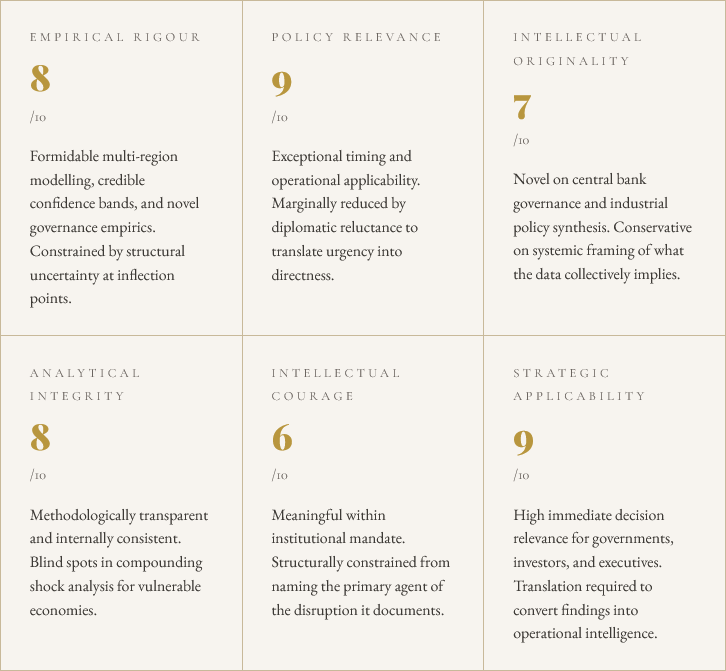
The IMF demonstrates significant intellectual courage in its quantification of central bank independence erosion, in its candid assessment of industrial policy's limitations, and in its explicit comparison of the AI boom with the dot-com bubble. These are not trivial positions for an institution that maintains diplomatic relationships with the governments its analysis implicates. The rating is, however, limited by the institution's structural inability to name the primary agent of the systemic disruption it documents, to declare explicitly that the post-Cold War economic order is ending, and to propose the architecture that might succeed it. Intellectual courage at the institutional level is constrained by institutional mandate in ways that strategic interpretation is not.
Intellectual Courage Rating: 6 out of 10. Significant within institutional constraints; insufficient relative to the magnitude of the moment. The report acknowledges structural challenges, yet stops short of fully confronting their geopolitical drivers.
The Strategic Briefing Verdict
The Single Most Important Insight: The Structural Rupture and Its Irreversibility, Growth Will Persist, But It Will No Longer Converge
The single insight that a global leader should retain above all others from this document is this: the growth premium of globalisation has been consumed, the convergence story has been interrupted, and the institutional foundations of the system that produced both are eroding faster than the technical policy responses being prescribed can repair them. This is not a conjunctural assessment subject to revision when the next trade deal is announced or the next tariff pause is extended. It is a structural finding grounded in the medium-term projections, the risk scenario analysis, the institutional governance data, and the industrial policy evidence that compose the analytical architecture of this report. The leaders who internalise this finding will make fundamentally different decisions about where to allocate capital, how to structure competitive positioning, which policy reforms to prioritise, and which geopolitical relationships to build, than the leaders who continue to treat the current environment as a temporary disruption to an otherwise stable trajectory. The defining feature of the next decade is divergence. Growth exists, yet its distribution fractures.
The Strategic Imperative for the Next 12 to 36 Months: A Concrete Priority Architecture, Redesign For A Fragmented World

For corporate leaders globally, the priority architecture for the next twelve to thirty-six months is: stress-test all supply chain configurations against a scenario in which tariff pass-through accelerates materially in 2026; build the institutional AI capabilities that drive enterprise productivity rather than concentrating exposure in AI equity valuations at stretched multiples; and develop the geographic and product diversification that reduces dependence on any single bilateral trade relationship in an environment where bilateral trade relationships are demonstrably unstable. For South African corporate leaders specifically, add to this list the aggressive pursuit of supply chain positioning as a US-China decoupling beneficiary, and the construction of the quality and governance credentials that make South African operations credible destinations for multinational supply chain diversification.
For national policymakers, the strategic imperative is institutional quality over policy instrument novelty. The IMF's evidence is unambiguous: the determinant of economic resilience in the coming risk-off environment is the quality of monetary, fiscal, and macroprudential institutions, not the specific policy tools those institutions deploy. Every dollar, rand, or shilling invested in strengthening independent fiscal institutions, credible central bank governance, transparent statistical systems, and rule-of-law infrastructure generates more economic resilience than the same resources deployed in industrial policy support without the institutional prerequisites. This is the report's most important finding for emerging economy policymakers, and it is one they should act upon with the urgency the external environment demands, because the external environment will not wait for the institutional building to be completed before delivering the next risk-off shock.
For African policymakers and business leaders, the most consequential strategic priority is the acceleration of regional integration under the AfCFTA, with the institutional seriousness that the IMF's evidence suggests is the prerequisite for integration to deliver resilience rather than merely regulatory complexity. The loss of AGOA is not recoverable through bilateral diplomacy alone; it is recoverable only through the construction of alternative market access, scale economies, and investment attractiveness that regional integration, if implemented with rigour, can provide. The strategic window for this construction is open, but it is not indefinitely open.
In essence, leaders must:
- Reconfigure supply chains for geopolitical resilience
- Prioritise fiscal credibility while funding strategic sectors
- Invest in productivity-enhancing technologies with discipline
- Position within emerging regional trade ecosystems
What This Report Changes: Landmark, Refinement, or Consolidation?
The October 2025 World Economic Outlook is a refinement of established thinking, not a landmark departure; but it is a refinement conducted at a moment when the established thinking is itself under the most severe stress in a generation, and the refinement therefore carries landmark implications. The industrial policy chapter is the most comprehensive empirical contribution to that debate produced by any multilateral institution. The central bank independence analysis is new, precise, and significant. The medium-term growth revision, which documents the deterioration of convergence prospects for two-thirds of the world economy, marks a quiet but historically consequential departure from the institutional narrative that has defined the IMF's developmental discourse for three decades.
What makes this report a document of unusual strategic significance is not any single analytical innovation. It is the totality of what its findings, read cumulatively and without the filter of institutional restraint, imply: that the world has entered a period of structurally lower growth, geopolitically driven fragmentation, fiscal vulnerability, and institutional erosion whose full consequences have not yet been priced into markets, policies, or strategic plans. The leaders who act on this implication before it is universally acknowledged will have made the most valuable investment available in the current environment: the investment in strategic foresight.
This is not a revolutionary document. It is a precise consolidation of a new reality. Its power lies in what it confirms. The report is indispensable as a diagnostic tool. It is insufficient as a strategic doctrine. Leaders must extend its logic beyond its constraints.
Final Assessment: The Verdict of a Trusted Strategic Adviser
The October 2025 World Economic Outlook is the most important institutional intelligence document published in 2025. It contains, in diplomatically restrained language, a comprehensive account of an international economic order in active structural transition; not crisis in the conventional sense, not recession in the technical sense, but the measured, systemic withdrawal of the institutional commitments, multilateral frameworks, and political consensus that constituted the architecture of post-war prosperity. The report's projections, its risk scenarios, its governance findings, and its industrial policy evidence all point in the same direction: the efficiency premium of the integrated global economy is being sacrificed to the political economy of national strategic competition, and the sacrifice is permanent, not temporary.
For global leaders who read it with the strategic literacy it demands, this document is a rare gift: a forensically rigorous, empirically grounded account of precisely where the world stands, delivered at the precise moment when the decisions that will define the next decade are being made. The leaders who act on its implications, with urgency proportionate to what the evidence implies rather than what the institution's diplomatic constraints permit it to declare, will be among those who shape the order that succeeds the one currently dissolving. The leaders who wait for greater certainty will discover, as every generation has discovered before them, that certainty arrives after the opportunity has passed.
For South African leaders specifically, this report is both warning and map. The warning is unmistakable: at 1.1 per cent growth, in a continent growing at 4.1 per cent, South Africa is not merely underperforming; it is surrendering the structural position that makes it a continental anchor rather than a continental burden. The map is equally clear: the institutional reforms, the regional integration commitments, the supply chain repositioning, and the diplomatic sophistication required to convert the current moment's threats into opportunity are knowable, implementable, and urgent. The question that the report's evidence compels South African leaders to answer is not what to do. It is whether the will to do it is equal to the scale of what the moment demands.
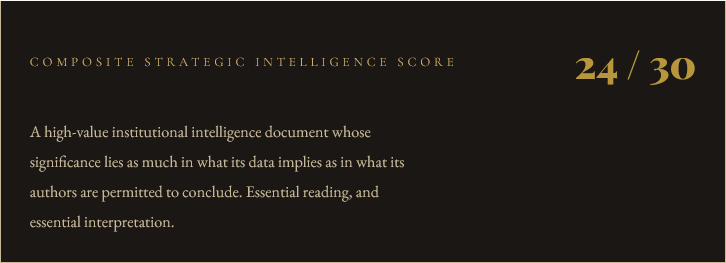
Overall Strategic Intelligence Scorecard

THE STRATEGIC ULTIMATUM: INTERPRETATION DEFINES POWER
The report describes a world of slowing growth, rising fragmentation, and constrained policy space. The deeper truth is more severe. The global economic system is not failing; it is being redesigned through conflict, constraint, and competition.
The decisive question is not whether this system will stabilise. It is who will shape its new equilibrium.
Those who wait for clarity will inherit decline. Those who act within ambiguity will define the future.
The individuals who shape outcomes in the architecture of global decision-making are rarely those who produce the reports. They are the ones who understand what the reports actually mean, who act before that meaning is universally acknowledged, and who refuse to mistake the comfort of institutional consensus for the clarity of strategic truth.
The report has been written. The interpretation has been delivered. The decision, as it always has been, belongs to you. Make it with the urgency the evidence demands and the courage the moment requires. The cost of inertia has already been calculated. It is measured in the growth that will not come, the institutions that will erode, and the opportunities that will consolidate around those who moved first.
Do not read the next institutional report as a summary of global conditions. Read it as a strategic problem requiring your immediate decision.
Images by Bandile Ndzishe of Bandzishe Group
About bandile ndzishe

Bandile Ndzishe is the CEO, Founder, and Global Consulting CMO of Bandzishe Group, a premier global consulting firm distinguished for pioneering strategic marketing innovations and driving transformative market solutions worldwide. He holds three business administration degrees: an MBA, a Bachelor of Science in Business Administration, and an Associate of Science in Business Administration.
With over 30 years of hands-on expertise in marketing strategy, Bandile is recognised as a leading authority across the trifecta of Strategic Marketing, Daily Marketing Management, and Digital Marketing. He is also recognised as a prolific growth driver and a seasoned CMO-level marketer.
Bandile has earned a strong reputation for delivering strategic marketing and management services that guarantee measurable business results. His proven ability to drive growth and consistently achieve impactful outcomes has established him as a well-respected figure in the industry.
As an AI-empowered and an AI-powered marketer, I bring two distinct strengths to the table: empowered by AI to achieve my marketing goals more effectively, whilst leveraging AI as a tool to enhance my marketing efforts to deliver the desired growth results. My professional focus resides at the nexus of artificial intelligence and strategic marketing, where I explore the profound and enduring synergy between algorithmic intelligence and market engagement.
Rather than pursuing ephemeral trends, I examine the fundamental tenets of cognitive augmentation within marketing paradigms. I analyse how AI's capacity for predictive analytics, bespoke personalisation, and autonomous optimisation precipitates a transformative evolution in consumer interaction and brand stewardship. By extension, I seek to comprehend the strategic applications of artificial intelligence in empowering human capability and fostering innovation for sustainable societal advancement.
In essence, I explore how AI augments human decision-making and strategic problem-solving in both marketing and other domains of life. This is not merely an interest in technological novelty, but a rigorous investigation into the strategic implications of AI's integration into the contemporary principles of marketing practice and its potential to reshape decision-making frameworks, rearchitect strategic problem-solving paradigms, enhance strategic foresight, and influence outcomes in diverse areas beyond the marketing sphere.