

Every decade produces one market that renders the hesitant irrelevant. This is that market. Africa is not a frontier waiting to be discovered; it is an integrated economic civilisation demanding to be understood. Global companies that misread this moment will not merely miss an opportunity; they will cede a generation of competitive advantage to those who did not.
The Defining Strategic Imperative
The Continent Is Not a Risk: It Is the Largest Unpriced Growth Option in the World
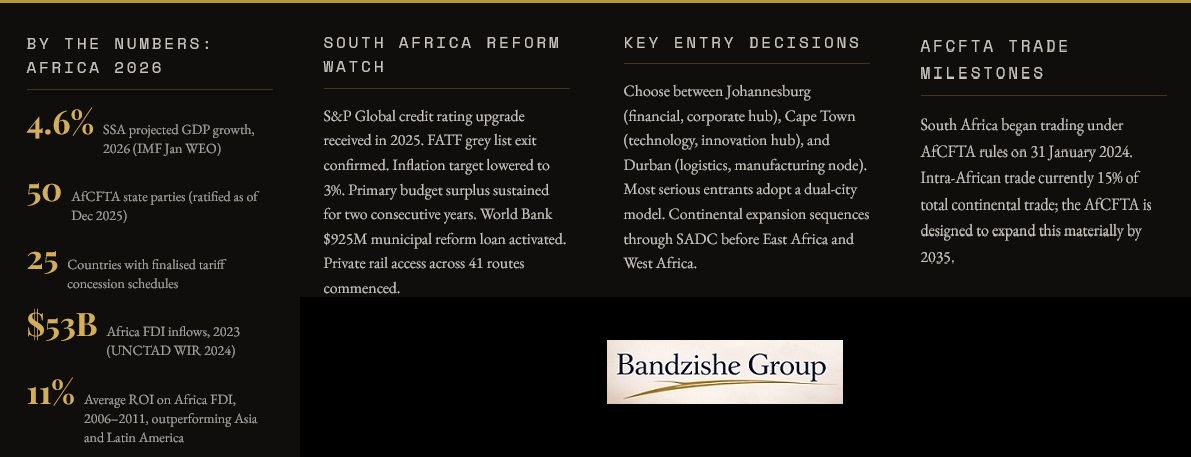
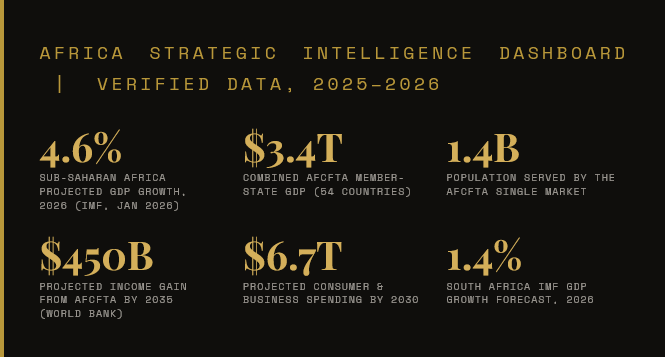
The global boardroom operates on a dangerous myth: that Africa is a supplementary consideration, a market to be approached once principal geographies have been saturated, a hedging instrument rather than a primary thesis. That myth is not merely intellectually dishonest; it is commercially catastrophic. Sub-Saharan Africa was forecast by the International Monetary Fund to record growth of 4.1 per cent in 2025, rising to a projected 4.6 per cent in 2026, at a moment when the global economy as a whole struggles to sustain 3.3 per cent expansion. The continent houses 1.4 billion people across 55 sovereign states, commands a combined GDP exceeding $3.4 trillion under the African Continental Free Trade Area framework, and is building, at this very moment, the largest free-trade architecture in human history by nation count. Yet multinational capital continues to flow elsewhere, distracted by markets that are rich, saturated, and diminishingly productive. The paradox is not that Africa is difficult to enter; it is that it is extraordinarily lucrative and yet systematically underweighted in the strategic portfolios of corporations that claim to think in decades.
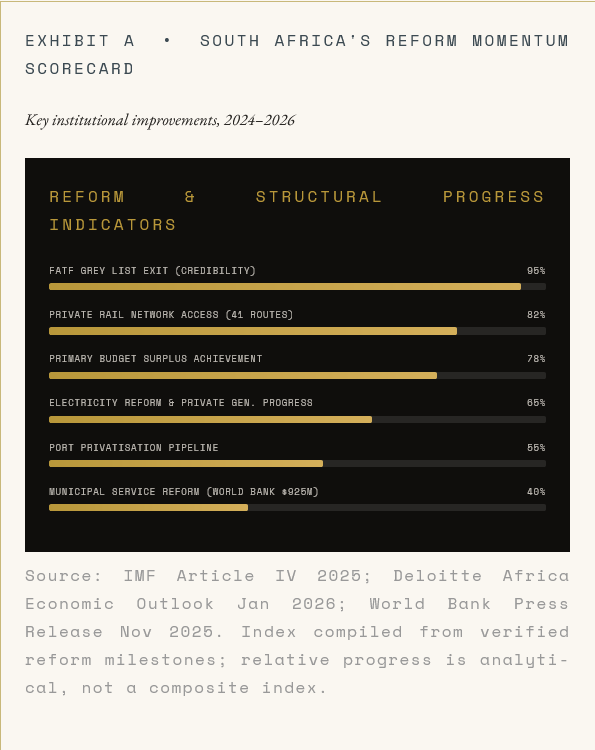
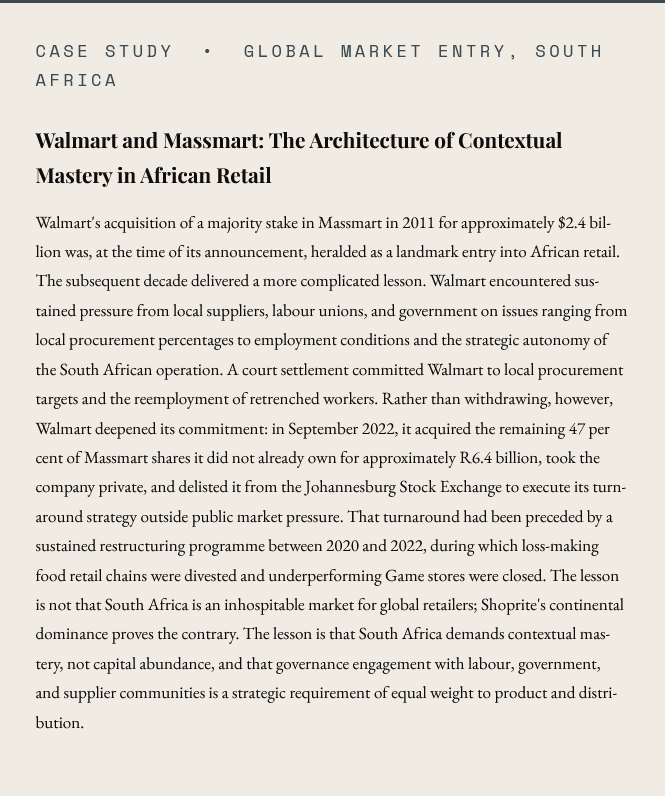
South Africa anchors this narrative with peculiar ferocity. It is simultaneously the continent's most industrialised economy and its most misunderstood one, a market of structured complexity that rewards those who read it correctly and punishes those who parachute in with generic emerging-market playbooks. The IMF's January 2026 World Economic Outlook revised South Africa's projected GDP growth upward to 1.4 per cent for 2026, a figure that, while modest by continental standards, obscures a deeper structural shift: the country has run primary budget surpluses for two consecutive years, exited the Financial Action Task Force grey list, received a credit rating upgrade from S&P Global, and adopted a credible 3 per cent inflation target, all within the span of eighteen months. These are not incremental adjustments; they are the foundational markers of an economy recalibrating its institutional credibility. For any global company assessing South Africa through the lens of yesterday's data, the strategic picture has already changed whilst they were looking elsewhere.
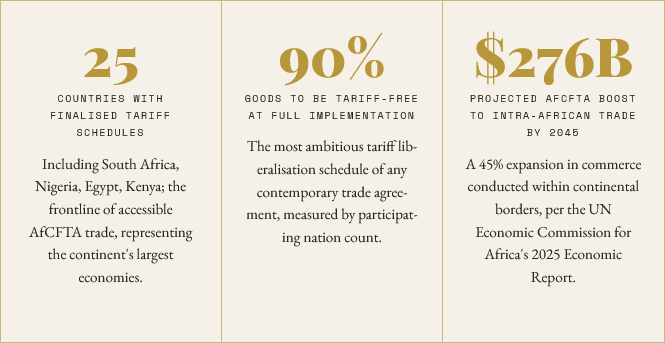
The argument for Africa must be made not through optimism but through arithmetic. The African Continental Free Trade Area, once its tariff-reduction schedules achieve full effect, is expected to boost Africa's aggregate income by $450 billion by 2035 and expand intra-African exports by $560 billion, the vast majority in manufacturing rather than commodities. The UN Economic Commission for Africa's Economic Report on Africa 2025 calculates that meticulous AfCFTA implementation could lift the continent's GDP by an additional $141 billion and intra-African trade by $276 billion, representing a 45 per cent expansion in commerce conducted within continental borders. Consumer and business spending across the AfCFTA zone is projected to reach $6.7 trillion by 2030. By 2050, as the AfCFTA Secretariat's Secretary-General Wamkele Mene has publicly affirmed, that figure exceeds $16 trillion, whilst Africa simultaneously commands the largest working-age population on earth. The corporation that dismisses these numbers as speculative does so not out of analytical rigour but out of institutional timidity, and institutional timidity is not a strategy; it is a surrender.
South Africa as Strategic Gateway
The Anchor Market Decoded: Why South Africa Is the Continent's Most Consequential Entry Point
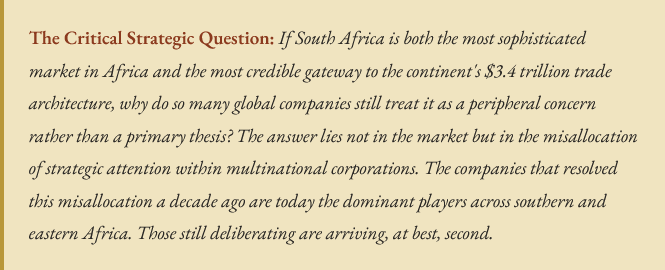
No market on the African continent offers a global corporation the institutional depth, financial sophistication, legal clarity, and continental connectivity that South Africa does. Johannesburg is home to the largest stock exchange on the continent by market capitalisation. Cape Town is simultaneously a technology hub of growing international repute and a gateway logistics node with port infrastructure that, despite its well-documented inefficiencies, is currently undergoing a fundamental reform through private-sector participation. The Johannesburg Securities Exchange, the sophisticated banking sector governed by a Reserve Bank that commands genuine institutional independence, the presence of all major international accounting and legal firms, the existence of the Companies Act and an established Competition Commission framework, all of these represent the infrastructure of commercial governance that multinationals require before they commit capital. South Africa is not an easy market; it is an orderly market, and the distinction is everything. The strategic logic of entering Africa through South Africa rests on three structural advantages that no other continental hub replicates. First, regulatory predictability: South Africa is a signatory to 50 bilateral investment treaties, imposes few restrictions on foreign private ownership, requires no government approval for most sectors, and has a legal system rooted in both Roman-Dutch and English common law, rendering it navigable for international counsel trained in either tradition. Second, financial depth: the banking system is sophisticated by global standards, trade finance is available, capital markets function with genuine price discovery, and the rand, though volatile, operates within a credible inflation-targeting framework. Third, continental leverage: South Africa's participation in the Southern African Development Community, the Southern African Customs Union, and the AfCFTA means that a business established in Johannesburg or Cape Town is not merely operating in a domestic market of 64.9 million people; it is positioned, with deliberate structuring, to access supply chains, distribution networks, and regulatory harmonisation spanning the entire southern African region.
Yet South Africa's structural advantages must be weighed with equal precision against its structural constraints, because honest strategic intelligence demands both. The economy carries public debt at elevated levels, with the IMF's baseline projecting a gradual improvement in the primary surplus from 0.9 per cent of GDP in the 2025 fiscal year towards 2.5 per cent by 2028 to 2029; the trajectory is favourable, but the consolidation is not yet secured. Unemployment remains one of the highest in the world among major economies, creating a dual reality for market entrants: a substantial pool of cost-competitive labour on the one hand, and compressed consumer purchasing power on the other. Logistics infrastructure, particularly Transnet's freight rail and port operations, has historically represented one of the most significant drags on export competitiveness, though the government's Operation Vulindlela Phase 2 reforms, including the allocation of rail network slots to eleven private train-operating companies across 41 routes, signal a reform trajectory that, if sustained, will materially alter the cost structure of goods movement across the country and into the continent.
Go-to-Market Architecture
The Five Doctrinal Errors: What Global Companies Get Catastrophically Wrong When They Enter Africa
The graveyard of failed African market entries is not populated by companies that lacked capital or ambition; it is populated by companies that entered with the wrong doctrine. Five categorical errors recur with sufficient frequency to constitute a pattern, and identifying these errors before they manifest is not merely intellectually satisfying; it is the difference between a successful market entry and an expensive withdrawal.
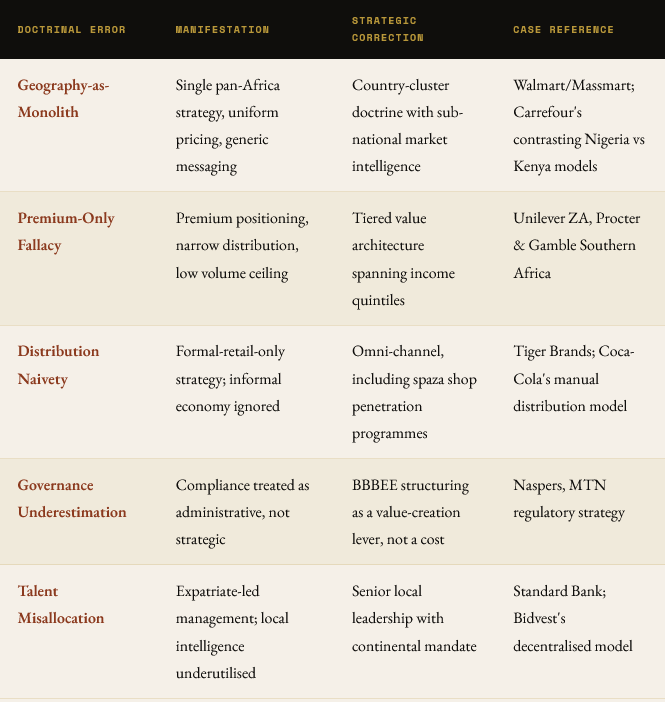
The first error is the geography-as-monolith fallacy: treating Africa as a single market with consistent consumer behaviour, regulatory frameworks, and competitive dynamics. Africa is 54 sovereign nations, each with distinct legal traditions, language hierarchies, currency exposures, consumer income distributions, and cultural cognition. A go-to-market strategy validated in Lagos will fail in Nairobi, and one refined in Johannesburg will be insufficient in Dakar. The company that enters Africa without country-specific, city-specific, and segment-specific strategic differentiation has not entered Africa; it has entered an abstraction, and abstractions do not generate revenue.
The second error is the premium-only fallacy, the assumption that because South Africa contains a developed-world-standard upper-middle-class segment, an aspirational premium positioning will capture the market. It will capture a fragment. The South African consumer market is a pyramid of profound asymmetry: a relatively small upper-income segment sits atop a vast base of aspirational middle-market and value-driven consumers whose purchasing decisions are determined not by brand aspiration alone but by price-performance ratio, accessibility, localised relevance, and community trust. Companies that price globally and distribute narrowly will find, within eighteen months, that their market-share ceiling is significantly lower than their initial projections suggested. The solution is tiered positioning, the deliberate engineering of multiple value propositions calibrated to distinct income strata, a strategy that Unilever, in its South African operations, has executed with characteristic precision, maintaining premium lines whilst investing in accessible-format, single-use offerings that capture township and peri-urban spending.
The third error is distribution naivety: the assumption that South Africa's developed retail infrastructure, represented by the dominance of Shoprite, Pick n Pay, Woolworths, and Checkers, constitutes a sufficient distribution strategy. Formal retail, whilst critically important, reaches a defined geographic and income segment. The informal economy accounts for a meaningful proportion of South African economic activity. Spaza shops, taverns, street traders, and mobile commerce channels are not supplementary; they are primary distribution nodes for a substantial portion of the population. Companies that ignore informal trade channels have, by definition, decided to ignore a significant portion of their addressable market, a decision that is commercially self-defeating in an economy where consumer spending is the principal growth driver cited by the IMF.
The fourth and fifth errors are governance underestimation and talent misallocation, each of which will be examined with surgical precision in the sections that follow.
Go-to-Market Execution
The Four-Phase Market Entry Doctrine: A Framework for Sovereign-Level Commercial Precision
A go-to-market doctrine for South Africa and the African continent must not be confused with a market entry plan. Plans are linear; doctrines are adaptive. Plans fail because the market refuses to behave as modelled; doctrines survive because they are built not around predicted conditions but around structural realities that do not change regardless of quarterly volatility. The doctrine advanced here consists of four phases, each possessing a distinct mandate, a defined set of deliverables, and a set of non-negotiable diagnostic gates that must be cleared before the subsequent phase is activated. The architecture is rigorous by design, because the cost of phase-skipping in an African market is not merely financial; it is reputational, regulatory, and, in some instances, irreversible.
Phase One: Intelligence Supremacy (Months 0–4)
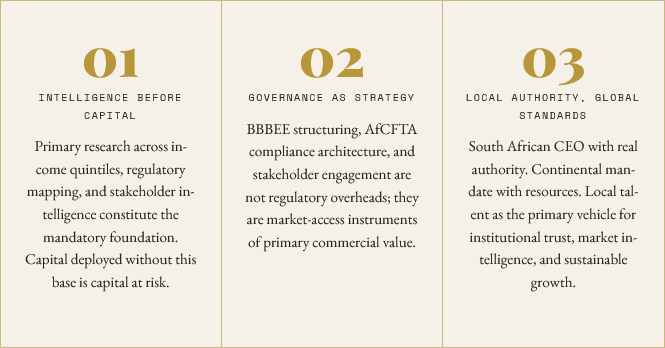
Before a single rand of capital is committed, the organisation must achieve a state of intelligence superiority over the market, its competitors, its regulatory architecture, and its consumer segments. This phase demands primary research across income quintiles, ethnographic consumer insight that goes well beyond survey data, regulatory mapping across the Companies Act, Competition Commission frameworks, BBBEE codes, and sector-specific licensing requirements, and a competitive intelligence analysis that identifies not only existing players but informal-market operators whose distribution networks may either threaten or be acquired. The gate to exit Phase One is a Market Intelligence Dossier of sufficient depth to withstand forensic challenge from the board.
Phase Two: Structural Positioning (Months 4–10)
This phase is where doctrine diverges most sharply from convention. Structural positioning is not brand positioning; it is the deliberate engineering of the organisation's legal, regulatory, commercial, and relational architecture within the market. It includes BBBEE ownership structuring, local partnership or joint-venture decisions, talent strategy, supply-chain localisation, and the selection of geographic entry point, whether Cape Town, Johannesburg, or Durban, each of which carries distinct sectoral advantages and relational networks. The gate to exit Phase Two is a signed term sheet, an incorporated legal entity, and a talent plan with named local senior hires.
Phase Three: Calibrated Market Activation (Months 10–24)
Market activation in South Africa must be executed with cultural precision that most multinational marketing functions are not, by default, equipped to deliver. Brand communication must navigate eleven official languages, a demographic composition of remarkable diversity, and a consumer psyche shaped by a specific post-apartheid social history that continues to influence trust, aspiration, and purchasing behaviour in ways that Western brand communication frameworks do not predict. The companies that succeed in this phase are those that vest creative and strategic authority in local teams rather than imposing global campaigns onto local markets. The gate to exit Phase Three is twelve months of trading data that validates the initial consumer proposition and identifies the segment adjustments required for Phase Four.
Phase Four: Continental Expansion via the AfCFTA Gateway (Months 24+)
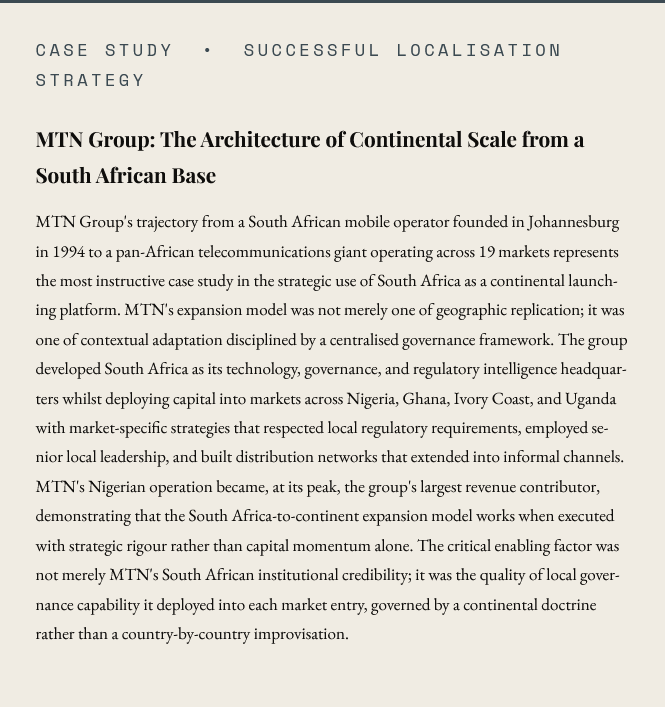
For companies that have successfully established their South African operations with the strategic discipline described above, the AfCFTA represents the single most consequential commercial multiplier available. South Africa has completed its schedule of tariff concessions under the AfCFTA, placing it among the 25 countries that have fulfilled this critical step, and has already begun trading under AfCFTA rules. The continental expansion phase requires a second doctrinal document: a sub-regional strategy that determines sequencing across SADC, East Africa, and West Africa, structured around supply-chain architecture rather than geographic proximity alone, and governed by a continental operations function with the authority, mandate, and budget to execute independently of the South Africa headquarters.
Regulatory & Governance Intelligence
BBBEE as Competitive Architecture: The Strategic Gift That Naïve Entrants Treat as a Compliance Tax

Broad-Based Black Economic Empowerment is, without exception, the most consequentially misunderstood element of the South African commercial environment. Global companies approach BBBEE as a compliance burden, a regulatory tax imposed by government upon the efficiency of commerce, a structural friction to be managed at minimum cost. This framing is not merely strategically primitive; it is commercially self-defeating. The companies that have built enduring competitive positions in South Africa have done the opposite: they have treated BBBEE as a strategic architecture, using ownership structuring, skills development investment, preferential procurement, and enterprise supplier development as instruments of market access, stakeholder loyalty, regulatory goodwill, and competitive differentiation. The distinction between treating BBBEE as a cost and treating it as an asset is the distinction between a company that perpetually operates at the margins of the South African market and one that commands it.
Consider the operational reality: major South African corporates, government entities, and state-owned enterprises make procurement decisions explicitly conditioned upon supplier BBBEE scorecards. A global company that enters South Africa without an optimised BBBEE structure is, by definition, excluded from a significant portion of the procurement market before it has made a single sales call. Furthermore, as Operation Vulindlela deepens its programme of governance reform at the municipal level, with eight major cities including Johannesburg, Tshwane, and Cape Town supported by a $925 million World Bank loan programme to drive institutional performance improvements, the procurement of goods and services by municipalities operating under improved governance frameworks will increasingly favour suppliers with demonstrably credible BBBEE profiles. The company that invests in its BBBEE architecture today is not merely complying with today's requirements; it is pre-positioning for tomorrow's procurement opportunities.
The practical architecture of a credible BBBEE strategy for a global market entrant consists of five interlocking levers. The first is ownership, specifically the structuring of a genuine, empowered black shareholding at a level that is both commercially meaningful and compliant with sector-specific codes. The second is management control, ensuring that the senior leadership of the South African entity includes black executives with operational authority rather than representational titles. The third is skills development, the allocation of a defined percentage of the payroll to training and development that directly builds the skills of black employees, including at the learnship and apprenticeship level. The fourth is enterprise and supplier development, the deliberate investment in and mentorship of black-owned suppliers within the company's value chain. The fifth is socio-economic development, the direction of a proportion of net profit after tax towards community and social investment that is verifiable, impact-measured, and aligned with the company's industry.
Consumer Intelligence & CMO-Level Strategy
Decoding the South African Consumer: A Market That Rewards the Contextually Literate
South Africa's consumer market is one of the most structurally complex in the world, not because its consumers are inaccessible but because they are profoundly contextual. The South African consumer simultaneously inhabits multiple economic and cultural registers: a person may be employed in the formal economy, live in a township, use mobile money for daily transactions, access premium digital content via smartphone, purchase food at a spaza shop, and aspire to brands that signal international sophistication. No single marketing framework captures this range. The CMO of a global company entering South Africa faces a demand challenge of rare sophistication: to speak simultaneously to the aspirant, the pragmatist, the value-maximiser, and the brand-conscious consumer, all of whom may coexist within the same household. The companies that have solved this challenge have done so not through clever campaign work alone but through structural consumer intelligence: deep, longitudinal research into household economics, social dynamics, and purchasing triggers that is updated continuously rather than conducted once at the point of market entry.
The digital dimension of the South African consumer market adds a further layer of strategic complexity that many global entrants underestimate. South Africa is one of the most digitally engaged societies on the African continent, with among the highest rates of social media penetration in the region. Yet digital access is profoundly unequal: broadband infrastructure remains stronger in metropolitan areas, whilst mobile data costs, despite recent reductions following the Competition Commission's intervention, continue to constrain data consumption at the lower end of the income distribution. The implication for digital go-to-market strategy is precise: a mobile-first, data-light approach is not optional; it is mandatory for any brand seeking to reach beyond the top income quintile. WhatsApp, as both a communication and an informal commerce platform, commands an engagement rate that no other digital channel in South Africa approaches. Brands that have built WhatsApp-native engagement strategies, including automated customer service, content delivery, and transactional capability, have achieved consumer intimacy that traditional digital channels cannot replicate at comparable cost.
Continental Expansion Intelligence
The AfCFTA Playbook: How to Convert a Trade Agreement Into a Revenue Architecture
The African Continental Free Trade Area is the most consequential trade architecture to emerge from any developing region in the twenty-first century, and its implications for global companies operating in South Africa are simultaneously strategic, operational, and reputational. To understand the AfCFTA merely as a tariff-reduction agreement is to miss its fundamental significance. It is an institutional project of continental economic integration that, at full maturity, will create a single market of 1.4 billion consumers, eliminate duties on 90 per cent of goods traded among member states, establish common investment rules, and, through the Pan-African Payment and Settlement System, enable cross-border trade in local currencies without the exchange-rate friction that has historically penalised intra-continental commerce. For a global company operating in South Africa, the AfCFTA is not a policy document; it is a commercial infrastructure through which the investment made in mastering South Africa compounds across 54 additional markets.
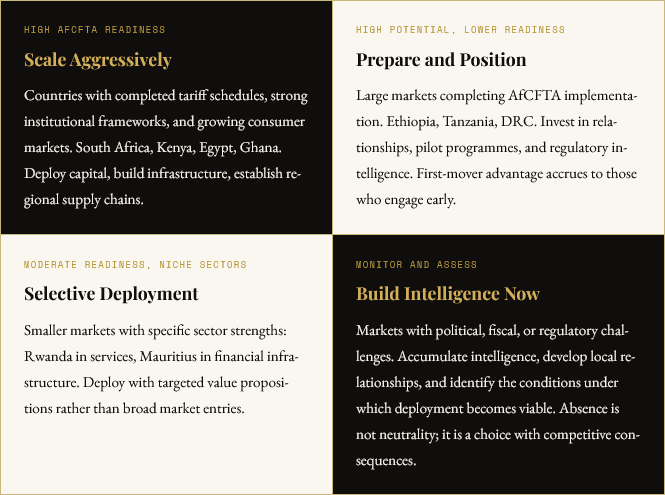
The strategic design of an AfCFTA-leveraged expansion requires three architectural decisions that must be made before the expansion phase commences. The first is supply-chain design: which of the company's products or product components can be manufactured or processed in South Africa under rules of origin that qualify them for preferential tariff treatment in other AfCFTA member states? South Africa's industrial capacity in automotive components, agro-processing, pharmaceuticals, and business services makes it a credible production platform for multiple categories of goods. The second decision is market-cluster sequencing: the AfCFTA zone is not equally accessible from day one. Countries that have completed both the ratification of the agreement and the finalisation of their schedules of tariff concessions, a group that now includes South Africa, Nigeria, Egypt, Kenya, and 21 other states, represent the first tier of accessible markets. The third decision is governance architecture: which organisational model should govern continental operations: a Johannesburg-based hub with country subsidiaries, a networked federation with regional hubs, or a matrix structure that balances global brand standards with local commercial autonomy?
The practical application of an AfCFTA strategy demands a level of trade facilitation intelligence that most multinational organisations do not yet possess internally. Rules of origin compliance is technically demanding and varies by product category; the automotive and textile sectors, for instance, remain areas where final rules of origin negotiations have not been concluded, creating operational uncertainty for companies in those industries. Non-tariff barriers, including duplicative customs documentation, informal border levies, and inconsistent regulatory interpretation, continue to add cost and delay to intra-African trade flows, with logistics costs at times consuming up to 40 per cent of the cost of goods traded between African nations. Companies serious about AfCFTA leverage must invest in trade facilitation expertise, either through internal capability development or through engagement with specialised advisory firms and the expanding ecosystem of digital trade platforms that are digitising customs procedures, origin certification, and payment settlement across continental corridors.
Technology, AI, and Innovation Ecosystems
The Digital Frontier: How Artificial Intelligence and Fintech Are Rewriting Africa's Commercial Grammar
The single most consequential misperception about African markets held by global technology companies is that digital infrastructure is a constraint rather than an opportunity. Africa did not inherit the rigid legacy technology architecture of developed economies; it leapfrogged it. Mobile money, exemplified by M-Pesa's transformation of financial services across East Africa and its increasing influence on southern African commerce, is not a workaround for the absence of banking infrastructure; it is a superior payments system that has rendered traditional retail banking architectures partially obsolete for the populations that matter most to growth. South Africa's fintech sector, anchored by players including Yoco, Jumo, and a growing cohort of embedded-finance companies, is building financial infrastructure that bypasses the cost and access barriers of traditional banking whilst creating data ecosystems of extraordinary richness for commercial intelligence.
Artificial intelligence is not a future consideration for companies entering South Africa; it is a present competitive requirement. The companies succeeding in South African consumer markets are deploying AI across customer segmentation, supply-chain optimisation, demand forecasting, credit-scoring for previously unbanked consumers, and hyper-personalised marketing at a scale and specificity that manual processes cannot match. The particular opportunity in South Africa and the broader African context is that AI can address the structural information asymmetries that have historically made market intelligence expensive and unreliable: satellite imagery for agricultural yield forecasting, mobile transaction data for consumer income profiling, natural language processing for eleven-language consumer sentiment analysis, and computer vision for informal trade outlet mapping. These are not experimental applications; they are operational deployments being executed today by the most sophisticated operators in the market, and they create data moats that are as defensible as any physical asset.
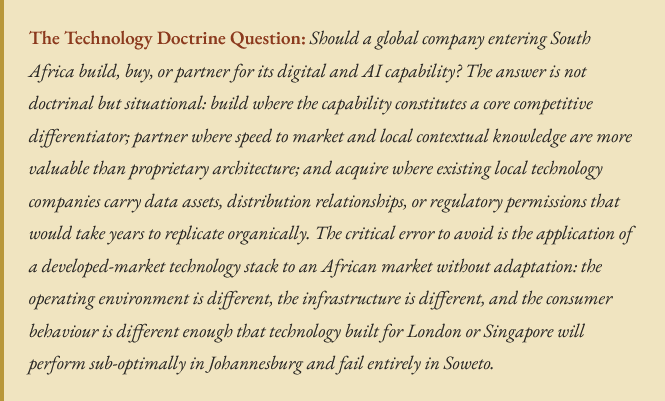
Cape Town's technology ecosystem deserves particular strategic attention as a global company selects its South African base of operations. The city has cultivated a concentration of engineering talent, venture capital, and international technology partnerships that is disproportionate to its population size. Companies including Amazon Web Services, which selected Cape Town for one of its African data centre regions, and a growing number of European and North American technology firms that have established African innovation outposts in the city, recognise that Cape Town's combination of world-class universities, an internationally mobile talent pool, high quality of life, and growing fibre infrastructure creates an innovation environment that compounds over time. For a global company with technology at the centre of its go-to-market model, establishing its African innovation function in Cape Town whilst locating its commercial headquarters in Johannesburg, where corporate relationships, financial institutions, and continental connectivity are strongest, is a dual-city architecture that many sophisticated entrants are already deploying.
Talent Strategy and Leadership Intelligence
The Talent Imperative: Why the Quality of Local Leadership Determines the Ceiling of Continental Ambition
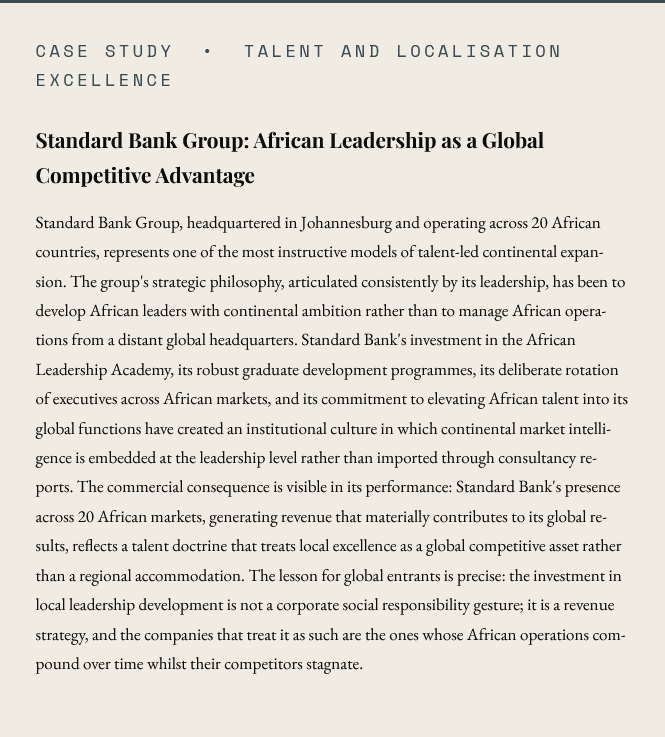
Every global company that has failed in South Africa has, upon forensic examination, made the same fundamental error: it underinvested in local leadership. The expatriate management model, compelling on the surface for its apparent security and institutional continuity, is a liability in the South African commercial environment for reasons that are structural rather than sentimental. The South African market requires leadership that possesses not merely professional competence but cultural fluency, regulatory navigation capability, stakeholder relationship depth, and the institutional trust of communities, unions, and government interlocutors that can only be built through presence, time, and demonstrated commitment. An expatriate executive, however talented, arrives without these assets and must spend the most valuable months of the market entry building them from zero, a cost that is invariably underestimated in the business case and consistently overrun in practice.
The counterargument, that local talent with the required seniority is scarce in South Africa, is both partially accurate and strategically insufficient. It is accurate in the sense that the combination of executive leadership capability, international commercial exposure, and South African market depth is genuinely rare; it is insufficient because the appropriate response to talent scarcity is investment in talent development, not the importation of talent that does not understand the market. The strategic talent model for a credible South African market entry consists of four elements: the appointment of a South African CEO with genuine operational authority and a direct line to the global board; the construction of a senior leadership team in which local executives hold at least two-thirds of the substantive roles; an aggressive graduate recruitment and development programme linked to the company's BBBEE skills development commitments; and the creation of a succession planning framework that makes visible, to the organisation and to external stakeholders, the pathway through which local leaders will ascend to continental and global roles over a defined horizon.
Implementation Pathways and Practical Solutions
The Implementable Architecture: Specific Solutions for Specific Challenges, Not Generic Frameworks for Comfortable Boardrooms
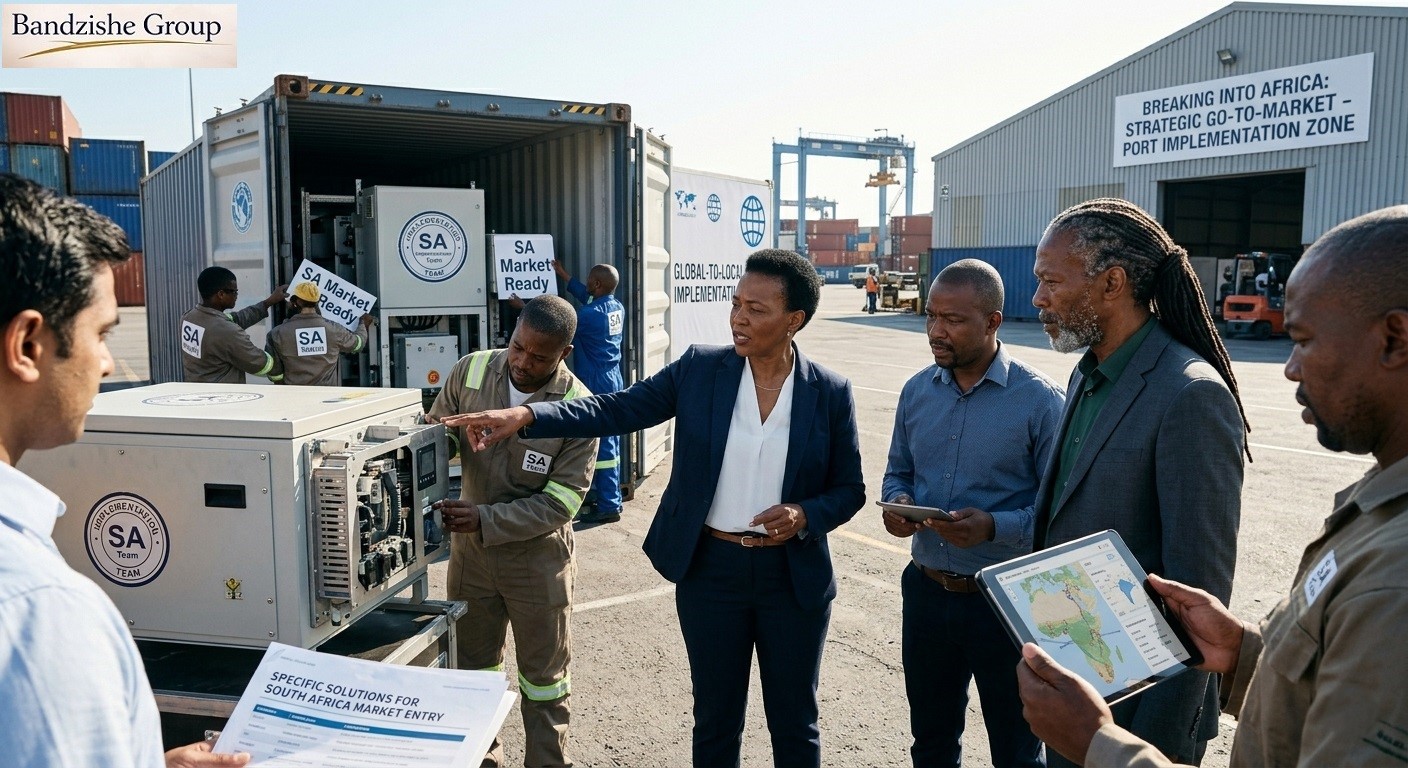
Strategic doctrine without implementable pathways is intellectual theatre. The following solutions are not aspirational principles; they are specific, deployable actions that address the structural challenges facing global companies at each stage of South African and continental market entry, informed by verified commercial experience and calibrated to the realities of the regulatory, economic, and competitive environment as it exists in 2026.
For South African companies seeking to internationalise via the AfCFTA, the first implementable action is rules-of-origin certification: engaging with the South African Revenue Service and the dtic to map which of the company's products qualify for AfCFTA preferential treatment and establishing internal compliance processes that enable certificates of origin to be issued routinely rather than on an ad hoc basis. This sounds technical; the commercial consequence is not. It is the difference between accessing a tariff-free continental market and competing in it at a structural cost disadvantage.
For global companies entering South Africa for the first time, the single most implementable and highest-return first investment is in local strategic intelligence, specifically the commissioning of a South African-led market intelligence programme that goes substantially beyond the desk research and analyst reports that most corporate strategy functions regard as adequate. The minimum acceptable intelligence programme for a serious market entry includes: twelve months of primary consumer research covering at least three income quintiles and three geographic typologies, a regulatory deep-dive conducted by South African counsel with sector-specific expertise, a competitive intelligence mapping exercise that includes informal-market operators as well as formal competitors, and a stakeholder mapping exercise that identifies the government, regulatory, labour, and community actors whose engagement or alienation will determine the company's licence to operate. The cost of this intelligence programme is invariably less than 1 per cent of the capital that will subsequently be committed to the market; the cost of entering without it is invariably multiples of the initial investment.
For companies already operating in South Africa and seeking to activate their AfCFTA continental strategy, the most consequential practical action is the establishment of a dedicated AfCFTA commercial function: a small, senior team with a mandate to identify the company's three to five highest-priority continental expansion markets, design the regulatory and supply-chain architecture for entry into each, and own the stakeholder relationships with the AfCFTA Secretariat, the dtic, and the national single windows of target markets. This function must report to the CEO rather than to a regional director, because the continental expansion decision is a board-level strategic commitment, not a divisional initiative. It must be funded as an investment rather than as a departmental overhead, because its financial returns operate on a five to ten year horizon rather than the twelve-month performance cycle to which most divisional budgets are tied.
Risk Intelligence and Structural Resilience
Controlled Volatility: Managing the Structural Risks That Separate Committed Operators from Opportunistic Entrants
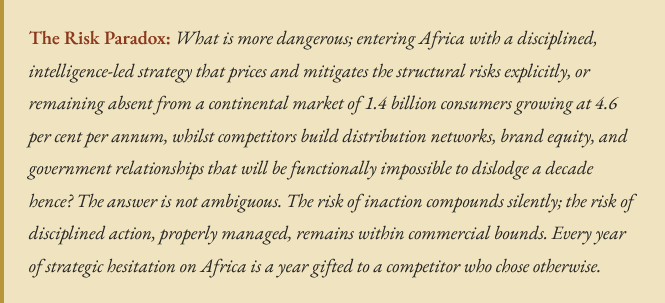
Africa is not a risk-free commercial environment. To claim otherwise would be intellectually dishonest and strategically irresponsible. The question is not whether risk exists; it is whether the structure of that risk, when properly mapped, managed, and priced, is consistent with the generation of returns that justify the capital committed. The evidence suggests, with considerable force, that it is. During the period 2006 to 2011, the African region yielded an average return on foreign direct investment exceeding 11 per cent, outperforming Asia at 9.1 per cent and Latin America at 8.9 per cent. FDI flows to Africa, after reaching a record $80 billion in 2021, stabilised at $53 billion in 2023, sustained by renewable energy, business services, and technology investments that reflect a structural diversification away from the extractive-industry dependency that once characterised African FDI. The risk profile is not merely manageable; it has generated, historically, superior returns to markets that are conventionally regarded as more stable. The company that uses risk as a reason not to engage with Africa has, in effect, chosen the risk of competitive irrelevance over the risk of structured market entry, and the former is, by any measure, the more damaging long-term exposure.
South Africa's specific risk architecture in 2026 includes five dimensions that a serious market entrant must map explicitly. Currency risk: the rand is one of the world's most volatile major currencies, and revenue generated in rand translates to global income at exchange rates that fluctuate significantly. The mitigation is not currency speculation but structural hedging, local reinvestment of rand earnings in rand-denominated assets, and the design of pricing models that are robust across a defined exchange-rate range. Political economy risk: South Africa's Government of National Unity, formed following the 2024 elections, represents an unprecedented coalition dynamic that creates both political stability through broad consensus and occasional policy uncertainty through coalition negotiation. Energy infrastructure risk: whilst the electricity reform programme has materially reduced load-shedding from its peak levels of 2022 to 2023, the grid remains vulnerable, and any company establishing a manufacturing or data-intensive operation in South Africa must invest in independent power generation capacity as a strategic, rather than contingent, asset. Logistics infrastructure risk: the freight rail and port system's continued recovery from its multi-year deterioration remains operationally uncertain in the near term, though the private-sector participation reforms create a medium-term trajectory that is demonstrably improving. Finally, labour relations risk: South Africa's labour market is governed by a legislative framework that strongly protects employee rights and empowers organised labour; any company that underestimates the strategic importance of labour relations management in its South African operations will encounter disruptions that are both commercially costly and reputationally damaging.
Strategic Conviction and Decision Under Consequence
Africa Does Not Wait: The Irreversible Logic of Committed Entry and the Permanent Cost of Prolonged Delay

The argument of this doctrine can be stated with precision: Africa's commercial moment is not approaching; it is in progress. The AfCFTA's $3.4 trillion combined market is not a projection to be validated; it is an institutional architecture already operational across 25 countries, with South Africa among its most advanced participants. The IMF's upward revision of South Africa's 2026 growth forecast, the country's exit from the FATF grey list, its two consecutive years of primary budget surpluses, its private-sector rail access programme, and its $925 million World Bank municipal reform partnership collectively constitute a reform signal of rare coherence: an economy that has chosen, deliberately and at institutional cost, to reconstruct its commercial credibility. The global company that chooses to interpret these signals as insufficient has set a standard of certainty that no emerging market, at any point in history, has ever been able to meet before the window of first-mover advantage closed.
The doctrine advanced here does not ask global companies to be naive about Africa's complexities; it demands that they be rigorous about its opportunities. Complexity and opportunity are not opposites; in high-growth markets, they are the same phenomenon experienced from different intellectual positions. The companies that understood China in the 1990s before institutional certainty arrived, that entered India before its regulatory frameworks were clean, that built positions in Southeast Asia before the ASEAN architecture matured, did not do so because those markets were easy. They did so because their leadership possessed the institutional courage to act on structural evidence before consensus caught up with reality. Africa in 2026 is that market. The structural evidence is present. The institutional progress is documented. The competitive window, whilst still open, is narrowing as each successive quarter brings additional global capital to the continent and each additional global entrant into the South African market reduces the first-mover premium available to those who act now.
The African continent, and South Africa in particular, does not owe any global company a second chance at the access conditions that exist today. Markets that wait for perfection discover, invariably, that perfection arrives simultaneously with competition so well-established that market penetration costs a multiple of what early entry would have required. The corporations positioned to define the next generation of African commerce are not those deliberating in quarterly strategy cycles; they are those already executing, already building, already embedding the institutional relationships, local talent networks, and consumer intelligence that constitute genuine and durable competitive advantage. They are, in other words, already inside the market that others are still studying from the outside, and the distance between those two positions, measured in time, capital efficiency, and competitive durability, is precisely the cost of prolonged hesitation.
Images by Bandile Ndzishe of Bandzishe Group
About bandile ndzishe

Bandile Ndzishe is the CEO, Founder, and Global Consulting CMO of Bandzishe Group, a premier global consulting firm distinguished for pioneering strategic marketing innovations and driving transformative market solutions worldwide. He holds three business administration degrees: an MBA, a Bachelor of Science in Business Administration, and an Associate of Science in Business Administration.
With over 30 years of hands-on expertise in marketing strategy, Bandile is recognised as a leading authority across the trifecta of Strategic Marketing, Daily Marketing Management, and Digital Marketing. He is also recognised as a prolific growth driver and a seasoned CMO-level marketer.
Bandile has earned a strong reputation for delivering strategic marketing and management services that guarantee measurable business results. His proven ability to drive growth and consistently achieve impactful outcomes has established him as a well-respected figure in the industry.
As an AI-empowered and an AI-powered marketer, I bring two distinct strengths to the table: empowered by AI to achieve my marketing goals more effectively, whilst leveraging AI as a tool to enhance my marketing efforts to deliver the desired growth results. My professional focus resides at the nexus of artificial intelligence and strategic marketing, where I explore the profound and enduring synergy between algorithmic intelligence and market engagement.
Rather than pursuing ephemeral trends, I examine the fundamental tenets of cognitive augmentation within marketing paradigms. I analyse how AI's capacity for predictive analytics, bespoke personalisation, and autonomous optimisation precipitates a transformative evolution in consumer interaction and brand stewardship. By extension, I seek to comprehend the strategic applications of artificial intelligence in empowering human capability and fostering innovation for sustainable societal advancement.
In essence, I explore how AI augments human decision-making and strategic problem-solving in both marketing and other domains of life. This is not merely an interest in technological novelty, but a rigorous investigation into the strategic implications of AI's integration into the contemporary principles of marketing practice and its potential to reshape decision-making frameworks, rearchitect strategic problem-solving paradigms, enhance strategic foresight, and influence outcomes in diverse areas beyond the marketing sphere.