

South Africa enters 2026 not with a whisper, nor with the false bravado of a speculative upswing, but with a fact that unsettles entrenched assumptions. The economy is no longer defined primarily by crisis management. It is defined by a narrowing window of strategic choice. A new inflation target of 3% has reset the monetary anchor. Energy supply has stabilised sufficiently to remove electricity from the daily vocabulary of corporate risk registers. Growth, modest yet credible, is projected to approach 1.8 %. The provocation is unavoidable.
The International Monetary Fund’s January Economic Outlook estimates that South Africa’s economy grew by 1.3% in 2025, with early projections for 2026 converging at approximately 1.4%, consistent with forecasts published by the World Bank and the South African Reserve Bank. Growth is expected to remain constrained, clustering between 1.4 and 1.5%, with upside potential approaching 1.8% only if recent gains in energy stability and monetary credibility are converted into execution at scale. Put differently, while most forecasts remain anchored around 1.4 to 1.5%, South Africa now possesses the ingredients for growth closer to 1.8%, but only if credibility is converted into execution rather than absorbed into complacency.
Is this the beginning of a reconstituted growth model, or merely an interlude of relief before structural gravity reasserts itself? The answer is not academic. It is decisive. South Africa stands at a decisive juncture in 2026, a moment that demands the attention of global leaders, CEOs, and billionaires who understand that the fate of one of the world’s most strategically positioned economies reverberates far beyond its borders. The country is not merely adjusting to cyclical fluctuations; it is undergoing a structural metamorphosis that will redefine its medium-term growth trajectory. The question is not whether South Africa will pivot, but whether the world’s elite decision-makers will recognise the scale of this transformation and act accordingly. Can any serious investor afford to ignore the convergence of structural reforms, technological adoption, and geopolitical repositioning that is reshaping the nation’s economic destiny? The answer is unequivocal: no.
This article serves as the definitive autopsy of the old stagnation and the birth certificate of a new, high-performance era. It is a summons to the percipient investor to recognise that the structural and cyclical forces currently at play are not merely additive; they are transformative. To ignore this moment is to misunderstand the mechanics of modern geopolitical and economic resurgence.
This Is the Definitive 2026 Economic Pivot: South Africa Weaponises Its Challenges as Catalysts for a Sophisticated Industrial and Fiscal Rebirth
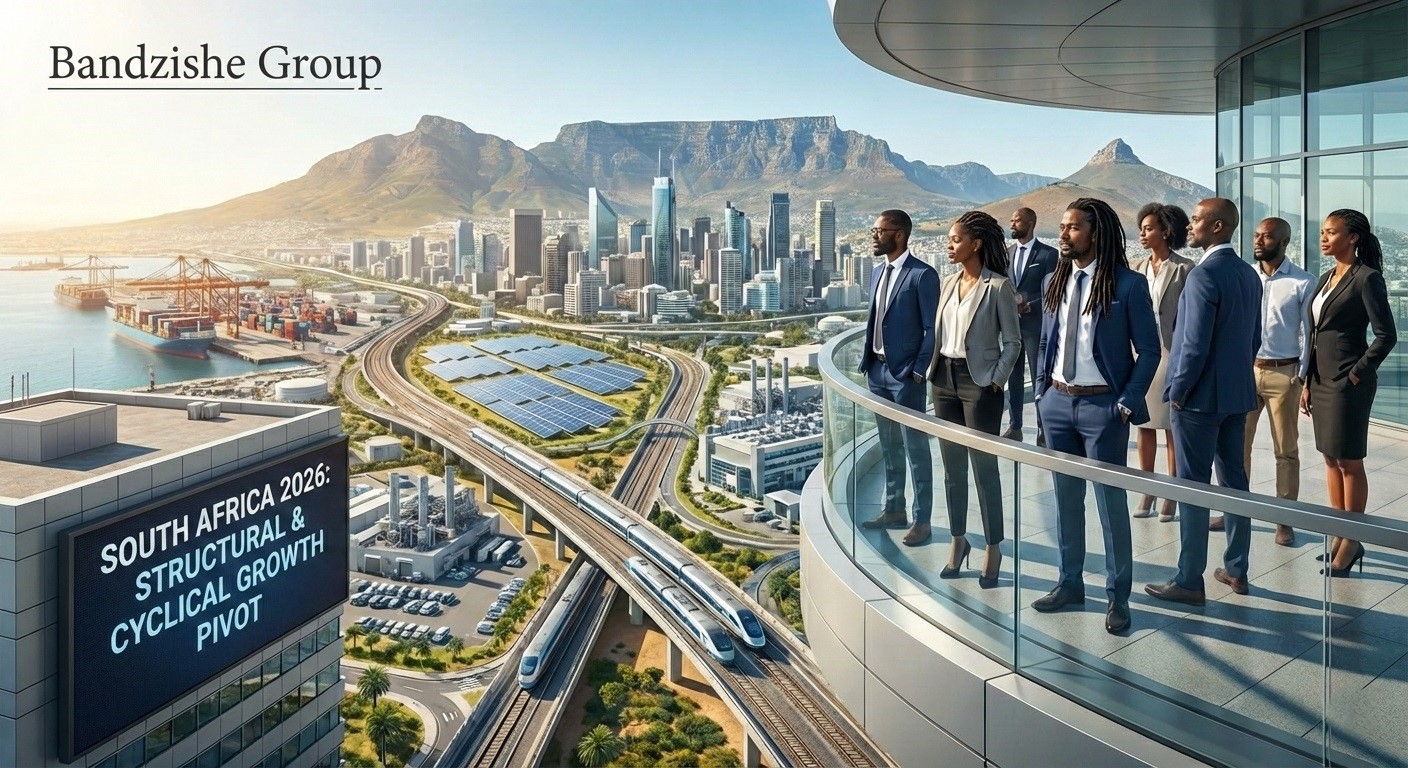
The era of South African inertia has reached its terminal conclusion; those who continue to bet against the resilience of this republic are operating on data that is not merely obsolete but dangerously deceptive. We are currently witnessing a tectonic realignment of the national trajectory that transcends the superficialities of political rhetoric or the ephemeral fluctuations of sentiment. This is the definitive 2026 economic pivot; it is a calculated and unsentimental reconstruction of the very foundations upon which the sub-Saharan hegemon stands. For the global elite, from the sovereign wealth fund managers in Riyadh to the technology lords of Silicon Valley, the message is singular and piercing: the discount on South African risk is closing with a speed that will leave the hesitant in a state of permanent regret. We are no longer discussing a nation merely surviving the shadow of its own history; we are analysing a state that has begun to weaponise its challenges as catalysts for a sophisticated industrial and fiscal rebirth. The convergence of a stable Government of National Unity, the aggressive pursuit of a three per cent inflation target, and the systematic dismantling of state monopolies in energy and logistics has created a structural momentum that is now irreversible.
The Unfolding Inflection: Why South Africa’s Trajectory Matters Now
South Africa’s current trajectory matters now because inflection points are rare, unforgiving, and indifferent to rhetoric. When monetary credibility, energy stability, and institutional reform briefly align, history shows that outcomes are determined not by intent but by execution speed, capital discipline, and policy coherence. Delay converts opportunity into inertia. Miscalculation hardens fragility into structure. What is unfolding is therefore not a cyclical recovery to be observed, but a narrow strategic window to be seized, one that will determine whether South Africa repositions itself as a credible emerging market allocator of capital or settles back into managed underperformance. The choice is immediate, and the consequences will compound for a decade.
The Monetary Reset as a Credibility Signal of Fiscal Sophistication: Why the 3% Inflation Target Changes the Conversation

Is it possible that the most potent weapon in the South African arsenal is not its mineral wealth, but rather the uncompromising independence of its central bank? The South African Reserve Bank has recently formalised its commitment to a three per cent inflation target; a move that signals a profound shift toward the highest standards of international monetary orthodoxy. This is not merely a technical adjustment; it is a declaration of war against the erosive effects of price instability on the long-term purchasing power of both citizens and investors. By anchoring inflation expectations at this lower level, the central bank is effectively reducing the structural cost of capital for every corporation operating within our borders. This policy ensures that the South African Rand remains a credible store of value in an increasingly volatile global currency market. The commitment to such a stringent target requires a level of intellectual fortitude that is rare in emerging markets; it demonstrates a willingness to endure short-term discomfort for the sake of enduring prosperity.
Global billionaires and institutional leaders understand that a low inflation environment is the ultimate soil for sustainable growth. It encourages domestic savings, attracts foreign direct investment, and provides a predictable framework for large-scale infrastructure projects. The monetary authorities are not merely managing a currency; they are architecting an environment of absolute fiscal transparency and reliability. This pivot toward a more conservative target is the quintessence of strategic foresight; it positions the republic as a beacon of stability in a world often distracted by the allure of easy money.
The recalibration of South Africa’s inflation target to 3% is not a technical adjustment buried in central bank communiques. It is a declaration of intent. For decades, inflation volatility corroded long-term planning, distorted capital allocation, and embedded a risk premium into every serious business decision. A tighter target reframes expectations across the entire economic system. It signals discipline to global markets, predictability to investors, and purchasing power protection to households. More importantly, it forces an uncomfortable but necessary reckoning. Monetary credibility now exists. Fiscal and structural credibility must follow, or the signal collapses under its own weight.
In practical terms, this shift alters boardroom behaviour. Firms can now model costs, wages, and returns with greater confidence. Long-term contracts regain meaning. Infrastructure financing becomes marginally cheaper, not because rates magically fall, but because uncertainty recedes. Consider the experience of countries such as New Zealand and Chile, where credible inflation targeting catalysed broader institutional reform rather than substituting for it. The lesson is unequivocal. A central bank can buy time, but it cannot buy growth. That responsibility rests with political leadership and corporate strategy. The rhetorical question, therefore, sharpens. Will South Africa leverage this credibility dividend, or squander it through fiscal drift and reform fatigue? The answer will determine whether 2026 is remembered as a pivot, or as a pause.
The Renaissance of Institutional Integrity: Orchestrating a Permanent Departure from Systemic Stagnation
Can a nation once synonymous with institutional decay truly orchestrate a symphonic recovery that satisfies the exacting standards of global capital? The answer lies not in hopeful optimism but in the empirical evidence of a governance model that has prioritised pragmatic efficiency over ideological purity. The Government of National Unity has functioned as a grand experiment in radical centrisms; it has effectively sidelined the populist fringes that previously threatened the sanctity of property rights and fiscal discipline. This political stability is the indispensable prerequisite for the structural reforms currently being executed under the formidable banner of Operation Vulindlela. By insulating technical decision-making from the vagaries of partisan skirmishes, the state has regained the trust of the most sceptical C-suite executives and international rating agencies. The recent positive outlook revisions from global credit agencies are not merely symbolic; they are a recognition of a disciplined fiscal path that targets a primary surplus while aggressively reducing the debt-to-GDP ratio.
We are witnessing the professionalisation of the public service; a transition from a patronage-based bureaucracy to a meritocratic administration that understands the urgency of global competition. This institutional renaissance is the anchor that prevents the cyclical winds from capsizing the national ship. It provides the necessary gravitas for South Africa to act as the primary interlocutor for the African Continental Free Trade Area. The strategic clarity of this administration is a testament to the fact that when survival is at stake, intelligence and courage inevitably triumph over recalcitrance and dogma.
Energy and Logistics Liberalisation and Stabilisation as Economic Multipliers: Dismantling Sclerotic Monopolies to Unleash Private Sector Dynamism

What occurs when the chains of state-led inefficiency are finally shattered by the hammer of private sector participation? We are observing the radical unbundling of Eskom and Transnet, a process that is recasting the South African industrial landscape with the precision of a master sculptor. The establishment of a competitive wholesale electricity market is already attracting billions in private investment, primarily in renewable energy sources that are decentralising power generation. No longer is the national economy a hostage to the failings of a single state entity; it is now becoming a multi-nodal network of efficient and agile energy producers. This transition is not merely about keeping the lights on; it is about creating a comparative advantage in the green hydrogen and critical minerals sectors.
Few variables have exacted as much economic damage as unreliable electricity. Its stabilisation is therefore not merely a relief; it is a structural release. When energy ceases to dominate executive agendas, cognitive bandwidth returns to strategy, innovation, and expansion. Factories operate at capacity. Data centres scale without contingency clauses. Logistics networks regain rhythm. This is not theoretical. Since energy supply stabilisation, South African manufacturers have reported improved utilisation rates and reduced operating volatility. These gains are modest but compounding.
Yet energy stability is not the prize. It is the platform. The strategic opportunity lies in what is built upon it. Global precedents are instructive. Germany’s post crisis energy restructuring did not aim merely to keep the lights on. It sought to rewire industrial competitiveness around resilience and efficiency. Vietnam leveraged energy reliability to attract advanced manufacturing, embedding itself deeper into global value chains. South Africa now faces a similar choice. Will energy stability simply normalise underperformance, or will it underpin a new industrial logic anchored in beneficiation, advanced services, and export sophistication? For corporate leaders, the tactical implication is clear. Capital expenditure deferred during the energy crisis must now be redeployed with intent, not caution. Waiting for perfect conditions is no longer prudence. It is strategic abdication.
Similarly, the introduction of private rolling stock on the national rail network is beginning to alleviate the logistical bottlenecks that have long stifled the mining and agricultural industries. We can draw a compelling parallel with the infrastructure boom in Vietnam, where the state strategically opened key sectors to international operators to drive export-led growth. South Africa is now following a similar trajectory; invite the world’s most efficient operators to manage our ports and railways under rigorous concession agreements. This is the practical application of lateral thinking; solving the problem of state capacity by leveraging the vast resources and expertise of the global market. The result is a logistics system that is becoming responsive to the needs of the twenty-first century rather than being anchored in the failures of the twentieth.
Growth at 1.8% as a Strategic Mirror: Why Modest Numbers Demand Radical Thinking
A projected growth rate of up to 1.8% does not invite celebration. It invites honesty. Such growth is insufficient to absorb labour, expand fiscal space, or materially reduce inequality. Yet it is sufficient to reveal underlying truths. The economy can grow when constraints ease. The question is why it cannot grow faster, and what prevents momentum from compounding.
This is where structural and cyclical forces intersect. Cyclically, global financial conditions remain tight, and geopolitical fragmentation constrains trade. Structurally, South Africa grapples with logistics inefficiencies, skills mismatches, and policy inconsistency. These are not mysteries. They are managerial failures at a national scale. The elite question, therefore, becomes uncomfortable. If growth remains anaemic even after monetary credibility and energy stability, what excuses remain? None that serious leaders can accept.
Practical solutions exist. Port efficiency can be transformed through targeted private participation, as demonstrated in the Durban pilot concessions. Skills bottlenecks can be alleviated through employer-led training compacts, as already proven in select automotive clusters. Regulatory clarity can be accelerated through sunset clauses that force policy decisions rather than defer them. Growth is not constrained by imagination. It is constrained by execution. That distinction matters.
Cyclical Catalysts: The Rhythm of Global Markets and Domestic Resilience

Cyclical forces are equally compelling. Commodity prices, particularly for platinum, palladium, and manganese, are buoyant, offering South Africa a short-term windfall. Yet the true test lies in whether these cyclical gains are channelled into long-term structural investments. Inflationary pressures, driven by global supply chain disruptions, are moderating, while interest rates are stabilising, creating a window of opportunity for capital-intensive projects. The cyclical upswing in tourism, bolstered by a weaker rand, is revitalising service industries. But will South Africa convert these cyclical advantages into enduring structural strength? The answer depends on disciplined fiscal management and strategic foresight.
Technology and Innovation: The Decisive Lever for Transformation
Technology adoption is no longer optional; it is existential. South African firms are embracing artificial intelligence, blockchain, and advanced manufacturing to leapfrog legacy inefficiencies. Case in point: Cape Town’s fintech ecosystem, which has attracted global venture capital and is now exporting solutions to emerging markets across Africa and Asia. Johannesburg’s mining sector is deploying automation and data analytics to enhance safety and productivity, transforming a historically labour-intensive industry into a technologically sophisticated enterprise. The lesson is clear: those who invest in South Africa’s technological pivot will not merely capture returns; they will shape the future of African innovation.
Structural Reform as Competitive Strategy: Turning Policy into Performance

Structural reform is often discussed as a moral obligation or a political burden. This framing is fatal. Reform must be repositioned as a competitive strategy. In a world where capital is mobile and attention is scarce, countries compete not on rhetoric but on friction. The less friction an economy imposes on enterprise, the more attractive it becomes.
South Africa’s opportunity lies in selective excellence rather than comprehensive overhaul. Logistics, digital infrastructure, and energy market design are the high-leverage nodes. Reform them decisively, and secondary benefits cascade. Consider the case of Rwanda, which transformed its investment climate not by fixing everything, but by fixing what mattered most to investors. Or Ireland, which aligned tax policy, education, and industrial strategy into a coherent growth narrative. South Africa does not lack policy documents. It lacks ruthless prioritisation.
For corporate leaders, this demands engagement beyond lobbying. It requires partnership. Several South African firms have already demonstrated this model by co-investing in training academies and infrastructure solutions that serve both private and public interests. These are not acts of altruism. They are investments in operating environments. The return is resilience.
South Africa’s Global Positioning and Strategic Role in a Fractured World: Why Timing Matters More Than Ever
The global economy in 2026 is defined by fragmentation, technological acceleration, and demographic divergence. Supply chains are shorter, but more complex. Capital is cautious, but searching for yield. Talent is scarce, but mobile. In this context, South Africa’s relative position is neither predetermined nor irrelevant. It is contested.
South Africa’s geopolitical positioning is critical. As a member of BRICS, it is leveraging alliances with China, India, and Brazil to diversify trade and investment flows. Simultaneously, it is strengthening ties with Western markets through targeted reforms and bilateral agreements. The nation’s role as a bridge between developed and emerging economies is not a rhetorical flourish; it is a strategic reality.
Countries that align domestic reform with global shifts will capture disproportionate gains. Those that hesitate will be bypassed. The rise of artificial intelligence, advanced manufacturing, and green finance creates openings for economies that can offer stability, skills, and scale. South Africa possesses all three in latent form. The missing ingredient is orchestration.
Consider the automotive sector, where German manufacturers are expanding production in South Africa to serve both African and global markets. This dual positioning enhances resilience and creates opportunities for multinational corporations to integrate South Africa into their global supply chains.
Executives I speak with, across sectors and continents, express a consistent refrain. They are not seeking perfection. They are seeking a trajectory. Show credible movement, and capital follows. Stall, and attention shifts elsewhere. The strategic imperative for 2026 is, therefore, narrative discipline grounded in action. The story must be coherent, and the evidence visible.
Case Studies: Lessons from Transformation in Practice

One illustrative case is the renewable energy sector. Independent power producers, supported by regulatory reforms, have deployed solar and wind projects that are now supplying significant portions of national demand. This has reduced reliance on coal, cut emissions, and attracted foreign direct investment. Another case lies in the agricultural sector, where precision farming technologies are boosting yields and enabling exports to high-value markets in Europe and Asia. These examples demonstrate that South Africa’s pivot is not theoretical; it is practical, measurable, and investable.
Private Sector Strategic Gateway for Billionaire Capital: Implementing Solutions for Global Corporations and Local Titans
How should a Fortune 500 CEO or a high-tech lord navigate this new terrain to maximise their strategic footprint? The implementation of a successful South African strategy requires a move away from the traditional model of passive investment toward one of active partnership in the nation’s structural rebirth. For instance, a global technology firm might look to the case study of Teraco, a major international data centre provider that recently established a massive hub in Cape Town. By partnering with local independent power producers to secure a dedicated and green energy supply, they bypassed the traditional risks associated with state utilities. While headquartered in Johannesburg, South Africa, Teraco is considered an international company due to its majority ownership by US-based Digital Realty and its role in connecting global cloud providers to Africa.
Global corporations should also leverage the streamlined work visa systems and digital public infrastructure reforms to attract and retain the world’s best talent within the South African jurisdiction. We offer a unique proposition, a sophisticated financial ecosystem and a robust legal framework situated at the gateway to the fastest-growing continent on earth. The solution for both South African and global companies is to invest in the digital transformation of their supply chains to align with the state’s new emphasis on logistics efficiency.
For instance, for South African companies, the imperative is to embrace technological adoption, invest in skills development, and align with global sustainability standards. For multinational corporations, the opportunity lies in integrating South Africa into global supply chains, leveraging its resource base, and capitalising on its innovation ecosystems. CEOs must ask themselves: can they afford to overlook a market that is simultaneously reforming structurally and benefiting from cyclical tailwinds? The answer is self-evident.
We recommend the establishment of public-private partnerships that focus on high-impact infrastructure, such as the development of smart ports that utilise artificial intelligence for container management. This is not a time for the timid; it is a time for the visionary to secure their position in the next great emerging market success story. Those who act now will define the commercial hierarchy of the next decade, while those who wait for more data will be forced to buy at the peak of the market.
Consider the success of the automotive sector, where manufacturers have integrated themselves into global value chains by adopting the latest automation technologies on South African soil. The practical tactical move is to establish local manufacturing capacity that serves as a hedge against global supply chain disruptions. Leaders must also engage with the local academic community to drive research and development in sectors such as biotechnology and financial technology. The path to dominance in the medium term involves a deep and multifaceted engagement with the South African economy’s new structural realities.
Policy shapers must ensure that fiscal discipline is maintained, regulatory clarity is enhanced, and corruption is decisively addressed. These are not optional measures; they are prerequisites for sustained growth.
Philosophical Reflections: The Deeper Meaning of Economic Transformation
Economic transformation is not merely about GDP growth; it is about redefining the social contract. South Africa’s pivot challenges conventional wisdom about emerging markets. It demonstrates that structural reform, when combined with cyclical opportunity, can create a virtuous cycle of growth and resilience. The philosophical question is profound: can nations reinvent themselves in the face of adversity, and can leaders recognise the moment when transformation is not optional but imperative? South Africa’s answer is resounding: yes.
A National Economic Growth Playbook for 2026 and Beyond: From Diagnosis to Execution

Solution One: Lock Monetary Credibility into Real Economy Behaviour
Problem addressed: Inflation credibility exists at the central bank, but has not yet fully transmitted into pricing behaviour, wage setting, and long-term investment decisions.
Actionable solution: Create formal inflation-anchored contracting frameworks across key sectors.
This means government, SOEs, and major corporates explicitly indexing long-term supplier contracts, wage agreements, and infrastructure concessions to the 3% target rather than legacy inflation expectations. This is not symbolic. It forces behavioural alignment.
Practical example: In New Zealand, post-inflation targeting reform, public sector procurement contracts were rewritten to explicitly reference the new target band. This reset pricing psychology across construction and logistics within two years.
South African application: National Treasury, together with Business Unity South Africa, can convene sector-specific contracting compacts for construction, logistics, and manufacturing. CEOs should insist that procurement teams abandon defensive price padding. Boards should reward executives who convert credibility into cost discipline.
Outcome: Lower embedded inflation expectations, improved capital efficiency, and a measurable reduction in project overruns.
Solution Two: Convert Energy Stability into an Industrial Weapon
Problem addressed: Energy supply has stabilised, but firms are behaving as if instability will imminently return, delaying investment.
Actionable solution: Mandate post-stability capital deployment thresholds.
Large energy-intensive firms should publicly commit to defined capital expenditure triggers once energy availability exceeds a set reliability benchmark for twelve consecutive months. This converts stability into obligation.
Practical example: Vietnam required export manufacturers to reinvest a portion of energy savings into capacity expansion and skills training once grid reliability improved. The result was rapid movement up the value chain.
South African application: Mining houses, data centres, and manufacturers should tie executive incentives to post-stability expansion metrics. The government can accelerate depreciation allowances for capacity added after reliability thresholds are met.
Outcome: Acceleration of fixed investment, productivity gains, and export competitiveness.
Solution Three: Treat Logistics Failure as a Balance Sheet Risk
Problem addressed: Port and rail inefficiencies are discussed politically but not priced corporately.
Actionable solution: Force logistics exposure disclosure.
Require JSE-listed firms above a revenue threshold to disclose logistics dependency risks and mitigation strategies in annual reports. What gets disclosed gets managed.
Practical example: After similar disclosure requirements in Australia’s resources sector, private operators rapidly co-invested in port efficiency solutions to protect shareholder confidence.
South African application: Boards must treat logistics fragility as a strategic risk, not an operational inconvenience. This accelerates private participation in ports and freight corridors without ideological debate.
Outcome: Capital mobilisation into logistics reform, faster turnaround times, lower export leakage.
Solution Four: Replace Skills Policy with Skills Procurement
Problem addressed: Skills shortages persist despite extensive policy frameworks.
Actionable solution: Shift from training incentives to skills purchase agreements.
Instead of subsidising training in the abstract, government and corporates jointly procure defined skill outcomes from training providers, paid only on verified placement.
Practical example: Germany’s dual system works because firms purchase skills, not courses. Payment follows employment, not attendance.
South African application: Automotive and financial services sectors already run pilot versions of this model. Scale it nationally. CEOs should treat skills pipelines as supply chains.
Outcome: Reduced mismatch, faster productivity onboarding, measurable employment outcomes.
Solution Five: Create Reform Sandboxes for Speed
Problem addressed: Policy reform is slowed by the need for universal consensus.
Actionable solution: Establish economic reform zones with temporary regulatory exemptions.
Allow ports, energy markets, and digital services to operate under accelerated rules for defined periods. Successful models are then scaled nationally.
Practical example: The United Kingdom used regulatory sandboxes in fintech to attract global capital without rewriting the entire financial code upfront.
South African application: Durban port operations, embedded generation markets, and digital identity systems are ideal sandbox candidates.
Outcome: Rapid experimentation, reduced policy risk, faster national rollout.
Solution Six: Corporate Leadership as System Architect
Problem addressed: Business waits for government certainty; government waits for business confidence.
Actionable solution: Institutionalise co-ownership of reform outcomes.
Create binding public-private performance compacts with published milestones. Missed milestones trigger automatic escalation, not excuses.
Practical example: Ireland’s social partnership agreements aligned unions, business, and government around shared performance targets during structural reform.
South African application: Sector CEOs should publicly sign growth compacts tied to investment, skills, and export targets. Silence must become reputationally costly.
Outcome: Trust rebuilt through delivery, not rhetoric.
Embracing the Future with Uncompromising Strategic Resolve: The Pivot Is Not Automatic, It Is Earned

The central truth is uncomfortable, but unavoidable. South Africa’s constraints are now sufficiently understood that failure to act is no longer a failure of knowledge. It is a failure of will. The most dangerous stance in 2026 is complacent realism. It sounds sensible. It feels prudent. It is fatal. The economy has opened a narrow corridor through which momentum can pass. Whether it does so depends on choices made now, not speeches delivered later.
South Africa’s 2026 economic pivot is neither guaranteed nor illusory. It is conditional. Structural credibility has begun to re-emerge. Cyclical pressures have eased just enough to expose the underlying architecture. The next phase will be unforgiving. It will reward coherence and punish drift. It will amplify good decisions and magnify bad ones.
The challenge to leaders, in boardrooms and cabinets alike, is stark. Act as though this moment matters, because it does. Invest as though trajectory counts, because it does. Reform as though credibility is perishable, because it is. The tools are available. The precedents exist. The credibility window is open, but it is not permanent. Economies do not drift into prosperity. They are driven there by leaders who convert insight into execution before conditions deteriorate again.
History will not judge South Africa by its intentions in 2026. It will judge it by whether this pivot was seized or squandered. The choice is not abstract. It is immediate. And it is decisive.
This article was never intended to be admired. It is intended to be used.
The question for every CEO, minister, investor, and board chair is therefore simple, and merciless. What will you implement in the next ninety days that proves you understood this moment?
History will not wait for consensus. It will only record who moved first.
Images by Bandile Ndzishe of Bandzishe Group
About bandile ndzishe

Bandile Ndzishe is the CEO, Founder, and Global Consulting CMO of Bandzishe Group, a premier global consulting firm distinguished for pioneering strategic marketing innovations and driving transformative market solutions worldwide. He holds three business administration degrees: an MBA, a Bachelor of Science in Business Administration, and an Associate of Science in Business Administration.
With over 30 years of hands-on expertise in marketing strategy, Bandile is recognised as a leading authority across the trifecta of Strategic Marketing, Daily Marketing Management, and Digital Marketing. He is also recognised as a prolific growth driver and a seasoned CMO-level marketer.
Bandile has earned a strong reputation for delivering strategic marketing and management services that guarantee measurable business results. His proven ability to drive growth and consistently achieve impactful outcomes has established him as a well-respected figure in the industry.
As an AI-empowered and an AI-powered marketer, I bring two distinct strengths to the table: empowered by AI to achieve my marketing goals more effectively, whilst leveraging AI as a tool to enhance my marketing efforts to deliver the desired growth results. My professional focus resides at the nexus of artificial intelligence and strategic marketing, where I explore the profound and enduring synergy between algorithmic intelligence and market engagement.
Rather than pursuing ephemeral trends, I examine the fundamental tenets of cognitive augmentation within marketing paradigms. I analyse how AI's capacity for predictive analytics, bespoke personalisation, and autonomous optimisation precipitates a transformative evolution in consumer interaction and brand stewardship. By extension, I seek to comprehend the strategic applications of artificial intelligence in empowering human capability and fostering innovation for sustainable societal advancement.
In essence, I explore how AI augments human decision-making and strategic problem-solving in both marketing and other domains of life. This is not merely an interest in technological novelty, but a rigorous investigation into the strategic implications of AI's integration into the contemporary principles of marketing practice and its potential to reshape decision-making frameworks, rearchitect strategic problem-solving paradigms, enhance strategic foresight, and influence outcomes in diverse areas beyond the marketing sphere.