

The most dangerous illusion in global leadership today is the belief that history rewards intention. It does not. History rewards execution, discipline, and the unglamorous persistence of institutional seriousness. Nations do not rise because they are morally right, nor because they are emotionally compelling, nor because they possess an inspiring story. They rise because they make a sequence of hard decisions and then defend those decisions against sentiment, populism, and fatigue. This article is written for leaders who understand that truth instinctively but rarely see it articulated without euphemism.
It is written for presidents, prime ministers, CEOs, board chairs, and investors who know that the next decade will punish strategic laziness more brutally than any period since the post-war reconstruction. It is written for those who are willing to confront uncomfortable comparisons without retreating into defensiveness. It is written because the world no longer has the luxury of pretending that structural failure is a mystery. It is written because Singapore solved problems that South Africa continues to debate. It is written because reading Lee Kuan Yew today is not an academic exercise but a leadership test. The question is not whether his lessons remain relevant. The question is who is prepared to apply them without compromise.
Beyond a Book Review – A Strategic Briefing for Global Leaders: Why This Book Caught My Attention and Demands Yours
From Third World to First is not a memoir in the sentimental sense, nor is it a nostalgic chronicle of national triumph. It is an operational manual for statecraft written by a man who understood that power without competence is theatrical and competence without power is impotent. What arrests the serious reader is not Singapore’s outcome but its method. Lee Kuan Yew writes with the calm confidence of someone who knew that correctness would eventually defeat popularity. He was not interested in winning applause; he was interested in winning decades. That distinction matters profoundly in an age where leaders confuse visibility with effectiveness.
This book demands attention because it refuses to flatter its reader. It assumes intellectual stamina, moral seriousness, and an appetite for responsibility. It also exposes the comfortable fiction that context excuses failure. Singapore had no natural resources, no hinterland, and no margin for error, yet it built one of the most efficient states in human history.
The uncomfortable implication is obvious. If Singapore could do this under those conditions, what exactly explains persistent dysfunction elsewhere? This is why the book still unsettles. It does not allow leaders to hide behind a narrative. It demands results.
For South Africa, the resonance is immediate. A nation endowed with mineral wealth, human capital, and cultural vibrancy, yet constrained by inequality, governance challenges, and structural inefficiencies, stands at a crossroads. The book demands attention because it demonstrates that leadership, when disciplined, visionary, and uncompromising, can transmute fragility into resilience. The Singaporean story is not a mirror; it is a provocation: will South Africa choose incrementalism, or will it embrace transformation with the same ferocity?
Why Should a Tech Billionaire, a Fortune 500 CEO, a President or a Prime Minister Care About the History of a Tiny Island?
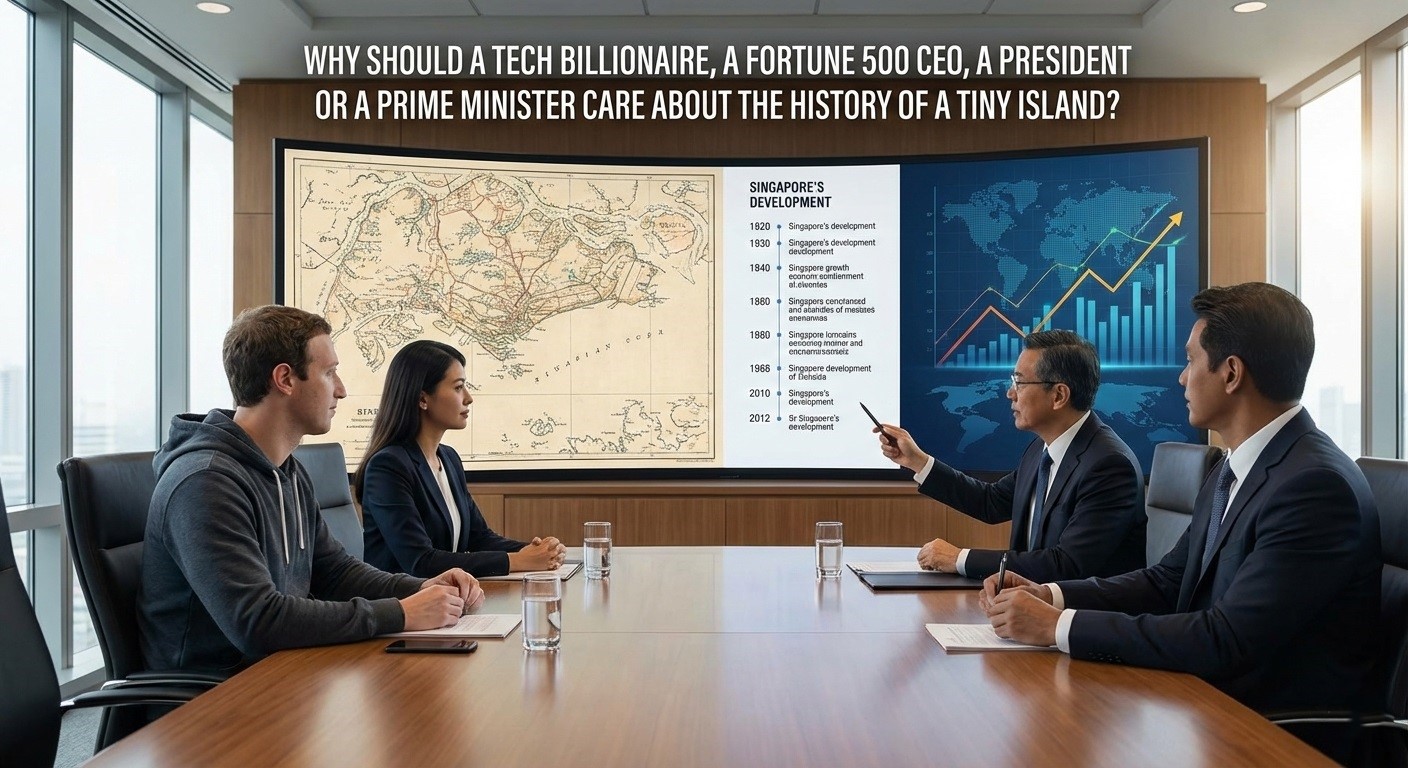
The literature of statecraft is often cluttered with the memoirs of the mediocre, yet Lee Kuan Yew’s seminal work remains a towering exception that demands the attention of every C-suite executive and world leader. I did not return to this text to seek nostalgic comfort in past successes; I returned to it to locate the precise mechanisms of rapid, systemic transformation that can be applied to the volatile markets of today.
The book serves as a diagnostic tool for identifying the rot within institutional structures and provides the antidote in the form of ruthless pragmatism and the pursuit of absolute efficiency. In an era defined by geopolitical fragmentation, the Singaporean blueprint offers a masterclass in how a small entity can exert disproportionate influence on the global stage. Because the principles of human capital optimisation and the eradication of systemic friction are universal requirements for any enterprise seeking to dominate its sector. My analysis of this work reveals that the success of Singapore was not a miracle but a calculated outcome of superior strategic problem-solving.
We must move beyond the superficial appreciation of Singapore’s skyline and interrogate the foundational choices that made such prosperity inevitable. This briefing is designed to translate those high-level historical insights into actionable strategies for the modern corporate and political titan. The stakes are far too high for us to ignore the lessons of a man who turned a swamp into a global financial hub in a single generation.
The Singapore Question: How a Small State Built Relentless Advantage Through the Architecture of Execution
Singapore’s success was not accidental, nor was it charismatic. It was engineered. The state prioritised competence over consensus, capability over coalition, and long-term credibility over short-term comfort. Civil service appointments were treated as strategic assets, not political rewards. Education was aligned ruthlessly with economic need, not ideological fashion. Foreign capital was welcomed without apology, regulated with intelligence, and integrated into national capability rather than allowed to dominate it.
Corruption was not debated; it was destroyed through the certainty of punishment and cultural intolerance. Lee Kuan Yew understood that corruption is not merely a moral failing but a systemic inefficiency that destroys the competitive advantage of a state. By establishing a civil service that paid its ministers the highest salaries in the world, he ensured that the brightest minds were not lured away by the private sector or tempted by illicit gains.
Urban planning, housing, transport, and healthcare were treated as systems, not silos. Every policy choice was evaluated through a single lens: would it compound national advantage over time? When mistakes were made, they were corrected without theatrical confession. This was governance as discipline rather than performance. For CEOs, the parallel is immediate. Firms that endure are not those with the loudest purpose statements but those with the clearest operating logic. Singapore functioned like a world-class enterprise with a demanding board and an unforgiving market. That is not poetry. That is the process.
Can a nation truly thrive when its civil service is a playground for political patronage rather than a sanctuary for the most brilliant minds of its generation? The answer is a resounding negative, as evidenced by the stagnation of states that value loyalty over competence. Singapore’s model of meritocracy created a culture of excellence that permeated every level of society, from the dockworkers to the directors of the sovereign wealth fund. This was not a passive evolution but an aggressive intervention against the natural tendency of systems to tend towards entropy. The strategic clarity required to maintain such a system is immense, demanding a leadership that is willing to sacrifice short-term popularity for long-term dominance.
Global leaders must recognise that the same principles apply to the governance of multinational corporations, where the dilution of meritocratic standards leads to inevitable decline. We must be prepared to dismantle the structures that reward mediocrity if we are to compete in a world that is increasingly indifferent to our past achievements.
Leadership as a System, Not a Personality, Not One Statesman: Why Institutions Must Outperform Personality through Sustainable Institutional Memory

The lazy critique of Singapore attributes its success to one extraordinary man. That argument collapses under scrutiny. Lee Kuan Yew mattered because he designed systems that outlived him. Leadership was embedded into institutions, not personalised around charisma. Succession was planned, competence was groomed, and mediocrity was excluded.
Contrast this with states and corporations where each leadership change resets strategy, dilutes accountability, and erases institutional memory. In such environments, learning never compounds because continuity never survives. Singapore understood that culture is not a slogan but a set of enforced behaviours repeated until they become normal. Performance was measured, rewarded, and protected. Failure was analysed, not excused. This is why the state remained coherent across decades. Global corporations that dominate their sectors operate the same way.
Consider how companies like Toyota institutionalised continuous improvement, or how Unilever built leadership pipelines that transcend individual CEOs. These organisations did not rely on heroic individuals. They built leadership systems. Singapore did the same at national scale.
The South African Divergence: Authority Without Advantage as History Stops Compounding
South Africa stands today at a juncture that is remarkably similar to the precarious beginnings of the Singaporean journey, albeit with a vastly different scale of resources and complexity. The nation possesses a sophisticated financial sector and a mineral wealth that should, by all rights, make it the undisputed economic engine of the African continent. However, the presence of these resources has often led to a dangerous complacency, where the easy wins of extraction have obscured the need for structural innovation.
South Africa entered democracy with moral authority that few nations have ever possessed. It had global goodwill, a respected constitution, sophisticated corporations, and a citizenry willing to believe. What it lacked was not vision but executional intolerance for failure. Political deployment replaced capability selection. Institutional erosion was rationalised as transformation. Short-term political survival displaced long-term economic strategy. The result was predictable. Infrastructure decayed, state-owned enterprises collapsed, and public trust evaporated. None of this occurred overnight. It unfolded through a thousand small compromises that leaders convinced themselves were temporary.
The tragedy is not that South Africa failed to become Singapore. The tragedy is that it abandoned the disciplines that would have made success inevitable. Private sector leaders adapted by building excellence inside their own firms while the state deteriorated around them. This created a bifurcated economy where islands of competence coexist with oceans of dysfunction. The lesson is severe. Authority without advantage decays into resentment. History stops compounding the moment discipline collapses.
Strategic Parallels: Singapore’s Ascent and the Potential for a South African Renaissance

Singapore’s rise was anchored in three pillars: ruthless meritocracy, incorruptible governance, and relentless global integration. Each was pursued with clarity and without compromise. South Africa, by contrast, has allowed political patronage to erode institutional integrity, tolerated corruption as systemic, and hesitated to integrate fully into global value chains. The parallel is stark. The question is piercing: can South Africa summon the courage to dismantle entrenched inefficiencies and rebuild its institutions with the same rigour? The answer lies not in rhetoric, but in action.
By inviting the private sector to take a leading role in the management of critical infrastructure (management only, not privatisation; that is another issue altogether), South Africa can bypass the inefficiencies of state-owned enterprises. This requires a level of intellectual courage that rejects the populist rhetoric of the day in favour of the cold, hard logic of economic necessity. The potential for a South African renaissance is not just a local concern; it is a strategic imperative for global investors who seek a stable and prosperous gateway into the African market. We must envision a South Africa where the Rule of Law is not a suggestion but a foundational certainty that attracts the highest calibre of international investment. The transition from a resource-based economy to a knowledge-based powerhouse is the only path forward for a nation that seeks to reclaim its place on the world stage.
For corporations, the lesson is equally sharp: governance is not a compliance exercise; it is the architecture of survival.
What South Africa Still Possesses: Latent Assets, Strategic Optionality, and Why Decline Is Not Destiny
Despite its failures, South Africa retains assets that Singapore never enjoyed. It has scale, natural resources, deep capital markets, and globally competitive corporations. Its constitution remains a sophisticated framework for accountability. Its private sector still produces leaders of international calibre. Its demographic profile offers potential energy rather than demographic exhaustion. These are not sentimental observations. They are strategic facts. The question is whether leadership is prepared to activate them.
Consider how Rwanda rebuilt institutional credibility within a generation by prioritising governance and execution.
Consider how Vietnam transformed itself by aligning state capability with market logic. These countries did not wait for perfect conditions. They imposed discipline on imperfect realities. South Africa could do the same if it treated reform as a sequence rather than a slogan. Energy reform, logistics reform, skills alignment, and professionalised public administration are not mysteries. They are choices. The obstacle is not knowledge. It is courage.
For instance, the South African integration of private power producers into the national grid serves as a prime example of how the dismantling of a state monopoly can lead to rapid improvements in service delivery. We must also consider the role of technology in automating the functions of government to eliminate the human element that is so often the source of corruption. Strategic problem solving is not about making marginal improvements to a broken system; it is about redesigning the system itself to be immune to the failures of the past.
Similarly, the global elite have a unique role to play as the architects of this new order, using their influence to demand the same level of performance from states as they do from their own companies. Legacy is not found in the accumulation of wealth but in the creation of systems that endure and empower long after the architect has departed.
Case Study One: Singapore’s Port and South Africa’s Logistics
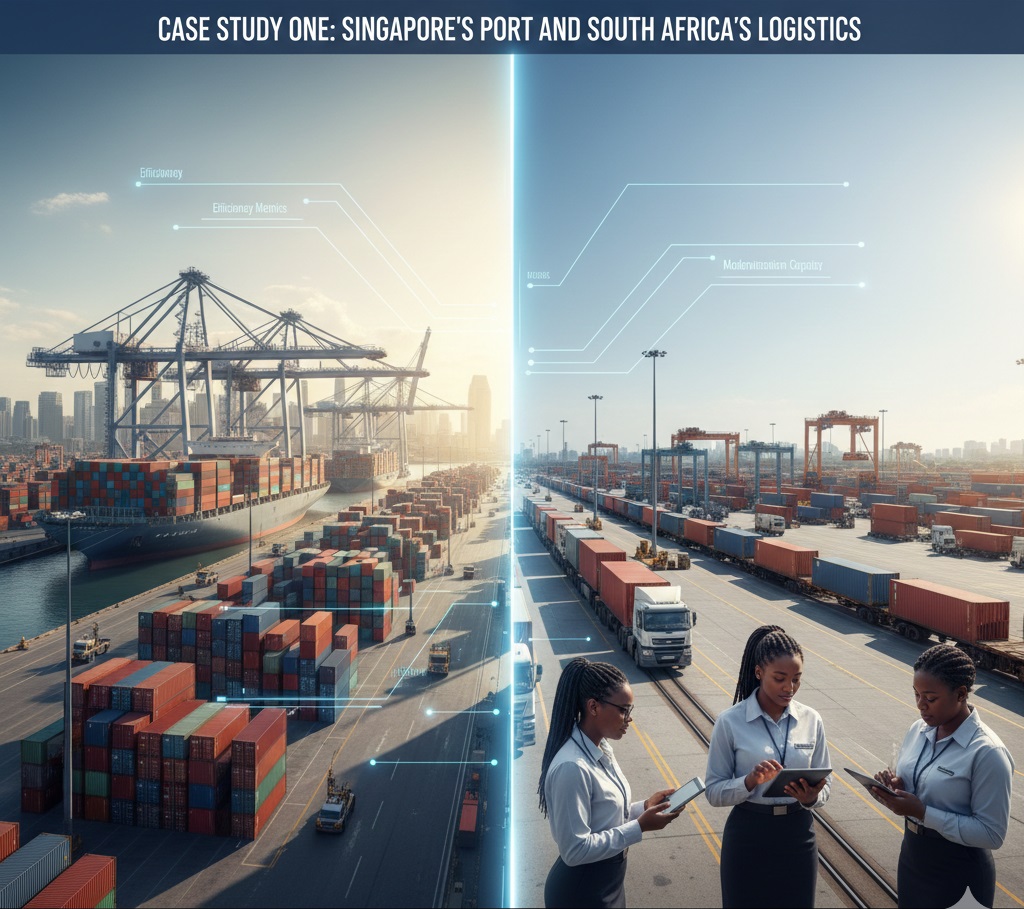
Singapore transformed its port into a global hub, not by accident, but by strategic foresight. Efficiency, transparency, and technological adoption became non-negotiable. South Africa’s ports, by contrast, remain plagued by inefficiency, strikes, infrastructural decay, ageing equipment, and bureaucratic delays that have cost the economy billions in lost trade opportunities. The tactical solution is clear: corporates and policymakers must invest in digitisation, predictive analytics, and public-private partnerships to re-engineer logistics. The prize is immense: reduced costs, accelerated trade, and enhanced competitiveness. The risk of inaction is catastrophic: exclusion from global supply chains.
The good news is that the solution, however, is already being pioneered through private sector partnerships that bring both capital and management expertise to the table. By adopting the same digital twin technology and automated crane systems used in Singapore, South African ports can rapidly close the productivity gap.
Case Study Two: Education as a Weapon of Transformation
Singapore weaponised education, aligning curricula with economic strategy. It transformed its education system into a world leader in STEM subjects, providing the human capital necessary for a high-tech economy. South Africa’s education system, fragmented and unequal, remains a bottleneck. The practical solution is to embed vocational training, STEM prioritisation, and corporate-sponsored academies into the national framework to ensure that South Africa's youth are prepared for the demands of the fourth industrial revolution. CEOs and billionaires must recognise that talent pipelines are not a social responsibility project; they are the lifeblood of competitiveness. The rhetorical question is unavoidable: Can a nation prosper if its youth are unprepared for the future? The answer is self-evident.
Case Study Three: Governance and Corporate Culture
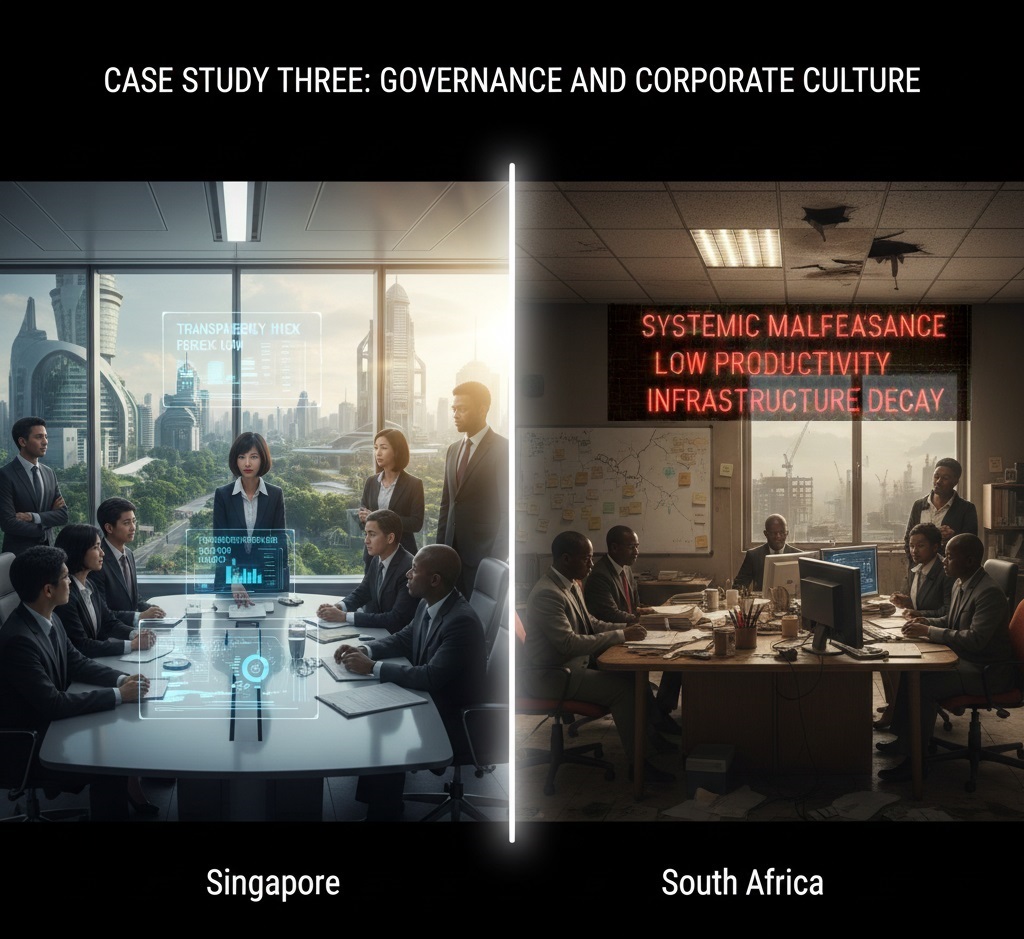
Singapore’s governance model was uncompromising in its intolerance of corruption. South Africa’s corporate and political landscape has tolerated mediocrity and malfeasance. The tactical solution is radical transparency, enforced accountability, and the institutionalisation of ethical leadership. For corporations, this means embedding integrity into culture, not as a slogan, but as a measurable practice. The global lesson is clear: governance is destiny.
These are not abstract goals but practical projects that can be initiated today with the right combination of political will and private sector partnership. The global elite must see these challenges not as reasons to disinvest but as opportunities to apply their unique problem-solving capabilities to some of the world’s most lucrative markets.
The Global Implication: Lessons for CEOs, Billionaires, and World Leaders
The Singaporean story is not parochial; it is universal. It teaches that leadership is not about managing decline, but about engineering ascent. For global corporations, the lesson is transferable: agility, discipline, and foresight are the currencies of survival. For South Africa, the opportunity is profound: to pivot from a narrative of potential unrealised to one of transformation achieved. The provocation is sharp: will leaders act before crisis compels them, or will they wait until catastrophe renders choice irrelevant?
A Ten-Year Strategic Reset, From Diagnosis to Execution: What Serious Leadership Would Actually Do
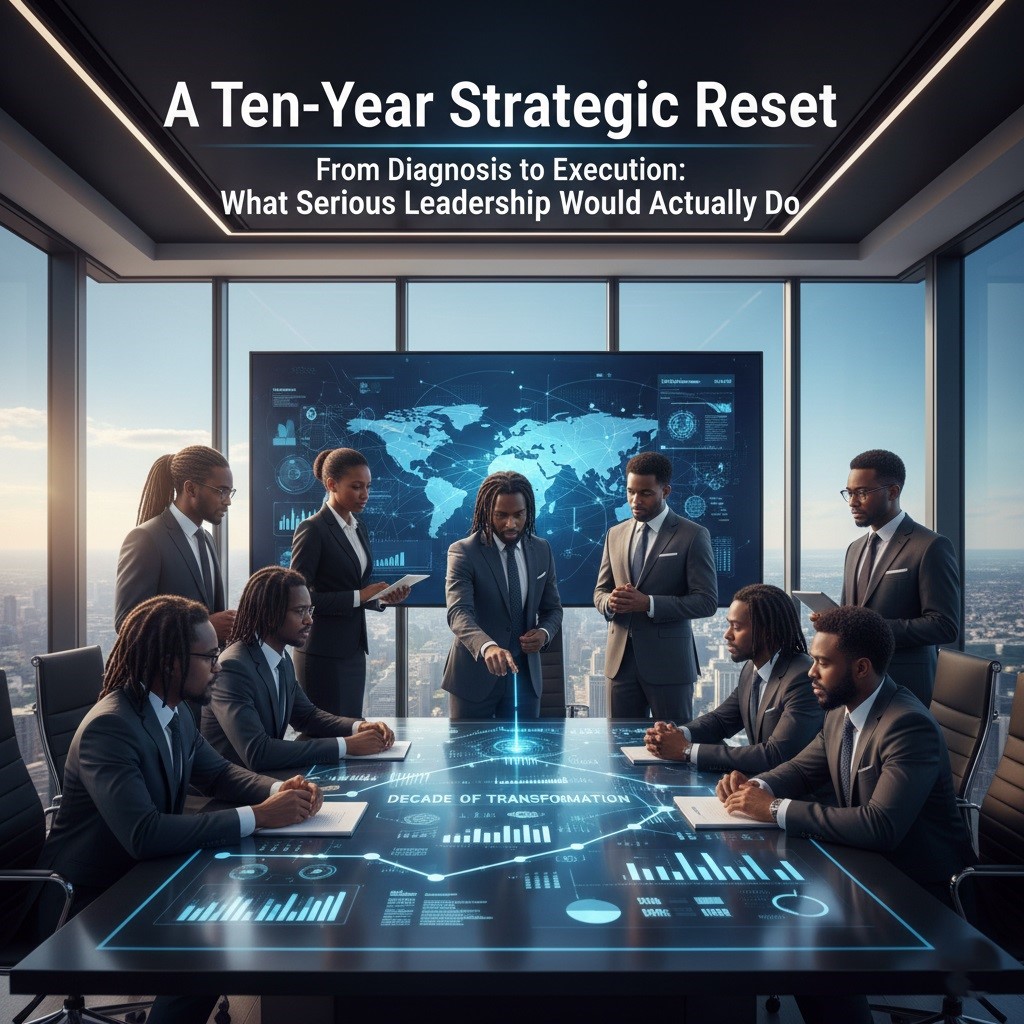
A credible reset begins with depoliticising competence. Public administration must be professionalised with clear performance contracts and consequences. Infrastructure investment must be treated as a national emergency with private sector partnerships structured for speed and accountability. Education must be aligned with economic demand rather than ideological comfort. Energy security must be resolved through diversification, regulatory clarity, and private capital mobilisation. Anti-corruption efforts must be judicially certain rather than rhetorically dramatic.
For CEOs, the implication is direct engagement. Corporate leaders cannot outsource national stability to politicians alone. Strategic coalitions between business, labour, and the state must focus on execution rather than dialogue theatre. Consider how Operation Vulindlela began to unlock reforms by bypassing bureaucratic paralysis. Consider how private logistics firms stepped in where ports failed. These are not complete solutions, but they demonstrate what is possible when urgency replaces ritual. Ten years is enough to change a country if seriousness replaces sentiment.
Stripped to their core, tactical implementation and practical solutions expose the gap between intention and consequence; they demand execution, not debate, they define who wins, who survives, and who is left behind:
• Digitise logistics: Deploy AI-driven predictive systems to optimise port operations.
• Reform education: Align curricula with industry needs, embed corporate academies, and incentivise STEM excellence.
• Institutionalise governance: Establish independent oversight bodies with prosecutorial authority, enforce radical transparency in procurement.
• Global integration: Position South Africa as a hub for renewable energy, fintech, and advanced manufacturing.
• Corporate leadership: CEOs must embed ethical leadership into culture, measure it, and reward it.
These are not abstract ideals; they are implementable strategies. The Singaporean precedent proves that transformation is possible when leadership refuses compromise.
The Sovereign Wealth Strategy: Reimagining Capital as a Tool for National Resilience
The creation of Temasek and GIC in Singapore transformed the state from a mere tax collector into a global investment powerhouse, a move that every resource-rich nation should study with intensity. South Africa, with its vast mineral reserves, has failed to create a comparable vehicle that could insulate the nation from the volatility of commodity cycles and provide a foundation for future generations. Why do we allow the wealth of the land to be dissipated in the pursuit of short-term consumption when it could be harnessed to build the infrastructure of the twenty-second century?
A sovereign wealth fund managed by independent, world-class professionals would provide the strategic depth required to weather any global economic storm. This is not a task for politicians but for the most sophisticated financial minds who understand the nuances of global asset allocation. The implementation of such a fund in South Africa would signal to the international community that the nation is finally serious about long-term stability and fiscal discipline. Global billionaires and institutional investors would find in such a fund a partner that shares their horizon and their commitment to excellence.
We must move away from the model of the state as a provider of welfare and towards the model of the state as an active participant in the global market. This shift requires a profound change in the national psyche, moving from a position of historical grievance to one of strategic confidence. The success of Singapore’s sovereign investments proves that capital, when directed by a clear vision, can achieve more for social stability than any number of populist handouts.
The Echo That Must Linger: A Mandate for Strategic Audacity and the Rejection of the Ordinary
The Singaporean story is a mirror held up to every leader who hesitates. It asks a question that cannot be ignored: will you lead with audacity, or will you preside over decline? We have seen that the difference between success and failure is not found in the presence of natural resources or the accidents of geography but in the quality of leadership and the rigour of the systems they build. I have presented a briefing that is both a diagnosis of the current malaise and a prescription for a future of undisputed dominance. Are you a leader who is content to watch the slow atrophy of your institutions, or do you possess the intellectual courage to lead a transformation that will be remembered for centuries? The time for incrementalism has passed; the era of strategic audacity is upon us.
South Africa has the potential to be the Singapore of the continent, but this will only happen when its leaders and its partners in the global C Suite commit to the uncompromising standards of excellence. This article is your call to action, a demand that you apply the same level of strategic rigour to the governance of the world as you do to the governance of your empires. The world does not need more commentators; it needs architects who are willing to advance into complexity and emerge with the blueprints for a new golden age. Take the insights from this briefing and turn them into the reality of a world that is efficient, meritocratic, and profoundly prosperous.
For South Africa, the choice is urgent. For global corporations, the lesson is timeless. Leadership is not about survival; it is about reinvention. The final imperative is clear: act now, with clarity, with courage, with precision. The world does not wait for hesitant leaders. It rewards those who dare to reimagine destiny.
The Final Leadership Test and the Future That Awaits a Decision: Choosing Discipline Over Comfort

This article is not an elegy, nor is it a celebration. It is a challenge. Singapore’s story reveals that excellence is engineered, not wished into existence. South Africa’s story reveals that moral capital decays without executional discipline. Global leaders reading this should recognise the pattern within their own institutions. Where have standards slipped under the guise of empathy? Where has accountability been deferred in the name of harmony? Where has strategy been sacrificed to narrative?
The future belongs to leaders who are prepared to make themselves unpopular in the service of results. History does not reward good intentions. It rewards those who build systems that work when sentiment fades. The question facing South Africa, and indeed every institution represented in this readership, is brutally simple. Will you design for excellence, or will you narrate decline? The answer will not be written in speeches. It will be written in outcomes.
Images by Bandile Ndzishe of Bandzishe Group
About bandile ndzishe

Bandile Ndzishe is the CEO, Founder, and Global Consulting CMO of Bandzishe Group, a premier global consulting firm distinguished for pioneering strategic marketing innovations and driving transformative market solutions worldwide. He holds three business administration degrees: an MBA, a Bachelor of Science in Business Administration, and an Associate of Science in Business Administration.
With over 30 years of hands-on expertise in marketing strategy, Bandile is recognised as a leading authority across the trifecta of Strategic Marketing, Daily Marketing Management, and Digital Marketing. He is also recognised as a prolific growth driver and a seasoned CMO-level marketer.
Bandile has earned a strong reputation for delivering strategic marketing and management services that guarantee measurable business results. His proven ability to drive growth and consistently achieve impactful outcomes has established him as a well-respected figure in the industry.
As an AI-empowered and an AI-powered marketer, I bring two distinct strengths to the table: empowered by AI to achieve my marketing goals more effectively, whilst leveraging AI as a tool to enhance my marketing efforts to deliver the desired growth results. My professional focus resides at the nexus of artificial intelligence and strategic marketing, where I explore the profound and enduring synergy between algorithmic intelligence and market engagement.
Rather than pursuing ephemeral trends, I examine the fundamental tenets of cognitive augmentation within marketing paradigms. I analyse how AI's capacity for predictive analytics, bespoke personalisation, and autonomous optimisation precipitates a transformative evolution in consumer interaction and brand stewardship. By extension, I seek to comprehend the strategic applications of artificial intelligence in empowering human capability and fostering innovation for sustainable societal advancement.
In essence, I explore how AI augments human decision-making and strategic problem-solving in both marketing and other domains of life. This is not merely an interest in technological novelty, but a rigorous investigation into the strategic implications of AI's integration into the contemporary principles of marketing practice and its potential to reshape decision-making frameworks, rearchitect strategic problem-solving paradigms, enhance strategic foresight, and influence outcomes in diverse areas beyond the marketing sphere.