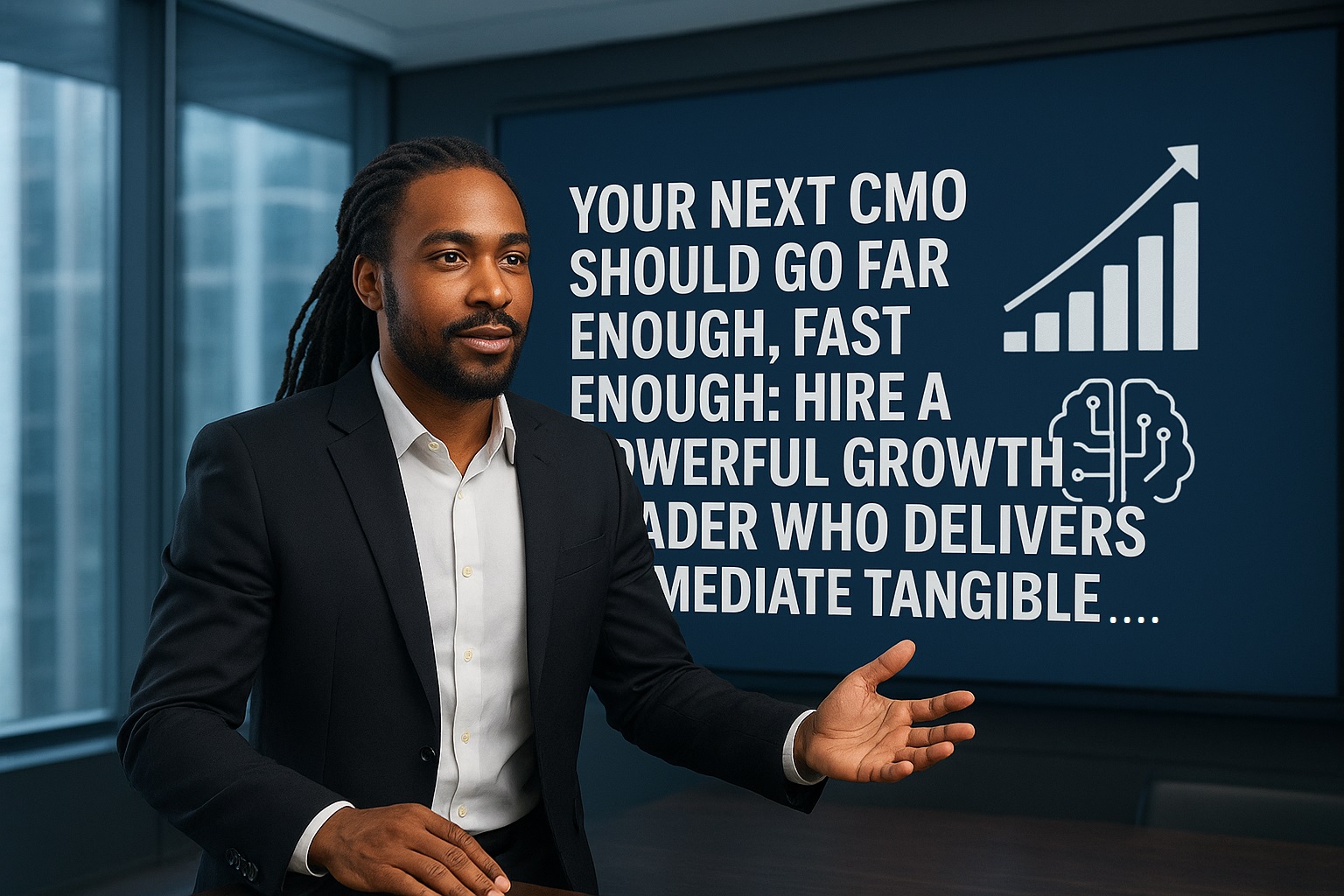

When I began my career in marketing nearly three decades ago, the landscape was profoundly different. The CMO’s role was largely one of brand stewardship and creative direction, a position focused on crafting compelling narratives and managing public perception. We operated on annual cycles, measured success in broad strokes, and relied on intuition as much as data. Yet, as a Senior Marketing Executive with a foundational expertise in the Trifecta of Strategic Marketing, Daily Marketing Management, and Digital Marketing, I have personally witnessed a seismic shift. The relentless velocity of digital disruption and the unforgiving contraction of market cycles have created a new, results-driven reality where brand is secondary to demonstrable commercial growth.
In this unforgiving business environment, organisations with immense potential have faltered because their leadership, and particularly their Chief Marketing Officer, failed to adapt. They spoke of long-term vision but were incapable of delivering short-term wins. They became strategic liabilities, a drain on resources that the modern enterprise simply cannot afford. It is this direct, personal experience as a Global Consulting Chief Marketing Officer for Bandzishe Group that has forged my core conviction: If your CMO cannot deliver a measurable win within 100 days, they are not the right fit.
I recall a pivotal moment in Johannesburg, seated across from the CEO of a major retail conglomerate, who asked whether their newly appointed CMO should be given more time to settle in. My response was the same as above, immediate, and unequivocal: if your CMO cannot deliver a measurable win within 100 days, they are not the right fit. They risk becoming a strategic liability and a fiscal drain on precious resources. And in today’s unforgiving climate, no organisation can afford such a luxury. Why settle for potential when immediate performance is what is needed?
This is not a philosophical abstraction; it is a commercial imperative. In a recent engagement with a telecommunications firm, our intervention yielded a 14 percent uplift in subscriber acquisition within 90 days. The previous CMO had spent two quarters theorising without traction. The difference was not talent; it was urgency. Why do global corporations continue to hire for potential rather than performance? Why do boards indulge the myth that strategic impact must be deferred? These are not rhetorical indulgences; they are questions that determine whether your organisation will lead or lag.
In the current brutal macroclimate, where capital is impatient and markets are merciless, the appointment of a CMO is not a ceremonial gesture; it is a declaration of intent. The modern CMO must be a growth architect, a commercial tactician, and a performance economist. Anything less is unacceptable.
The Paradigm Shift: From Brand Custodian to Growth Catalyst
The traditional CMO, a figure once primarily preoccupied with brand perception and communications, is an anachronism. This is a bold claim, perhaps, but one borne out by the unforgiving metrics of the market. The modern business landscape demands a far more dynamic and results-oriented archetype, the growth leader.
This individual is not merely a custodian of the brand but a relentless architect of commercial expansion, a master of both strategic foresight and tactical execution. They view marketing not as a cost centre but as a profit engine, a direct lever for driving revenue, market share, and shareholder value. They understand that brand equity is a lagging indicator of a thriving business, a consequence of success rather than its primary cause. Their mandate is to move beyond abstract brand narratives and deliver concrete, immediate, and quantifiable results that resonate directly with the C-suite and the board.
The 100-Day Rule as a Non-Negotiable Benchmark for Strategic Fit: Why Early Traction is the Only Credible Indicator of Long-Term Value

The first 100 days of a CMO’s tenure must be treated as a crucible, a proving ground where strategic hypotheses are tested against commercial reality. This period is not for orientation, but for orchestration. A CMO who cannot demonstrate traction within this window is not merely underperforming, they are misaligned with the velocity of modern enterprise. The notion that marketing is a long game is intellectually seductive but operationally dangerous. In truth, marketing is a series of short games played with long-term consequences.
The CMOs of the top performing global companies are both a strategic architect and an executional lightning rod who demonstrate immediate, measurable value rather than abstract promise. Yet how many CEOs today are content to wait six months, for marketing leadership to justify its existence? In truth, no modern enterprise, whether a South African conglomerate navigating sluggish GDP growth or a global Fortune 500 titan under investor glare, can afford such inertia.
A leader who fails to produce early, tangible outcomes endangers market positioning, investor confidence and internal morale with equal vigour. Smart CEOs therefore insist on CMOs who blend audacious strategic vision with operational velocity, turning intent into demonstrable returns in weeks rather than quarters.
Consider the case of a pan-African fintech firm that engaged Bandzishe Group to recalibrate its customer acquisition strategy. Within 100 days, we re-engineered their digital ecosystem, introduced predictive analytics into their CRM, and achieved a 22% increase in conversion rates. The lesson is clear: strategic marketing must be both visionary and executable. Theoretical elegance without operational rigour is a vanity metric.
Is it elitist to demand results within 100 days? Perhaps. But is it irresponsible not to? Absolutely.
The 100-Day Imperative: A Litmus Test for Delivering Tangible Wins as Strategic Proof of Value
Why do I insist on the 100-day horizon? Because this period is long enough to demonstrate the capacity to design, execute, and measure results, yet short enough to avoid indulgence in abstract theorising. CEOs and boards should demand a visible uplift, whether in revenue acceleration, lead generation efficiency, digital engagement metrics, or customer acquisition cost reductions, within this defined window.
My experience at Bandzishe Group, where we specialise in pioneering strategic marketing innovations for a global clientele, has repeatedly shown me that the first 100 days of a new CMO’s tenure are the most telling. This period is a critical litmus test of their capabilities, their leadership prowess, and their capacity to instigate meaningful change. A powerful growth leader, when given the reins, immediately conducts a surgical analysis of the existing marketing apparatus, identifying and swiftly rectifying bottlenecks, optimising campaigns for maximum ROI, and unlocking latent value within the customer base. They don’t just observe; they act.
Globally, consider Nestlé’s approach in its pivot to digital-first consumer engagement. Their CMO introduced a rapid, 90-day pilot campaign on data-driven personalisation across European markets. The result was a measurable uptick in engagement and sales, which subsequently justified broader roll-out. The lesson is clear: decisive experiments that deliver tangible impact early on secure legitimacy for wider strategy.
Beyond Symbolism: Why Marketing Leadership Must Justify Its Seat Quickly

Is it sufficient to appoint a CMO who promises long-term transformation without evidence of immediate impact? Certainly not. In both Johannesburg and New York, the currency of credibility is tangible, near-term success. The CEO who entrusts growth leadership to a candidate lacking urgency is effectively placing the enterprise at risk.
Consider the South African retailer Woolworths. When faced with a stagnant food and fashion portfolio, its marketing leadership focused first on tactical wins, aggressive promotional campaigns and sharper customer segmentation, and that drove measurable traffic uplift within weeks. Only after proving that momentum did longer-term transformation of supply chain and product mix follow. The sequence is instructive: the quick win created trust, which then bought patience for more structural innovation.
Strategic Speed: Balancing Tactical Urgency with Long-Term Vision
Does demanding immediate results not risk shallow marketing gimmicks at the expense of durable growth? The scepticism is valid, but misplaced. A competent growth leader understands that tactical victories need not undermine strategic ambition, they must in fact enable it. The first measurable wins, whether through sharper digital targeting or revitalised sales enablement, serve as stepping stones towards systemic change.
Take Capitec Bank in South Africa. Their rapid early success in capturing customer attention was not merely a marketing stunt but a disciplined focus on transparency, simplicity, and pricing communicated through bold campaigns. Within months, tangible customer acquisition growth validated the bank’s trajectory, enabling it to embed deeper digital transformation thereafter. Strategic speed, therefore, is not recklessness but intelligent sequencing.
Do You Prioritise Potential or Performance? Why the Cult of Potential is a Dangerous Distraction from Commercial Reality

The prevailing wisdom in executive recruitment often prioritises "strategic fit" and "long-term vision," laudable concepts, but ones that can become euphemisms for a lack of immediate impact. Is it not a fundamental strategic flaw to hire an executive on the promise of future potential when the competitive landscape demands present performance? In my private reflections, I often ponder the historical parallel of military generals. The most successful commanders were not those who possessed the most impressive theoretical knowledge of strategy, but those who could decisively win battles on the field of engagement. The same principle applies to modern commerce. Your CMO is a field general; they must be able to secure tactical victories, not merely plan for hypothetical future wars. The risk of inaction, of settling for a leader who requires a protracted period of integration and acclimatisation, is simply too great. It is a luxury that modern enterprises can no longer afford.
Simply put, potential, unaccompanied by performance, is a strategic mirage. In my experience, the most dangerous hire is not the incompetent, it is the unproven visionary whose ideas never materialise. As a self-respecting CEO, you cannot allow your incumbent CMO to spend 18 months crafting a brand repositioning strategy that never sees daylight. You must find a CMO to replace abstraction with action by launching three targeted campaigns within 60 days, each delivering measurable ROI. The board, previously paralysed by indecision, will regain confidence in marketing as a growth lever.
The Anatomy of an Immediate Win: Data, Decisions, and Dynamic Execution
What, then, constitutes a "measurable win" within this stringent timeframe? It is not a cosmetic change or a superficial rebranding exercise. It is a tangible, data-backed improvement in key performance indicators (KPIs) that directly impacts the bottom line. This could be a significant increase in lead-to-sale conversion rates, a substantial expansion of the sales pipeline, or a demonstrable rise in customer lifetime value. For a global corporation, this might involve the rapid deployment of an international campaign that captures a new market segment.
For instance, if you are a European luxury goods conglomerate, you could identify an untapped demographic in the Southeast Asian market, a group that value digital authenticity and sustainable practices. Your new CMO, a true growth leader, could forgo spending months on market research. Instead, they could launch a highly focused, agile campaign on specific social platforms within 60 days, yielding a remarkable surge in engagement and initial sales; a clear, irrefutable win that will prove the efficacy of their approach.
Growth Leadership Defined: What Today’s CEO Should Demand

What distinguishes the powerful growth leader who accelerates growth from the ceremonial CMO? First, a refusal to hide behind lagging indicators or nebulous brand sentiment alone, they must unambiguously link marketing initiatives directly to revenue and profit metrics. Second, mastery of the Trifecta of Strategic Marketing, Daily Marketing Management, and Digital Marketing, a rare combination cultivated only through decades of executional depth and strategic foresight. Third, the gravitas to operate as an equal to the CFO and COO, not a subordinate reporting on “campaigns” but an executive architecting enterprise growth.
In my consulting practice, I have repeatedly observed the futility of appointing CMOs who mistake visibility for value. A high-profile presence at conferences or verbose declarations of “innovation” cannot substitute for immediate delivery of measurable outcomes. CEOs must instead demand a CMO who can show the numbers, within 100 days.
The Trifecta of Marketing Mastery: Strategy, Management, and Digital Execution
Why elite CMOs must operate across all three dimensions to deliver tangible results?
A truly effective CMO must master the trifecta of Strategic Marketing, Daily Marketing Management, and Digital Marketing. These are not silos, they are symphonic disciplines that must be orchestrated with precision. Strategic Marketing sets the direction, Daily Marketing Management ensures momentum, and Digital Marketing delivers scale. The absence of any one element renders the entire apparatus impotent.
At Bandzishe Group, we embed this trifecta into every engagement. For a global pharmaceutical client entering the South African market, we developed a strategic positioning framework, instituted agile campaign management protocols, and deployed a digital-first launch strategy. Within 100 days, the brand achieved 11% market penetration in a previously saturated category.
Can your current CMO operate across all three dimensions? If not, they are not equipped for the demands of modern commerce. The era of single-discipline marketers is over.
Practical Blueprint: How Leaders Should Frame the First 100 Days
How, then, should CEOs structure expectations to ensure their CMO does not flounder and the enterprise does not fund false promise? The blueprint is both practical and demanding. First, establish mutually agreed definition of a tangible win, be it a numeric target in market share, digital lead volume, margin contribution or conversion uplift. Second, provide access to data, decision-making forums, and agile budgets, without which even the most capable CMO will be paralysed. Third, insist on a “100-Day Marketing Impact Report” that quantifies both wins achieved and longer-term strategies initiated for sustaining the growth.
At Bandzishe Group, we often recommend a dual-track approach: launch one or two rapid pilot initiatives that can deliver measurable gains in 60–90 days, while simultaneously initiating longer-term structural reforms (such as customer data integration or AI-enabled targeting) that will compound those early results and underpin sustainable growth. The two tracks reinforce each other, immediacy creates credibility, credibility creates permission for transformation.
As a veteran in this field, I can attest that the most effective growth leaders are those who are given the freedom to fail fast and iterate even faster. In the context of South African companies, this might mean empowering a new CMO to pivot away from traditional advertising models towards a laser-focused e-commerce strategy, using the country's unique digital consumer behaviour to drive unprecedented sales growth.
Two Illustrative Global and Local Case Studies: Tangibility Across Contexts

Global corporations and South African enterprises alike provide fertile illustrations. Globally, Microsoft’s marketing leadership re-established the brand’s relevance within months of Satya Nadella’s appointment as CEO, through bold repositioning and targeted campaigns that quickly boosted enterprise adoption of cloud solutions. Locally, MTN’s aggressive “Everywhere You Go” campaign rapidly reasserted market dominance in the early 2000s, winning measurable customer acquisition in weeks while setting the stage for continental expansion. The unifying theme is that both organisations understood the necessity of early, measurable victories as proof points. Without such demonstration effects, neither would have secured the boardroom confidence required for longer-term transformation.
The Provocative Question: Are You Hiring a Growth Leader, or a Placeholder?
So the decisive question for every CEO and board becomes this: are you hiring a growth leader who will deliver immediate tangible results, or a ceremonial placeholder who will drain resources while offering promises of eventual success, someone whose gift is rhetoric and optics? The distinction determines not merely marketing effectiveness, but enterprise competitiveness, shareholder confidence, and executive legitimacy.
In my nearly three decades of global marketing leadership, I have seen careers, companies, and even industries falter because executives settled for symbolism over substance. The CMO role, perhaps more than any other, must prove its legitimacy not in theory but in numbers, and it must do so within the first 100 days. Ask the candidate directly what tangible win they will deliver in the first 100 days, and evaluate whether the plan is credible, measurable and resourced.
The Call to Elite Leaders to Demand More, Faster
The choice before every CEO, chair and investor is stark: appoint a growth leader who goes far enough, fast enough, and produces measurable results in 100 days, or tolerate a costly indulgence that erodes value. This is not a provocation for its own sake but a practical imperative rooted in accountability and competitive survival. Anything less than delivering tangible results within the first 100 days risks turning a critical role into a resource drain, a costly indulgence at a time when margins and markets are under unrelenting pressure.
The market will not wait for you to find your footing. Your competitors are not bogged down in deliberations about potential; they are relentlessly focused on performance. Do you have the courage to demand immediate tangible results? Do you have the foresight to recognise that anything less is a strategic retreat?
So, I leave you with a simple, provocative challenge: when the next CMO sits across from you, ask not for a three-year vision but for a 100-day verdict; what precise, measurable win will you deliver, and how will it shift the fortunes of this company immediately? If that answer is hesitant, evasive or vague, you already have your verdict; decline, recruit otherwise, and insist on results.
Images by Bandile Ndzishe of Bandzishe Group
About bandile ndzishe

Bandile Ndzishe is the CEO, Founder, and Global Consulting CMO of Bandzishe Group, a premier global consulting firm distinguished for pioneering strategic marketing innovations and driving transformative market solutions worldwide. He holds three business administration degrees: an MBA, a Bachelor of Science in Business Administration, and an Associate of Science in Business Administration.
With over 30 years of hands-on expertise in marketing strategy, Bandile is recognised as a leading authority across the trifecta of Strategic Marketing, Daily Marketing Management, and Digital Marketing. He is also recognised as a prolific growth driver and a seasoned CMO-level marketer.
Bandile has earned a strong reputation for delivering strategic marketing and management services that guarantee measurable business results. His proven ability to drive growth and consistently achieve impactful outcomes has established him as a well-respected figure in the industry.
As an AI-empowered and an AI-powered marketer, I bring two distinct strengths to the table: empowered by AI to achieve my marketing goals more effectively, whilst leveraging AI as a tool to enhance my marketing efforts to deliver the desired growth results. My professional focus resides at the nexus of artificial intelligence and strategic marketing, where I explore the profound and enduring synergy between algorithmic intelligence and market engagement.
Rather than pursuing ephemeral trends, I examine the fundamental tenets of cognitive augmentation within marketing paradigms. I analyse how AI's capacity for predictive analytics, bespoke personalisation, and autonomous optimisation precipitates a transformative evolution in consumer interaction and brand stewardship. By extension, I seek to comprehend the strategic applications of artificial intelligence in empowering human capability and fostering innovation for sustainable societal advancement.
In essence, I explore how AI augments human decision-making and strategic problem-solving in both marketing and other domains of life. This is not merely an interest in technological novelty, but a rigorous investigation into the strategic implications of AI's integration into the contemporary principles of marketing practice and its potential to reshape decision-making frameworks, rearchitect strategic problem-solving paradigms, enhance strategic foresight, and influence outcomes in diverse areas beyond the marketing sphere.