
This is a post-budget analysis of Finance Minister Enoch Godongwana's 2026 Budget Speech and its consequences for South Africa's growth trajectory, business confidence, industrial competitiveness, and social stability. It is based on the full text of the 2026 Budget Speech delivered on 25 February 2026. It is intended for C-suite executives, global billionaires with vested interests in South Africa, institutional investors, policymakers, and strategic advisors seeking rigorous analytical engagement with the budget's implications for growth, business confidence, hiring, consumer spending, and lending dynamics.
Executive Introduction: The Verdict a Nation Cannot Afford to Defer
A nation that has spent seventeen consecutive years watching its debt-to-GDP ratio climb cannot afford the luxury of celebrating mere stabilisation as though it were renaissance. When Finance Minister Enoch Godongwana tabled the 2026 Budget Speech before the National Assembly on 25 February 2026, the central question confronting every chief executive, every institutional investor, every policy architect, and every citizen with skin in South Africa's economic future was not whether the numbers balanced; it was whether this fiscal framework possessed the structural musculature to bend the growth curve upward with sufficient force and velocity to absorb approximately twenty two million South Africans of working age who remain outside employment into productive economic activity. This figure is not drawn from a single official category, but reflects the structural gap between a working-age population exceeding 41 million and an employed base of approximately 17 million, as reported by Statistics South Africa. It captures, in aggregate form, the full scale of labour market exclusion that extends beyond the narrow and expanded definitions of unemployment, both of which measure specific conditions rather than total economic disengagement. The answer, examined with unflinching analytical precision, is simultaneously encouraging and sobering.
Godongwana delivered, by every measure of fiscal orthodoxy, a technically credible budget. Debt stabilises at 78.9 per cent of GDP in 2025/26 and begins a multi-year descent. The consolidated deficit narrows from 4.8 per cent to 4.5 per cent of GDP, on a clear trajectory toward 3.1 per cent by 2027/28. South Africa has exited the Financial Action Task Force grey list, secured its first credit rating upgrade in sixteen years, and earned the consequential reduction in sovereign borrowing costs that such milestones confer. These are not trivial achievements; they are the hard-won fruits of sustained fiscal discipline exercised in a political economy that rewards populist spending and punishes restraint. Godongwana and the National Treasury deserve full and unequivocal credit for this structural correction.
And yet: the budget projects real GDP growth of 1.6 per cent for 2026, rising to an average of 1.8 per cent over the medium term and a mere 2 per cent by 2028. For a country with a youth unemployment rate hovering near 60 per cent, a national unemployment rate above 32 per cent, and a social grant dependency base of 26.5 million beneficiaries absorbing more than 60 per cent of non-interest spending, these growth projections are not a programme of national recovery; they are, at best, a programme of managed decline deceleration. The question that every board, every investor, and every policymaker must answer with absolute candour is this: does Budget 2026 alter South Africa's growth trajectory, or does it merely stabilise fiscal optics while the structural engines of genuine prosperity remain critically underpowered?
The analysis that follows is designed not to administer comfort, but to administer clarity. It will examine the budget's architecture with the same forensic rigour that McKinsey applies to strategic restructuring mandates, the same causal reasoning that the Harvard Business Review demands of its contributors, and the same institutional urgency that the Financial Times reserves for nations standing at civilisational crossroads. South Africa is, unmistakably, standing at such a crossroads. The choices embedded in this budget, and the choices that must now follow it, will determine whether this republic advances into its second generation of democracy as a sovereign economic force or surrenders its potential through the compounding effects of insufficient ambition.
Fiscal Credibility Restored: The Architecture of What Has Been Won
The single most consequential achievement of the 2026 Budget is not any individual line item; it is the restoration of fiscal credibility as a functioning institutional asset. Credibility, in sovereign finance, is not an abstraction; it is a priced commodity that directly determines the cost at which governments and, by extension, the enterprises operating within their jurisdictions can access capital. When South Africa was downgraded to sub-investment grade by all three major credit rating agencies in 2020, the consequence was not merely symbolic humiliation on the international stage; it was a structural surcharge levied on every rand-denominated borrowing, every infrastructure financing transaction, and every corporate bond issuance. The credit rating upgrade secured in the intervening period, the first in sixteen years, signals that the global capital markets are revising their assessment of South Africa's institutional reliability.
This matters enormously for lending. When sovereign risk premiums decline, commercial banks operating within that sovereign environment gain expanded headroom to price credit more competitively, and corporate treasurers at institutions such as Standard Bank, FirstRand, Nedbank, and Absa can approach capital allocation decisions with greater confidence in the regulatory and macroeconomic scaffolding. The withdrawal of the R20 billion in proposed tax increases, made possible by stronger-than-expected revenue collections, including higher-than-anticipated net VAT, corporate income tax, and dividends tax, demonstrates that the fiscal framework is performing with greater resilience than its architects originally projected. This is not fiscal luck; it is the dividend of institutional reform, of the South African Revenue Service's continued operational excellence under Commissioner Edward Kieswetter, and of a macroeconomic environment modestly more conducive to corporate profitability than feared.
The primary budget surplus, now at 0.9 per cent of GDP for 2025/26 and projected to reach 2.3 per cent by 2028/29, is the single metric most closely watched by international investors assessing whether South Africa's debt dynamics have genuinely turned. A sustained primary surplus means that government revenues, excluding interest payments, exceed non-interest expenditures; it means the state is generating resources sufficient to service its own obligations without perpetually increasing the outstanding stock of debt. The IMF and World Bank, whose analytical frameworks govern the thinking of the largest sovereign wealth funds and pension allocators globally, regard primary surplus trajectory as the most reliable forward indicator of fiscal sustainability. Budget 2026 passes this test, and it passes it convincingly. The question is whether the private sector will now respond with the investment conviction that fiscal stabilisation is supposed to unlock.
The proposed fiscal anchor, to be consulted upon and introduced at the Medium-Term Budget Policy Statement, is a significant structural commitment. Just as inflation targeting provided the South African Reserve Bank with an institutional framework that made monetary policy predictable and credible, a principles-based fiscal anchor would provide the National Treasury with a constitutional-grade constraint against future fiscal expansion beyond sustainable parameters. This matters for business planning. C-suite executives at multinational corporations evaluating South African market entries, capital expenditure programmes, or regional headquarters decisions require multi-year fiscal predictability. A legally anchored fiscal framework reduces the uncertainty premium embedded in long-dated investment decisions. Godongwana's commitment to this anchor is therefore not merely a technical refinement; it is a long-overdue act of institutional courage.
The Growth Paradox: Stabilisation Without Acceleration Is Not Enough
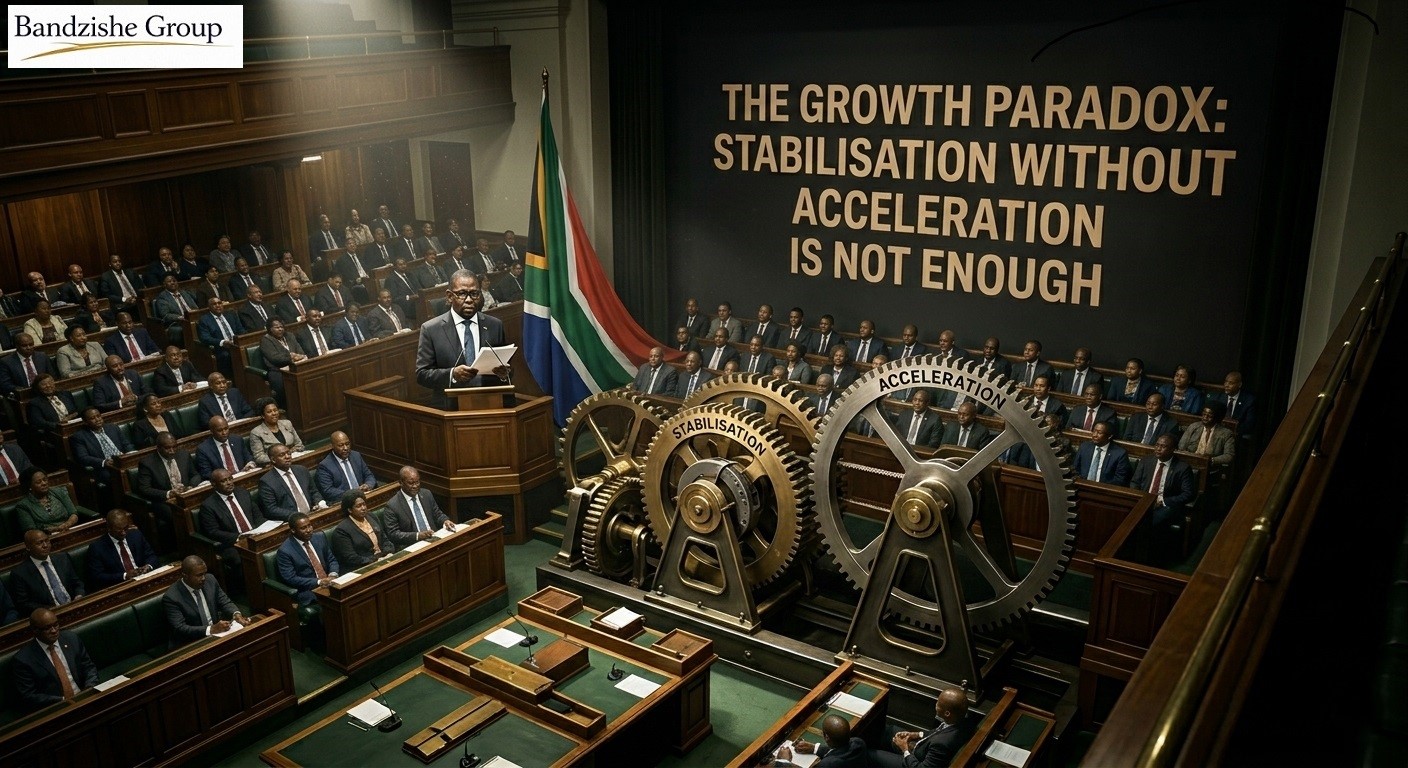
Here is the structural paradox at the heart of Budget 2026, stated without equivocation: a government can achieve exemplary fiscal consolidation and still preside over the gradual impoverishment of its population if the real economy fails to grow at a rate sufficient to absorb its labour force, generate tax revenues beyond current projections, and reduce structural dependency on the social wage. South Africa's projected growth trajectory of 1.6 per cent in 2026, ascending to 1.8 per cent over the medium term, is analytically insufficient for a country with its structural configuration. The World Bank's research on inclusive growth in developing economies with high inequality coefficients, such as South Africa's Gini index of approximately 0.63, suggests that meaningful poverty reduction and labour market absorption require sustained real GDP growth of no less than 4 to 5 per cent per annum. Budget 2026 projects growth rates that are, at best, half this threshold.
Why does this matter for hiring? Employment creation in South Africa is profoundly sensitive to the growth rate, not merely its existence. At 1.6 per cent growth, the formal economy generates insufficient incremental output to justify the marginal employment decisions that drive net job creation. Corporate hiring decisions at Shoprite, at Sasol, at MTN, at AngloGold Ashanti, at Bidvest, and across the entire spectrum of South African enterprise are made at the margin; they respond to demand signals, to the expectation of increased revenue, to the availability of appropriately priced credit, and to the confidence that the regulatory and fiscal environment will not deteriorate faster than the investment can be recovered. Growth at 1.6 to 1.8 per cent sends an ambiguous signal: the economy is stabilising, but it is not accelerating with the conviction required to trigger the investment-employment-consumption virtuous cycle that genuinely transformative growth demands.
The consumption implications are equally serious. Consumer spending, which represents the dominant share of South Africa's GDP, is constrained by three interlocking forces: high unemployment suppressing household income formation; high household indebtedness limiting credit-fuelled consumption growth; and an inflationary environment that erodes real purchasing power. The budget's decision to adjust personal income tax brackets and rebates fully in line with inflation is a welcome relief for the working middle class; it represents a genuine restoration of real purchasing power for salaried earners who would otherwise have suffered bracket creep. The increase in the tax-free savings account annual limit from R36,000 to R46,000, and the lifting of the retirement fund deduction ceiling from R350,000 to R430,000, are structurally sound incentive mechanisms that serve a dual purpose: they reduce the tax burden on saving households while directing private capital toward longer-term accumulation instruments that deepen South Africa's domestic savings base. These are substantive, praiseworthy interventions.
Nevertheless, the honest assessment is that consumer demand stimulation in Budget 2026 is modest and incremental rather than transformatively expansive. The social grant increases, while morally necessary and constitutionally obligated, are calibrated to inflationary adjustment rather than genuine real-value upliftment. The old age grant rises to R2,400 per month, representing an R80 increase. In a country where the food poverty line stands at approximately R760 per person per month, R2,400 is inadequate as a comprehensive safety net for elderly South Africans who frequently support extended multigenerational households. The child support grant of R580 per month, increased by R20, is similarly a figure that arithmetic, rather than compassion, should compel policymakers to examine with greater urgency. The budget allocates R292.8 billion to social grants, and this represents, by any measure, a massive redistributive transfer; but a transfer to 26.5 million grant dependents at current rates is the symptom of an economy that has not grown fast enough to generate sufficient formal employment, not the solution to that failure.
Structural Reforms: Operation Vulindlela and the Infrastructure Imperative
Where Budget 2026 speaks with its most compelling strategic voice is in its commitment to structural reform through Operation Vulindlela and the over-R1 trillion public-sector infrastructure investment commitment over the medium term. The structural thesis is analytically sound: South Africa's growth potential has been systematically suppressed not primarily by insufficient demand, but by supply-side constraints; by the catastrophic logistics failures of Transnet, which rendered South African export commodities uncompetitive; by energy insecurity that imposed a discretionary tax of load-shedding on every enterprise in the country; by municipal dysfunction that inflated the cost of basic services and degraded the spatial efficiency of urban economic activity; and by a regulatory environment that deterred private investment in sectors that should be magnets for capital. Operation Vulindlela addresses these structural fracture points with a directness and institutional seriousness that deserves recognition.
The energy reforms are already yielding measurable results. The liberalisation of the electricity generation sector, including the removal of the licensing threshold for embedded generation and the acceleration of the Renewable Energy Independent Power Producer Programme, has catalysed over R200 billion in private investment commitments and has materially reduced the frequency of load-shedding. For South African manufacturers, retailers, and exporters, a stable electricity supply is not a luxury; it is the foundational prerequisite for competitive production, for maintaining the capital utilisation rates necessary to justify plant investment, and for attracting the foreign direct investment that technology-intensive sectors require. The Credit Guarantee Vehicle, being developed in partnership with the World Bank to support transmission infrastructure investment, is a sophisticated financial engineering response to a well-identified constraint; its operationalisation later in 2026 will represent a pivotal inflection point in South Africa's energy transition architecture.
The logistics reforms are equally consequential. Transnet's decades of mismanagement, accelerated by the ravages of State Capture, left South Africa's coal export corridor performing at roughly 50 per cent of its nameplate capacity and the iron ore corridor similarly constrained. The Budget Facility for Infrastructure's approval of R21.9 billion for Transnet's coal and iron ore corridor projects, targeting a restoration of 77 million tonnes capacity on the coal line and 60 million tonnes on the ore line, is an investment that will generate compounding economic returns far in excess of its direct capital cost. Every additional tonne of coal and iron ore exported at world market prices is a foreign currency earning that strengthens the rand, reduces the current account deficit, and generates corporate tax revenues that reduce the fiscal burden on domestic taxpayers. The analytical case for prioritising logistics capacity restoration is overwhelming, and Godongwana's budget commits to it with appropriate conviction.
The Public-Private Partnership framework reform, currently yielding a pipeline of 63 projects at various stages of development, represents one of the most structurally significant elements of the budget's infrastructure strategy. The six border posts PPP, expected to reach financial close in 2026, will materially reduce transaction costs in South Africa's cross-border trade flows, which are estimated to constitute a disproportionate drag on regional competitiveness. The Gautrain rapid rail link procurement process, now advanced, offers a template for how South Africa can finance and operate world-class urban mobility infrastructure without burdening the sovereign balance sheet with capital that the fiscus cannot currently afford. The lesson from global precedent, from the United Kingdom's Private Finance Initiative to Singapore's infrastructure financing frameworks to India's National Infrastructure Pipeline, is that PPPs work when the contractual architecture is sound, the governance is rigorous, and the political will to honour long-term commitments is sustained. The finalisation of new PPP regulations for municipalities by June 2026 will, if executed as announced, extend this framework to the sphere of government where infrastructure deficits are most acute and most directly damaging to daily economic activity.
Business Confidence and Investment: What the Private Sector Now Requires
The relationship between fiscal credibility and business confidence is not linear; it is mediated by a complex ecosystem of regulatory predictability, institutional quality, infrastructure reliability, and the perceived trajectory of policy. Business confidence in South Africa, as measured by instruments such as the South African Chamber of Commerce and Industry Confidence Index and the RMB/BER Business Confidence Index, has remained structurally depressed despite the macroeconomic improvements of the past three years. The question that boards at Discovery, at Sanlam, at Pick n Pay, at Siemens South Africa, at Amazon Web Services' rapidly expanding South African operations, and at every institutional investor with a South African portfolio allocation must answer is: Does Budget 2026 provide sufficient positive signalling to justify an upward revision of growth and investment assumptions?
The answer, examined with the rigour the question deserves, is a conditional yes, qualified by the speed and fidelity of implementation. The budget's withdrawal of the proposed VAT increase, which had been provisionally included in the May 2025 Budget, removes a significant source of business planning uncertainty. VAT increases of the magnitude proposed, 0.5 percentage points to reach 16 per cent, would have directly suppressed consumer spending, particularly in the lower-to-middle income segments most sensitive to price changes, and would have generated immediate margin pressure for retailers operating on thin earnings before interest and taxes margins. The withdrawal of this increase is therefore not merely a revenue management decision; it is a demand-side protection measure that benefits every South African enterprise dependent on domestic consumption.
The decision to raise the compulsory VAT registration threshold from R1 million to R2.3 million in annual turnover is a genuinely transformative intervention for the small and medium enterprise ecosystem. This single measure will remove thousands of small businesses from the administrative burden of VAT compliance, reducing the regulatory drag on precisely the category of enterprise that South Africa's economic development theory identifies as the most potent generator of employment at the margins of the formal economy. Small business owners such as the Gauteng entrepreneur Renette Oosthuizen, whose citizen submission catalysed this very measure, understand intuitively what economic theorists demonstrate empirically: compliance costs are regressive for small enterprises, consuming a disproportionate share of management time and financial resources relative to the revenue they generate. The threshold adjustment is fiscally modest but strategically significant; it signals that the National Treasury is listening to the operational realities of enterprise rather than governing from the abstraction of aggregate revenue optimisation.
For large corporations and institutional investors, the budget's signal on data infrastructure is noteworthy. Minister Godongwana's explicit framing of data infrastructure as critical economic infrastructure, comparable in strategic importance to electricity, ports, and transport networks, represents a meaningful shift in the government's conceptual architecture. The commitment to exploring options that expand data centre investment and solidify South Africa's role as a regional hub for data technologies is directly relevant to the investment decisions being made in boardrooms in Seattle, in Dublin, in Singapore, and in Shanghai. The hyperscaler investments already committed by Microsoft, Google, and Amazon in South Africa's data centre ecosystem represent billions of rands in capital expenditure, thousands of high-skill employment opportunities, and a technological sovereignty dividend that cascades across financial services, healthcare, logistics, and manufacturing. The government's willingness to treat this infrastructure category with the same strategic seriousness as physical infrastructure is a signal that the policy architecture is evolving in the right direction.
Human Capital, Skills Architecture, and the Productivity Imperative
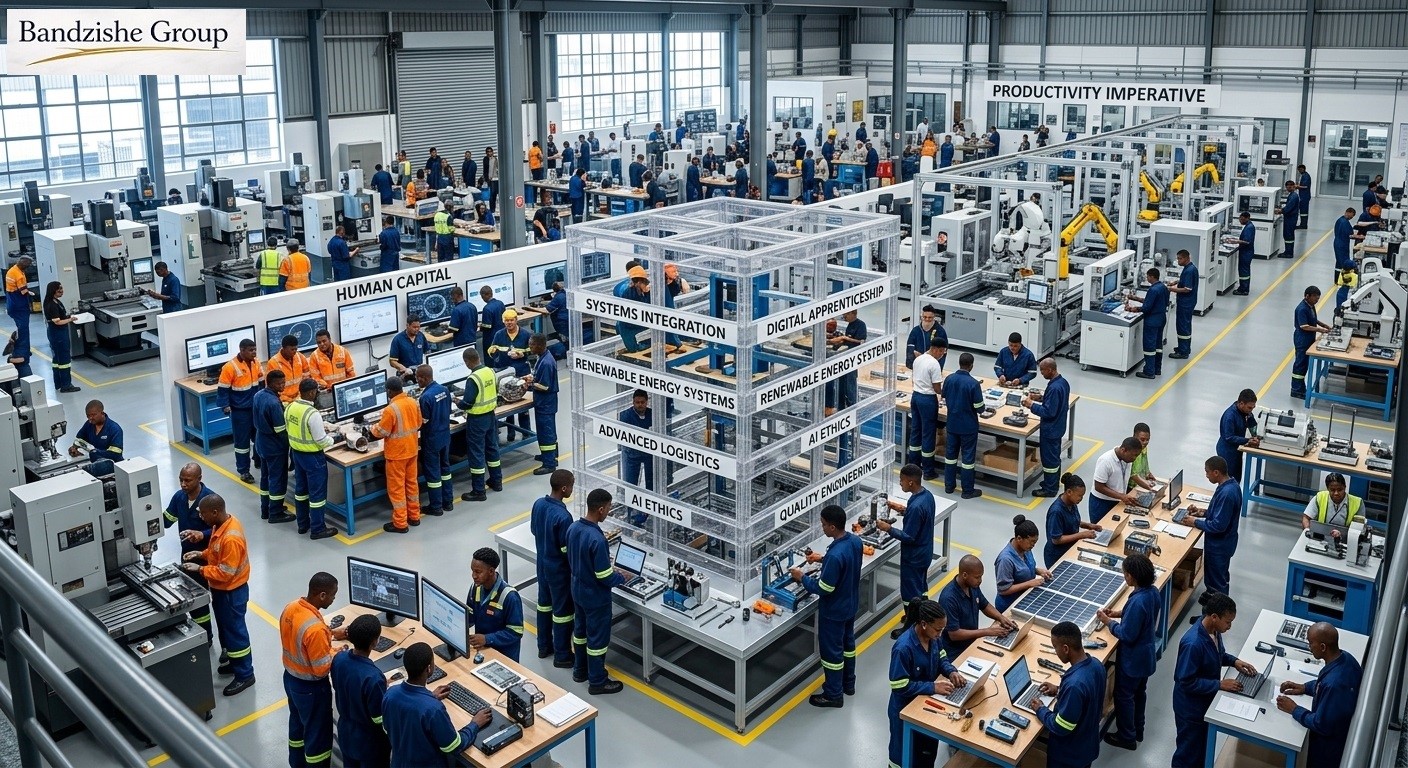
No budget, however technically sophisticated, can deliver sustained economic growth without a parallel investment in human capital of commensurate ambition. South Africa's human capital deficit is not a problem at the margins of its growth challenge; it is a central structural constraint that limits the productivity of every rand of capital investment, every technology deployment, every infrastructure project, and every enterprise expansion. Budget 2026 addresses the skills development question with a degree of analytical honesty that is welcome, if overdue. The government's acknowledgement that the Skills Development Levy paid by employers to fund Sector Education and Training Authorities and the National Skills Fund has not yielded the expected outcomes is a significant institutional admission; it represents a willingness to evaluate existing spending programmes by outcomes rather than by inputs, which is precisely the discipline that elite consulting firms such as McKinsey and BCG apply when auditing organisational effectiveness.
The proposed dual-training skills acquisition system, modelled on the vocational education architectures that have made Germany's Mittelstand and Switzerland's precision manufacturing base globally competitive, represents one of the most intellectually promising reform ideas in the budget. The German apprenticeship model, which integrates workplace training with theoretical instruction and grants industry a genuine co-ownership stake in curriculum design, has demonstrably produced a workforce whose practical competence exceeds what classroom-only models can achieve. For South Africa, where youth unemployment is both the most urgent social crisis and the most acute structural constraint on growth, a genuine dual-training system that deploys the institutional capacity of private employers alongside the credentialing authority of public training institutions would represent a structural correction of profound importance. The caveat is equally important: this remains an exploration rather than an implementation commitment, and the distance between policy aspiration and operational reality in South African public administration has historically been the graveyard of well-intentioned reform.
The early childhood development allocation deserves particular analytical attention. The R12.8 billion additional allocation to the ECD grant over three years, expanding service coverage to an additional 300,000 children and sustaining the per-child, per-day subsidy of R24, represents an investment that cognitive science, developmental economics, and longitudinal social research all validate as among the highest-return public expenditures available to any government. Nobel Prize-winning economist James Heckman's foundational research demonstrates that the return on investment in early childhood cognitive and social development, particularly for children from economically disadvantaged households, exceeds the return on virtually any other category of public spending, including tertiary education infrastructure and adult skills retraining. South Africa's investment in ECD is therefore not a social welfare expenditure in the conventional sense; it is a forty-year growth strategy. The budget's commitment to sustaining and expanding this programme is analytically sound and deserves to be recognised as one of the most consequential long-term structural decisions embedded in the 2026 fiscal framework.
The allocation of R26 billion to provinces to bolster the HIV/AIDS programme, including the prevention of mother-to-child transmission and the provision of antiretrovirals, following the funding withdrawal by the United States government from PEPFAR, is both a moral obligation and an economic calculation. South Africa carries the world's largest HIV-positive population, and the productivity loss from unmanaged HIV infection across the working-age population represents a measurable drag on GDP that dwarfs the fiscal cost of treatment. The decision to repurpose provincial funding to meet PEPFAR obligations is a responsible response to an externally imposed fiscal shock, but it raises a question that the global health and development community must confront directly: the withdrawal of United States government support for HIV treatment programmes in sub-Saharan Africa is not merely a bilateral policy decision; it is a geopolitical act with measurable human and economic consequences that will reverberate through labour markets, household income trajectories, and social stability indices for decades.
Municipal Governance and Local Economic Development: The Accountability Architecture
No honest analysis of South Africa's growth constraints can avoid a direct confrontation with the local government crisis. The budget's data is stark and demands the full weight of its implications: 63 per cent of South Africa's municipalities are in financial distress. The proportion of clean audits remains, in the Minister's own characterisation, unacceptably low. The case of Johannesburg, where water revenue of R11.9 billion generates a capital expenditure allocation to Johannesburg Water of only R1.3 billion, producing a maintenance backlog estimated at R64 billion, is not an anomaly; it is emblematic of a systemic practice in which revenue collected for essential services is diverted to unrelated functions, leaving the service infrastructure to degrade until it collapses. This is not a governance failure in the administrative sense; it is a structural economic failure that imposes a chronic competitiveness tax on every enterprise located within these dysfunctional municipalities.
The R27.7 billion performance-linked reform allocation for metro trading services in electricity, water, sanitation, and solid waste, with the explicit conditionality that failure to meet reform targets will result in budget reductions, represents a structurally correct approach to breaking the cycle of municipal financial mismanagement. The metro reform framework is philosophically aligned with the private sector principle that capital should follow performance rather than precedent. Cities such as eThekwini and the City of Johannesburg, now implementing Council-approved improvement plans to ring-fence revenue and reinvest in water and electricity services, are being asked to demonstrate precisely the kind of service-specific financial discipline that every well-managed infrastructure business applies as a matter of operational orthodoxy. If executed with the rigour the framework demands, this reform could catalyse the single most significant improvement in urban economic productivity that South Africa has achieved in a generation.
The split delivery model for the Municipal Infrastructure Grant, which redirects funding from municipalities with serious capacity or governance failures to capable district municipalities and accredited implementing agencies, is analytically defensible even if politically contentious. The economic logic is compelling: capital allocated to projects that are not implemented, or are implemented deficiently, destroys value. The grants system's persistent underspending and misuse represent not merely a fiscal inefficiency; it represents a failure to deliver the physical infrastructure, the roads, the water reticulation, the sanitation systems, upon which enterprise competitiveness and household welfare depend. By introducing a performance-contingent delivery model, the budget signals that accountability is no longer a rhetorical aspiration but an operationally enforced condition of resource allocation. This is a structural reform of significant importance, and its implementation deserves rigorous independent monitoring.
The Office of the Chief Justice's budget independence, formalised by the R883.8 million reallocation from the Department of Justice, and the parallel arrangements for the funding independence of Parliament, deserve recognition as institutional architecture improvements with direct implications for the investment climate. The independence of the judiciary, credibly demonstrated through institutional financial autonomy rather than merely asserted through constitutional text, is a fundamental determinant of contract enforcement confidence. Every foreign direct investment decision, every private equity commitment, every cross-border acquisition, and every trade finance arrangement depends at its foundation on the confidence that disputes will be adjudicated impartially. The strengthening of judicial independence in Budget 2026 is therefore not merely a constitutional nicety; it is an economic investment in the rule-of-law infrastructure upon which productive capital allocation depends.
Technological Sovereignty and the Artificial Intelligence Dividend: South Africa's Strategic Window
The global race for technological sovereignty is being run at a velocity that tolerates no complacency. Nations that fail to position themselves as credible hosts and developers of artificial intelligence infrastructure, data ecosystems, and digital financial architecture within this decade will find themselves structurally relegated to the periphery of the innovation economy, dependent on technological capabilities owned, priced, and governed by other jurisdictions. South Africa stands at a moment of genuine strategic opportunity in this race, an opportunity that Budget 2026 acknowledges but does not yet pursue with the full ambition its structural advantages warrant. The hyperscaler investments already operational in South Africa, the country's position as the continent's most sophisticated financial services market, its robust legal and intellectual property framework, and its English-language technical workforce represent a combination of attributes that should be making South Africa the default African headquarters for every global technology company's regional operations.
Minister Godongwana's explicit elevation of data infrastructure to the status of critical national infrastructure, and the commitment to exploring options for expanding data centre investment, is a conceptually important signal. However, the exploration of options is a long way from the implementation of policy. What South Africa's technology sector requires is not an exploratory framework; it is a comprehensive digital infrastructure investment strategy, with specific fiscal incentives for data centre development, defined fast-track licensing processes for digital infrastructure projects, and a skills pipeline explicitly calibrated to the human capital requirements of a technology-intensive economy. Countries such as Singapore, Estonia, and, increasingly, Rwanda, have demonstrated that digital transformation does not require decades; it requires political will, institutional speed, and a governance environment sufficiently predictable to justify the patient capital that technology infrastructure demands.
The budget's treatment of crypto assets, with the forthcoming publication of draft regulations under the Currency and Exchanges Act to include crypto assets in the capital flow management regime, represents a mature and pragmatic regulatory response to an asset class that has too often been governed by regulatory avoidance rather than regulatory design. South Africa's positioning as a thoughtful, rules-based jurisdiction for crypto asset regulation, complementary to the existing anti-money-laundering and fraud-prevention framework, could attract fintech investment and talent at a meaningful scale. The African Continental Free Trade Agreement's implementation, which the budget identifies as a key objective for the financial sector, creates a multi-trillion-rand market opportunity for South African financial institutions, payment infrastructure providers, and technology companies with the structural capacity to serve continental scale. PayInc, the Payments Utility established in November 2025 to provide open, shared digital payments infrastructure, is precisely the kind of foundational financial infrastructure that enables fintech innovation to scale rapidly. Its successful operationalisation could position South Africa as the continent's default payments infrastructure provider.
The artificial intelligence integration imperative extends well beyond the technology sector. Every South African enterprise that fails to integrate AI-driven decision-making into its operations, its marketing architecture, its supply chain management, and its customer engagement strategy within the next three to five years will find itself structurally disadvantaged relative to global competitors that have made this transition. The implications for strategy, for talent acquisition, for capital allocation, and for organisational design are profound. Boards at South African corporates have a fiduciary obligation to their shareholders, and increasingly to their stakeholders, to ensure that AI adoption is not a peripheral digital transformation initiative but a core strategic priority embedded in executive mandates and performance metrics. Budget 2026's data infrastructure commitments provide the enabling environment; the execution imperative now rests with the private sector.
Global Comparative Positioning: What South Africa Must Learn from Peer Economies

The most productive analytical lens through which to examine Budget 2026 is not comparison with South Africa's own historical performance, where the baseline of State Capture, junk credit status, and FATF grey-listing makes almost any improvement appear impressive, but comparison with peer economies that have navigated similar structural challenges and achieved superior growth outcomes. South Korea's transition from a middle-income economy to a high-income technology powerhouse between 1970 and 1995 was driven by three simultaneous strategies: aggressive investment in human capital at all levels of the education system; deliberate industrial policy that targeted export-oriented manufacturing sectors with globally competitive cost structures; and fiscal frameworks that directed sovereign savings into productive capital formation rather than consumption transfers. The parallels with South Africa's current structural choices are imperfect but instructive.
India's sustained growth acceleration since 2014, which has produced average annual real GDP growth rates approaching 7 per cent and is projected, according to the 2026 budget's own global economic outlook, to continue outperforming the global average, has been powered by a combination of infrastructure investment, digital public goods infrastructure, and reforms to the business regulatory environment that dramatically reduced the time and cost of establishing formal enterprises.
India's Unified Payments Interface, the digital payments platform that processed over 100 billion transactions in 2023, is a direct parallel to South Africa's PayInc ambition, and its success story offers a concrete implementation roadmap. Indonesia, Vietnam, and Bangladesh have each demonstrated that economies with large, young, relatively unskilled labour forces can achieve 5 to 7 per cent sustained growth through strategic integration into global manufacturing supply chains, predicated on regulatory competitiveness, logistics infrastructure investment, and macroeconomic stability. These are not abstract models; they are proven growth architectures that South Africa's policymakers and private sector leaders should be studying with far greater intensity than they currently appear to.
The African Continental Free Trade Agreement, ratified by 54 of the 55 African Union member states and representing a combined market of 1.4 billion people with a combined GDP exceeding three trillion United States dollars, is the most consequential strategic growth opportunity available to South African enterprise in the coming decade. Budget 2026's commitment to using the financial sector as a vehicle for regional integration and AfCFTA implementation is structurally sound, but it requires private sector execution with far greater urgency and institutional coordination than has characterised South Africa's continental engagement to date. South African banks, retailers, telecommunications companies, and logistics providers that move decisively to establish continental footprints in the next five years will capture market shares that will be structurally difficult to displace. Those that hesitate will find Rwandan, Kenyan, and increasingly Chinese and Turkish competitors occupying the strategic positions that South African enterprises, by virtue of their sophistication and capitalisation, should by rights dominate.
The illicit trade crisis, which Godongwana identified with unprecedented directness in the budget speech, referencing the announcement by a major tobacco producer that it will close its local operations as a consequence of illicit trade displacement, is a structural competitiveness crisis that extends well beyond the tobacco sector. Illicit trade in tobacco, alcohol, petroleum products, and counterfeit goods represents an annual fiscal loss estimated in the tens of billions of rands; it suppresses legitimate enterprise investment, destroys formal employment, and signals to international investors that South Africa's regulatory enforcement capacity is insufficient to protect market integrity. The SARS intensification of enforcement, in collaboration with the Border Management Agency, the South African Police Service, and the South African National Defence Force, is a necessary response. But the deeper structural question is whether South Africa's institutional framework for border management and trade enforcement is adequately capitalised, technologically equipped, and organisationally designed to address the scale and sophistication of modern illicit trade networks.
Implementation Intelligence: Practical Pathways for South African and Global Corporations
Strategic analysis without implementation intelligence is intellectual theatre. What South African chief executives, what global corporate boards with South African operations, and what institutional investors with South African portfolio exposure require from Budget 2026 are not merely macroeconomic narratives; they require specific operational intelligence about how the budget's structural choices create actionable opportunities and where the residual risks require active management. Consider first the infrastructure investment opportunity. The R1 trillion public-sector infrastructure commitment over the medium term, combined with the growing PPP pipeline of 63 projects, creates a procurement and partnership market of extraordinary scale for the construction, engineering, technology, financial services, and professional services sectors. Companies such as WBHO, Murray and Roberts, Aveng, and their international counterparts, such as Bouygues, AECOM, and Bechtel, that position themselves strategically within this procurement ecosystem, through the development of PPP expertise, black economic empowerment partnership architectures, and project finance capabilities, will capture disproportionate value from a capital allocation cycle that the budget has now credibly committed to sustaining.
For multinational corporations evaluating or operating within South Africa, the VAT threshold increase from R1 million to R2.3 million represents an immediate opportunity to restructure supply chains to leverage smaller South African suppliers that were previously excluded from formal commercial relationships by VAT compliance barriers. Global companies such as Unilever, Nestlé, and Procter and Gamble, which operate in South Africa with deep domestic supply chain footprints, should be recalibrating their supplier development programmes to capture the entrepreneurial energy that this regulatory liberalisation will release. The tax-free savings account limit increase, from R36,000 to R46,000 annually, creates an opportunity for financial services providers and fintech companies to design and market new savings products calibrated to the revised limits. Companies such as Old Mutual, Sanlam, Discovery Invest, and a new generation of neobank competitors should be in product development mode today, designing the savings vehicles that will capture the incremental capital this fiscal incentive directs toward formal savings instruments.
The data infrastructure and technology sector opportunity demands the most urgent response from both South African enterprises and global technology corporations. South Africa's designation as a regional data hub, supported by hyperscaler investments and an evolving regulatory framework for crypto assets and digital finance, positions Johannesburg and Cape Town as credible candidates for the regional headquarters of technology companies currently evaluating African market strategies. The practical recommendation for technology sector executives is direct and time-sensitive: file planning approvals for data centre developments now, ahead of the regulatory framework updates that the budget commits to; engage National Treasury and the Department of Communications and Digital Technology on the incentive structures under exploration; and build the public-private partnership relationships that will be essential for navigating the licensing and utility supply processes that constrain data centre deployment timelines. The window of strategic advantage in this sector is narrowing; Rwanda and Kenya are advancing their own data infrastructure propositions with significant speed.
For human capital strategy, the dual-training skills system signals an emerging opportunity for South African corporates to co-design training curricula with public institutions in ways that directly address their sector-specific skills shortages. Companies in financial services, technology, mining, logistics, and healthcare that invest in shaping the dual-training system from its architectural phase will gain preferential access to the talent pipelines it produces, a competitive advantage whose value compounds over decades. The model is well established internationally: Goldman Sachs, Siemens, Volkswagen, and Bosch each operate proprietary training academies integrated with national vocational systems. South African executives who dismiss this opportunity as a government initiative unworthy of private sector engagement are misreading the strategic landscape with consequences that will materialise in their workforce capability gaps five to ten years hence.
Social Stability and the Inequality Dividend: The Governance Compact
Economic growth divorced from social stability is a chimera; it cannot be sustained because the social tensions generated by extreme inequality and mass unemployment will ultimately overwhelm the institutional capacity to maintain the security, the property rights protection, and the contract enforcement upon which productive economic activity depends. South Africa's inequality and unemployment statistics are not merely moral indictments; they are systemic economic risks. An unemployment rate above 32 per cent, concentrated overwhelmingly in the Black African demographic that comprises 80 per cent of the population, produces social pressures that manifest in strike action, in protest disruptions to logistics and production, in property crime that inflates the security expenditures of every enterprise in the country, and in the political dynamics that constrain the fiscal space available for growth-enhancing investment. Every rioter who burns a shopping centre, every strike that halts a production line, every informal settlement expansion that degrades urban infrastructure, represents a direct cost to the growth agenda that Budget 2026 seeks to advance.
The budget's commitment to peace and security spending, with the deployment of defence force alongside police to address illegal mining and gangsterism as announced in the State of the Nation Address, reflects a government grappling seriously with the social stability prerequisites of economic development. The additional R1 billion to the South African Police Service and R1 billion to the SANDF through the Criminal Assets Recovery Account for combating organised crime, the R687 million increase in judiciary capacity, and the enhanced independence of the Office of the Chief Justice are all components of an institutional architecture that, if properly executed, reduces the transaction costs of doing business in South Africa by strengthening the rule-of-law foundations on which enterprise confidence depends. Businesses do not locate, invest, and hire in jurisdictions where organised crime controls supply chains, where illegal mining operations disrupt water and electricity infrastructure, and where the judicial system is too under-resourced to resolve commercial disputes within commercially meaningful timeframes.
The social wage, representing more than 60 per cent of non-interest spending and supporting 13.6 million school children, healthcare services for 84 per cent of the population, and social grants for 26.5 million beneficiaries, is simultaneously the budget's greatest social achievement and its most fiscally constraining structural characteristic. The basic education allocation, representing 23.7 per cent of consolidated spending over the medium term and the largest single category of government expenditure, reflects an institutional commitment to human capital formation that the economic growth literature consistently validates as the most important long-run determinant of development outcomes. The question is not whether to fund education but whether the current architecture of educational expenditure, heavily weighted toward teacher compensation in a system where learning outcomes in South African schools remain deeply below OECD and upper-middle-income country benchmarks, is generating the return on investment that the allocation size warrants.
The HIV/AIDS funding decision, absorbing provincial allocations to meet the PEPFAR obligations vacated by United States policy changes, illuminates a structural vulnerability in South Africa's social infrastructure that the budget cannot fully resolve within its current fiscal parameters. South Africa's public health system is carrying a disease burden, encompassing HIV, tuberculosis, and a rapidly escalating non-communicable disease profile driven by dietary transition and urbanisation, that would challenge the fiscal capacity of an economy three times its current size. The health sector allocation of R21.3 billion over the medium term for doctor compensation and goods and services expenditure shortfalls is a credible commitment within the constraints of available fiscal space; it is not, however, a transformation of South Africa's health system from its current state of chronic undercapacity to the state required to support a productive, physically capable workforce of the scale the growth agenda demands. The honest conclusion is that Budget 2026 maintains South Africa's social floor with fiscal responsibility; it does not raise that floor with the transformative ambition that the growth imperative requires.
Final Synthesis: Growth as National Mandate, Not Macroeconomic Variable
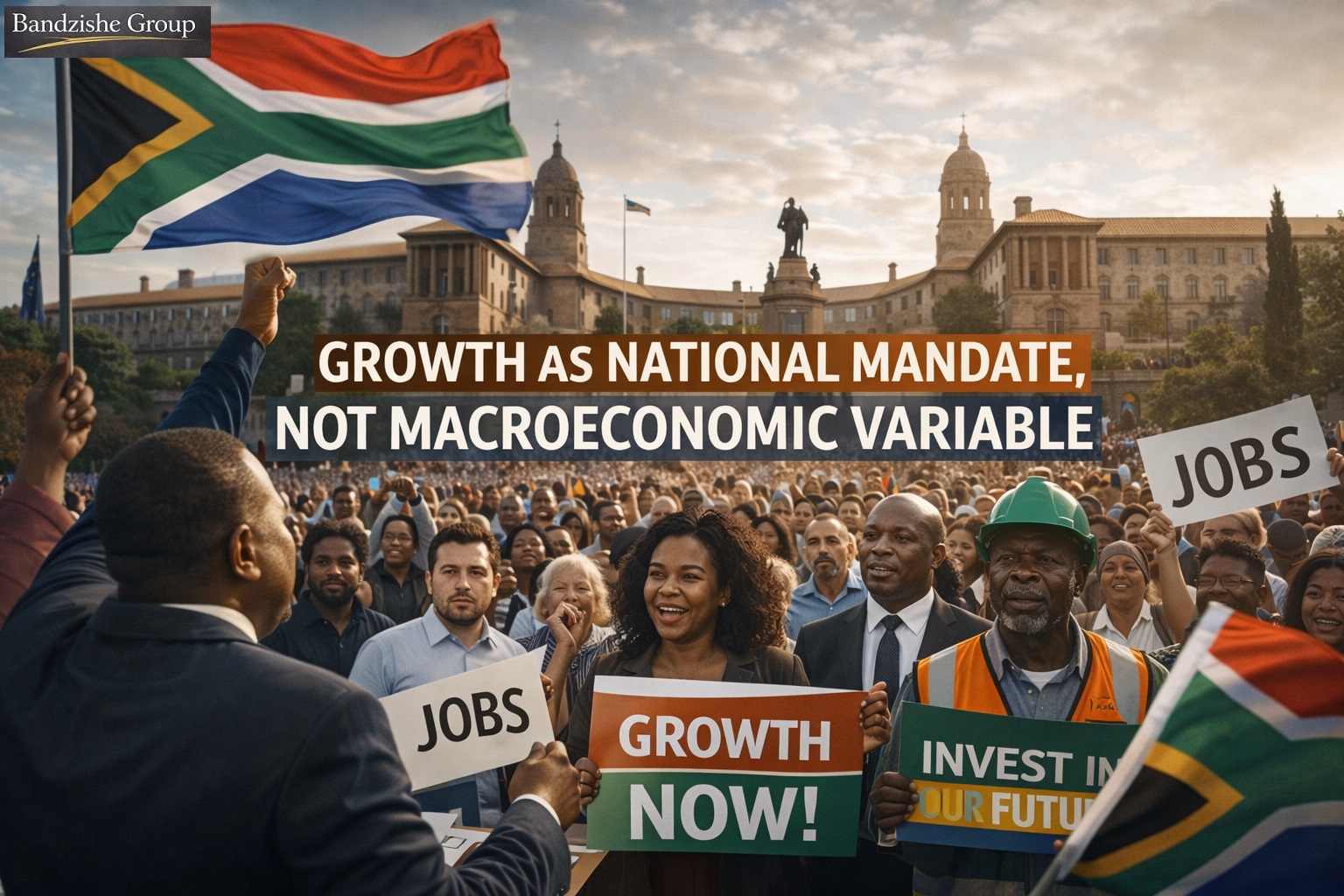
The definitive verdict on Budget 2026 is this: it is the most fiscally responsible, institutionally credible, and structurally coherent budget that South Africa has produced in a generation. Minister Godongwana has navigated an extraordinarily complex political economy with technical precision, institutional courage, and a strategic vision that extends beyond electoral cycles. The debt stabilisation, the primary surplus trajectory, the credit rating upgrade, the FATF grey list exit, the structural reform commitments, the infrastructure investment pipeline, the regulatory liberalisation for small businesses, and the data infrastructure ambition collectively represent a fiscal framework that deserves the respect and engagement of every serious business leader, every institutional investor, and every policymaker who cares about South Africa's trajectory. This must be acknowledged without reservation.
And yet: fiscal responsibility is the floor of national ambition, not its ceiling. South Africa's civilisational challenge, its approximately 22 million working-age citizens excluded from employment, its 26.5 million grant dependents, its collapsing municipal infrastructure, its schools producing graduates without the competencies the economy requires, its hospitals straining under disease burdens that a wealthier country would manage with greater ease, is not a challenge that growth at 1.6 to 1.8 per cent per annum will resolve within the political and social timeframes that democratic governance requires. The growth doctrine is not a sterile macroeconomic variable; it is the civilisational force that determines whether South Africa fulfils the constitutional promise of human dignity, equality, and freedom that the generation of 1994 bequeathed to its successors. A nation that stabilises its debt while its social fabric frays is a nation deferring a reckoning, not averting one.
What is now required, in the period between Budget 2026 and the 2026 Medium-Term Budget Policy Statement, is an acceleration of ambition to match the acceleration of implementation. The structural reforms must be executed with the same rigour that designed them. The PPP pipeline must move from development to financial close at commercial speed. The dual-training skills system must transition from exploration to legislation within twelve months. The data infrastructure strategy must evolve from commitment to policy instrument within six months. The municipal reform framework must be enforced with the conditionality that the budget promises, without political accommodation of persistent non-performers. And the private sector, fortified by restored fiscal credibility and emboldened by the regulatory improvements this budget delivers, must respond with the investment conviction that the structural improvements warrant. Business leaders who wait for perfect conditions will wait forever; the conditions that Budget 2026 establishes are the best that South Africa has offered in a generation.
The ultimate test of Budget 2026 will not be administered by credit rating agencies, though their assessments matter; not by the IMF's Article IV consultations, though their conclusions influence capital flows; not by the World Bank's Doing Business indices, though their rankings affect foreign direct investment decisions. The ultimate test will be administered by the 22 million South Africans without formal employment who wake each morning to confront an economy that has not yet grown fast enough to offer them a productive place within it. They are the auditors of everything this budget promises. Their verdict will be rendered not in Parliament but in the labour market, in the consumer economy, in the social stability statistics, and in the political choices of a democracy that, five years hence, will assess whether the growth trajectory of 2026 became the genuine economic renaissance that was always possible, or merely the most technically accomplished chapter in a long story of deferred transformation.
The choice, as it has always been, belongs to those with the power, the knowledge, and the courage to exercise it. Budget 2026 has expanded that power and deepened that knowledge. The question that now confronts every South African boardroom, every institutional investor, every global corporation with a South African mandate, and every policymaker who has absorbed the implications of this analysis, is whether the courage is adequate to the moment. History will not accept the pleading of insufficient circumstances. It will only record whether, when the conditions for transformation were present, the people with the authority to act chose to act, without hesitation and without compromise.
Images by Bandile Ndzishe of Bandzishe Group
About bandile ndzishe

Bandile Ndzishe is the CEO, Founder, and Global Consulting CMO of Bandzishe Group, a premier global consulting firm distinguished for pioneering strategic marketing innovations and driving transformative market solutions worldwide. He holds three business administration degrees: an MBA, a Bachelor of Science in Business Administration, and an Associate of Science in Business Administration.
With over 30 years of hands-on expertise in marketing strategy, Bandile is recognised as a leading authority across the trifecta of Strategic Marketing, Daily Marketing Management, and Digital Marketing. He is also recognised as a prolific growth driver and a seasoned CMO-level marketer.
Bandile has earned a strong reputation for delivering strategic marketing and management services that guarantee measurable business results. His proven ability to drive growth and consistently achieve impactful outcomes has established him as a well-respected figure in the industry.
As an AI-empowered and an AI-powered marketer, I bring two distinct strengths to the table: empowered by AI to achieve my marketing goals more effectively, whilst leveraging AI as a tool to enhance my marketing efforts to deliver the desired growth results. My professional focus resides at the nexus of artificial intelligence and strategic marketing, where I explore the profound and enduring synergy between algorithmic intelligence and market engagement.
Rather than pursuing ephemeral trends, I examine the fundamental tenets of cognitive augmentation within marketing paradigms. I analyse how AI's capacity for predictive analytics, bespoke personalisation, and autonomous optimisation precipitates a transformative evolution in consumer interaction and brand stewardship. By extension, I seek to comprehend the strategic applications of artificial intelligence in empowering human capability and fostering innovation for sustainable societal advancement.
In essence, I explore how AI augments human decision-making and strategic problem-solving in both marketing and other domains of life. This is not merely an interest in technological novelty, but a rigorous investigation into the strategic implications of AI's integration into the contemporary principles of marketing practice and its potential to reshape decision-making frameworks, rearchitect strategic problem-solving paradigms, enhance strategic foresight, and influence outcomes in diverse areas beyond the marketing sphere.