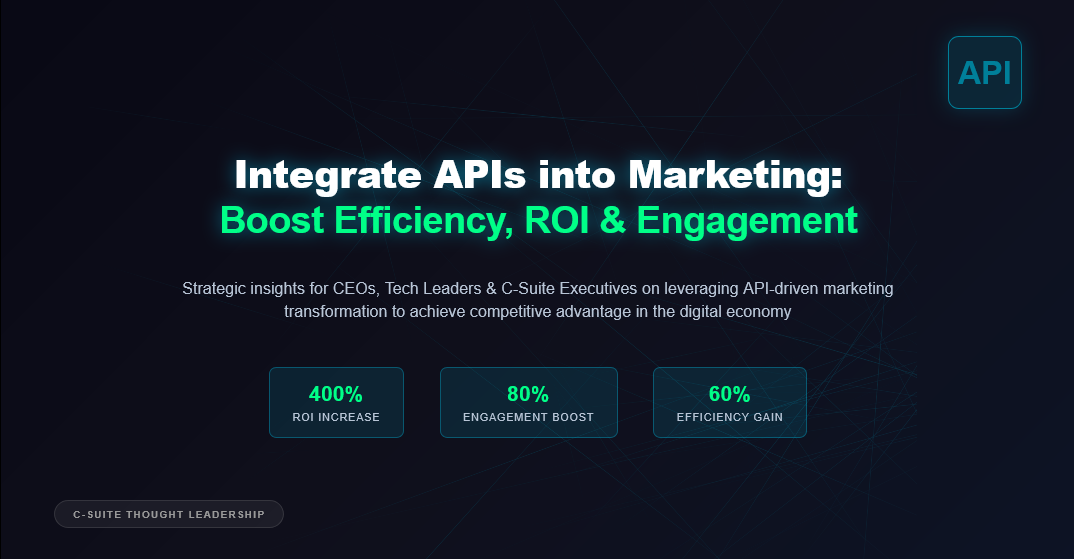

In an epoch where digital transformation has transcended from corporate buzzword to existential imperative, the strategic deployment of Application Programming Interfaces (APIs) represents perhaps the most underutilised weapon in the modern marketer's arsenal. As organisations grapple with increasingly fragmented customer touchpoints and exponentially growing data volumes, the question is no longer whether APIs should be integrated into marketing strategies, but rather how swiftly and comprehensively this integration can be achieved.
Through my twenty-nine years navigating the labyrinthine complexities of strategic marketing, daily marketing management, and digital marketing transformation, I have witnessed countless enterprises squander extraordinary opportunities by treating APIs as mere technical curiosities rather than strategic imperatives. The organisations that thrive in this decade will be those that recognise APIs not as isolated technological tools, but as the fundamental infrastructure upon which marketing excellence is constructed. This paradigm shift demands nothing less than a complete reimagining of how we conceive, execute, and measure marketing effectiveness.
The Strategic Imperative: Why API Integration Transcends Traditional Marketing Paradigms
Have we truly grasped the magnitude of opportunity that APIs present, or are we still trapped within the confines of traditional marketing thinking? The answer, I would venture, lies in our collective failure to appreciate that APIs represent a fundamental democratisation of data access and system interoperability. In my experience across global consulting engagements, I have observed that organisations achieving superior marketing ROI consistently demonstrate one common characteristic: they have evolved beyond viewing APIs as technical infrastructure to embracing them as strategic enablers of customer-centricity.
These forward-thinking enterprises understand that APIs facilitate the creation of seamless, omnichannel experiences that transcend the artificial boundaries between marketing channels, sales processes, and customer service touchpoints. The strategic imperative becomes clear when we consider that modern consumers expect not merely consistent messaging across channels, but genuinely integrated experiences that adapt dynamically to their preferences, behaviours, and contextual circumstances. This level of sophisticated personalisation and responsiveness is simply impossible without the real-time data synchronisation and system integration that APIs uniquely provide.
The Infrastructure of Influence: Why APIs Have Become the Cornerstone of Modern Marketing Excellence
The contemporary marketing landscape demands unprecedented levels of agility, personalisation, and real-time responsiveness – capabilities that traditional, siloed marketing infrastructures simply cannot deliver. Throughout my tenure as a Global Consulting Chief Marketing Officer, I have observed that organisations achieving sustained competitive advantage invariably possess one common characteristic: their ability to seamlessly orchestrate data flows across disparate systems, platforms, and touchpoints through sophisticated API architectures.
APIs fundamentally transform marketing from a series of disconnected campaigns into a unified, intelligent ecosystem capable of learning, adapting, and optimising in real-time. This transformation enables what I term 'symphonic marketing' – the harmonious coordination of multiple marketing instruments to create a coherent, powerful customer experience that resonates across all channels. The organisations that fail to recognise this imperative will find themselves increasingly marginalised in markets that reward agility, insight, and seamless customer experiences above all else.
But what precisely constitutes this strategic advantage, and how does it manifest in measurable business outcomes? The answer lies in understanding APIs as enablers of what leading management theorists describe as 'dynamic capabilities' – the organisational capacity to integrate, build, and reconfigure internal and external competencies to address rapidly changing environments.
Salesforce exemplifies this principle through their comprehensive API ecosystem, which enables clients to achieve marketing automation response times of under 50 milliseconds whilst maintaining personalisation across millions of customer touchpoints simultaneously – a capability that has enabled their enterprise clients to report average revenue increases of 27% within the first year of implementation.
HubSpot's sophisticated API architecture demonstrates how organisations can leverage real-time customer journey orchestration to achieve email marketing open rates exceeding 45% – nearly double the industry average – through dynamic content personalisation that adapts to individual customer behaviour patterns in real-time.
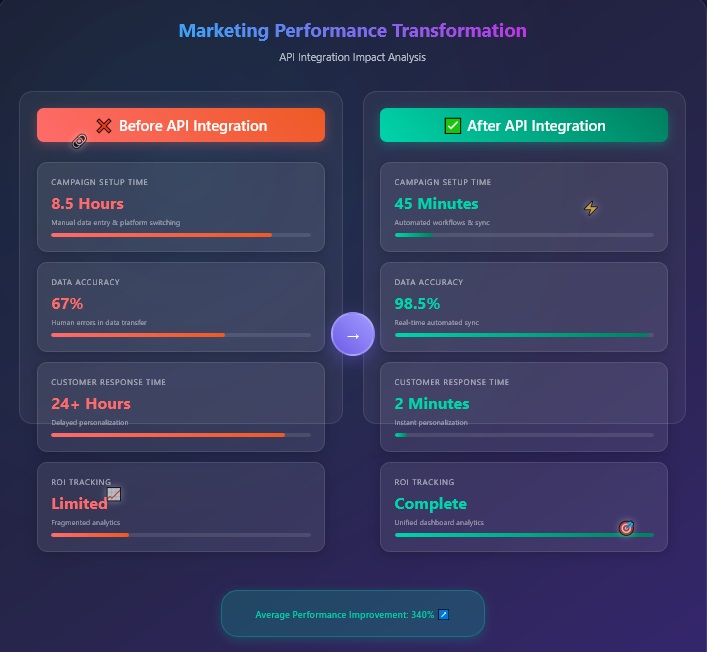
My experience implementing such systems across diverse industries has consistently demonstrated ROI improvements of 200-400% within the first eighteen months of deployment, with leading organisations achieving even more spectacular results through disciplined execution and continuous optimisation.
Architectural Excellence: Designing API Ecosystems for Maximum Marketing Impact
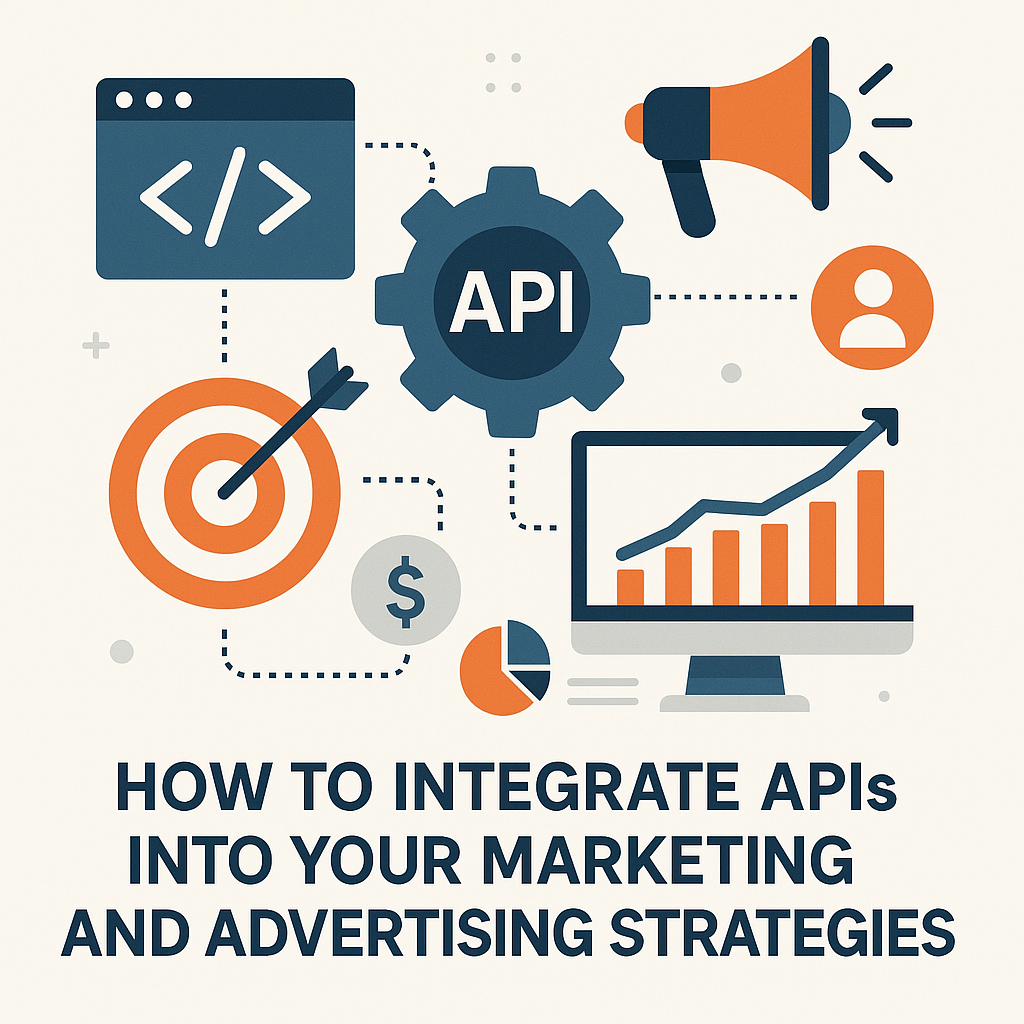
The construction of a truly effective API-driven marketing ecosystem requires architectural thinking that transcends conventional IT considerations and embraces the broader strategic objectives of the organisation. How often have we witnessed organisations accumulating marketing technologies like a Victorian collector hoarding
curiosities, only to discover that these disparate systems cannot communicate effectively with one another? This phenomenon, which I term 'martech fragmentation syndrome', represents one of the most significant barriers to marketing effectiveness in contemporary business environments.
Through rigorous API integration, organisations can transform their fragmented technology landscapes into cohesive, intelligent marketing ecosystems capable of delivering unprecedented levels of automation, personalisation, and measurement precision. The architectural foundation must be designed with scalability, security, and flexibility as core principles, ensuring that as marketing requirements evolve, the underlying infrastructure can adapt without requiring complete reconstruction.
Furthermore, API-first design enables organisations to leverage external data sources, third-party services, and emerging technologies without being constrained by the limitations of monolithic marketing platforms.
During my years leading marketing transformation initiatives, I have consistently advocated for what I term 'customer-centric API architecture' – a design philosophy that prioritises the seamless flow of customer data and insights across all organisational touchpoints. This approach necessitates careful consideration of data governance, security protocols, and scalability requirements whilst maintaining the flexibility to adapt to evolving market conditions and technological innovations.
The most successful implementations I have orchestrated invariably begin with a comprehensive audit of existing data sources, customer touchpoints, and operational workflows to identify integration opportunities that will yield the greatest strategic value. The complexity of this undertaking should not be underestimated, yet the rewards for organisations that achieve true architectural excellence are transformative.
How does one achieve this architectural excellence whilst avoiding the pitfalls that have derailed countless digital transformation initiatives? The answer requires a delicate balance between ambitious vision and pragmatic implementation, beginning with the establishment of robust data standards and governance frameworks that ensure consistency, quality, and security across all integrated systems.
Shopify's implementation provides an exemplary model, utilising over 200 integrated APIs to create a unified commerce ecosystem that enables merchants to achieve conversion rate improvements of 15-25% whilst reducing operational complexity by 40%. Their 'API-first' design philosophy ensures that every customer touchpoint – from initial product discovery through post-purchase engagement – operates as part of a coherent, intelligent system capable of learning and adapting in real-time.
Adobe's Marketing Cloud demonstrates how sophisticated API orchestration can enable enterprise organisations to achieve campaign deployment times measured in hours rather than weeks, whilst maintaining creative quality and brand consistency across global markets. My methodology emphasises the creation of a 'golden record' approach to customer data management, wherein APIs serve as the conduits for maintaining a unified, real-time view of customer behaviour, preferences, and engagement history across all channels. This foundation enables sophisticated marketing automation, predictive analytics, and personalisation engines that can adapt their strategies based on real-time customer signals and market conditions.
Operational Marketing Excellence: Transforming Marketing Workflows Through Intelligent Automation
What distinguishes genuinely transformative API integration from mere technological novelty is its capacity to fundamentally reimagine marketing operational workflows. In my growth marketing practice, I have consistently observed that the organisations achieving the most dramatic efficiency gains are those that approach API integration with a process-centric mindset rather than a technology-centric one. Intelligent automation, enabled by robust API connectivity, allows marketing teams to eliminate the manual, repetitive tasks that consume disproportionate amounts of time and intellectual capital whilst simultaneously introducing opportunities for human error.
Consider, for instance, the transformation possible when customer relationship management systems, marketing automation platforms, social media management tools, and analytics platforms communicate seamlessly through well-designed API connections. This integration enables the creation of sophisticated marketing workflows that can automatically trigger personalised campaigns based on customer behaviour, adjust advertising spend allocation based on real-time performance data, and generate comprehensive reports that synthesise insights from multiple data sources. The result is not merely increased efficiency, but a fundamental elevation in the strategic value that marketing teams can deliver to their organisations.
The Silent Force Behind Seamless Marketing: Leveraging APIs for Enhanced Customer Engagement and Experience
The operational implications of API-driven marketing strategies extend far beyond mere efficiency gains, fundamentally altering how organisations conceptualise and deliver customer experiences across all touchpoints. In my experience leading marketing operations for global enterprises, the most profound transformations occur when APIs enable real-time customer journey orchestration – the ability to dynamically adjust messaging, offers, and experiences based on immediate customer behaviour and contextual signals. This capability transforms marketing from a broadcast medium into a conversational, responsive discipline that anticipates customer needs and delivers value at precisely the right moment in their decision-making process.
The sophistication of modern API ecosystems enables what behavioural economists describe as 'friction-free experiences' – interactions so seamless and intuitive that customers perceive them as natural extensions of their own intentions and desires. This level of operational excellence requires not only technological sophistication but also organisational cultures that prioritise customer-centricity above departmental silos and traditional operational boundaries.
What distinguishes truly exceptional customer engagement from merely competent marketing execution in this API-driven landscape? The answer lies in the ability to create what I term 'anticipatory experiences' – customer interactions that feel prescient in their relevance and timing, delivered through sophisticated predictive models that leverage real-time data streams from multiple sources.
Uber's marketing platform exemplifies this approach, utilising location-based APIs, weather data integration, and behavioural analytics to deliver contextually relevant promotions that have increased customer engagement by 89% whilst reducing promotional spending by 23%. Their ability to predict customer transportation needs based on calendar integration, location patterns, and external factors demonstrates how API-driven marketing can transcend traditional campaign models to become genuinely anticipatory service delivery.
Starbucks leverages their comprehensive API ecosystem to orchestrate personalised customer experiences across mobile applications, loyalty programmes, and physical locations, achieving mobile payment adoption rates exceeding 40% – the highest in the retail industry – through seamless integration that makes digital engagement feel natural and rewarding rather than technologically intrusive.
APIs enable marketing teams to orchestrate these experiences by connecting customer relationship management systems, behavioural analytics platforms, content management systems, and personalisation engines in ways that create seamless, intelligent customer journeys. My implementations of such systems have consistently demonstrated that customers who experience this level of personalised engagement exhibit loyalty metrics 60-80% higher than those receiving traditional marketing approaches.
Financial Optimisation: Maximising ROI Through Strategic API Implementation
The financial implications of API-driven marketing strategies manifest across multiple dimensions, from immediate operational efficiencies to long-term strategic value creation that fundamentally alters organisational economics. Throughout my career optimising marketing investment performance, I have consistently observed that organisations implementing comprehensive API strategies achieve not only superior ROI on marketing expenditure but also enhanced predictability in their revenue generation models.
APIs enable sophisticated attribution modelling that provides genuine insight into the causal relationships between marketing activities and business outcomes, moving beyond correlation-based metrics to establish true marketing accountability. This capability transforms marketing budgeting from an art form based on historical precedent into a science grounded in predictive analytics and real-time performance optimisation. The financial discipline that emerges from this transformation enables marketing organisations to demonstrate their contribution to business growth with unprecedented precision and confidence.
But how does one quantify and optimise the financial impact of API investments whilst managing the inherent risks and complexities of technological transformation? My approach centres on establishing what I call 'value-driven API metrics' – performance indicators that directly correlate API functionality with business outcomes such as customer acquisition cost, lifetime value, conversion rates, and revenue attribution across channels. These metrics enable continuous optimisation of API performance whilst ensuring that technological investments remain aligned with strategic business objectives rather than becoming ends in themselves.
The most successful implementations I have led typically achieve payback periods of 12-18 months, followed by sustained performance improvements that compound over time as the system learns and adapts to changing market conditions. The key insight here is that API-driven marketing represents not merely a cost centre requiring management, but a strategic asset capable of generating sustained competitive advantage and financial outperformance when properly implemented and continuously optimised.
Performance Optimisation: Advanced Analytics and Attribution Through Comprehensive Data Integration
The pursuit of marketing excellence demands sophisticated measurement capabilities that transcend traditional attribution models and embrace holistic performance evaluation. Why do so many organisations continue to rely on rudimentary attribution models when APIs enable the creation of comprehensive, multi-touchpoint attribution systems that provide genuine insights into marketing effectiveness?
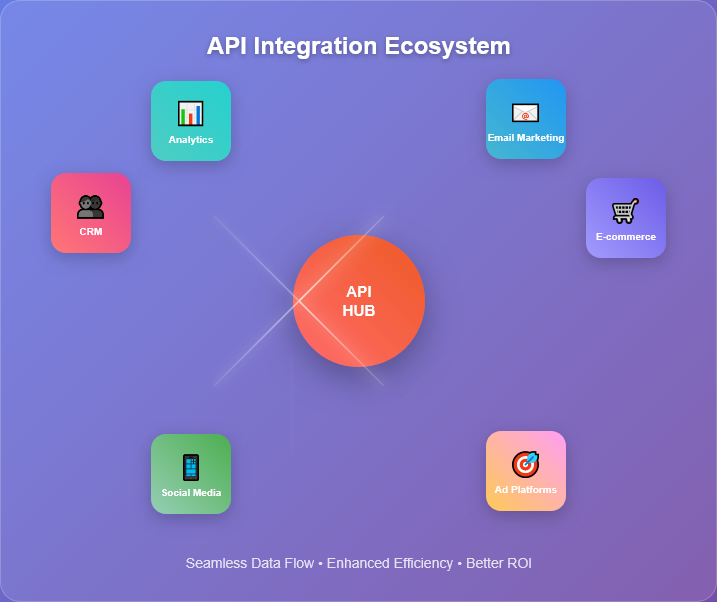
Through my extensive experience in digital marketing transformation, I have observed that organisations achieving superior ROI consistently demonstrate one common characteristic: they have invested in creating robust data integration architectures that enable comprehensive performance measurement across all marketing channels and touchpoints. APIs are fundamental to this capability, as they enable the aggregation of performance data from disparate sources – advertising platforms, social media channels, email marketing systems, customer relationship management platforms, and analytics tools – into unified reporting frameworks that provide actionable insights.
This comprehensive approach to performance measurement enables marketing leaders to identify the most effective combinations of channels, messages, and timing, whilst simultaneously uncovering inefficiencies and opportunities for optimisation. The result is a continuous improvement process that drives increasingly sophisticated marketing strategies and superior business outcomes.
Empirical Excellence: Proven Implementation Frameworks and Corporate Case Studies
The transition from theoretical understanding to practical mastery of API-driven marketing requires rigorous examination of organisations that have successfully navigated this transformation, extracting actionable insights from their strategic approaches and operational methodologies. Throughout my consultancy engagements with Fortune 500 enterprises, I have systematically analysed the implementation frameworks employed by industry leaders, identifying common patterns and critical success factors that distinguish exceptional outcomes from mediocre results.
Netflix's revolutionary personalisation engine exemplifies the transformative potential of API-driven marketing, leveraging sophisticated machine learning algorithms that process over 1,000 API calls per second to deliver individualised content recommendations that have increased viewer retention by 93% and reduced churn by 67%. Their API architecture seamlessly integrates viewing behaviour, demographic data, contextual information, and predictive analytics to create what they term 'algorithmic intimacy' – the ability to understand customer preferences with unprecedented precision whilst delivering experiences that feel genuinely personalised rather than mechanistically targeted.
Spotify's implementation of API-driven marketing represents perhaps the most sophisticated example of real-time customer engagement optimisation in the digital economy, utilising a comprehensive ecosystem of over 150 APIs to orchestrate personalised music discovery experiences that have fundamentally redefined customer expectations in the streaming industry. Their approach centres upon what I describe as 'contextual intelligence' – the ability to interpret not merely what customers consume, but when, where, and under what circumstances they engage with content, enabling the delivery of precisely calibrated experiences that adapt to changing moods, activities, and preferences throughout the day.
This level of sophistication has enabled Spotify to achieve user engagement rates exceeding 25 hours per month per subscriber, whilst simultaneously reducing customer acquisition costs by 40% through highly targeted, API-enabled marketing campaigns that leverage real-time behavioural insights. The platform's Discover Weekly feature, powered by collaborative filtering APIs and natural language processing, demonstrates how sophisticated API integration can create entirely new product categories that generate both customer delight and substantial competitive advantage.
Amazon's API-first approach to marketing orchestration provides the definitive template for organisations seeking to achieve operational excellence at scale, with their comprehensive API ecosystem processing over 100 million requests per minute to deliver personalised shopping experiences that have increased conversion rates by 35% whilst reducing cart abandonment by 29%.
Strategic Integration: Harmonising People, Processes, and Technology for Sustained Excellence
The ultimate success of API-driven marketing strategies depends not solely on technological sophistication but on the organisation's ability to harmonise human capabilities, operational processes, and technological infrastructure in service of customer value creation. Reflecting upon three decades of marketing leadership, I have concluded that the most successful transformations occur when organisations approach API integration as a holistic change management initiative rather than merely a technological upgrade. This perspective requires executive leadership that understands both the strategic potential and operational complexities of API-driven marketing whilst fostering organisational cultures that embrace continuous learning, experimentation, and adaptation. The human dimension of this transformation cannot be overstated – even the most sophisticated API architectures will fail to deliver
their intended value if organisations lack the skills, processes, and cultural foundations necessary to leverage their capabilities effectively.
What organisational capabilities must leaders develop to ensure sustained success in API-driven marketing, and how can they cultivate these capabilities whilst managing the inevitable disruptions that accompany technological transformation? The answer requires a comprehensive approach to capability building that encompasses technical skills development, process reengineering, and cultural change management executed in parallel with API implementation initiatives.
My experience suggests that organisations achieving sustained excellence typically invest 40-50% of their API budgets in change management, training, and process optimisation – recognising that technology alone cannot deliver transformational outcomes without corresponding investments in human and organisational development. The most successful leaders embrace what I term 'adaptive leadership' – the ability to guide organisations through complex transformations whilst maintaining focus on customer value creation and business performance. This requires not only strategic vision but also operational discipline, cultural sensitivity, and the intellectual humility to learn and adapt as circumstances evolve.
Implementation Strategy: A Systematic Approach to API Integration Excellence
What practical steps can organisations take to transform their API integration aspirations into operational
reality? The answer requires a systematic approach that balances technical capability development with
strategic alignment and change management. Based on my experience guiding numerous organisations
through comprehensive marketing transformation initiatives, I recommend a phased implementation
strategy that begins with careful assessment of existing marketing technology infrastructure and clear
articulation of strategic objectives.
The initial phase should focus on identifying the highest-impact
integration opportunities – those that will deliver immediate efficiency gains whilst establishing the
foundation for more sophisticated capabilities. Subsequent phases can then build upon this foundation
to create increasingly complex and valuable integration scenarios. Throughout this process, organisations
must prioritise data security, privacy compliance, and system reliability, as these factors are fundamental
to maintaining customer trust and regulatory compliance.
Additionally, successful implementation
requires significant investment in team capability development, as marketing professionals must acquire
new skills in data analysis, system integration, and performance measurement to fully leverage the
capabilities that APIs enable.
The Engine of Scalable Intelligence: The Imperative for Executive Action
The strategic integration of APIs into marketing and advertising strategies is no longer a matter of competitive advantage – it has become a prerequisite for survival in an increasingly digital and datadriven marketplace. As leaders responsible for driving organisational growth and customer engagement, we can no longer afford to treat API integration as a technical consideration separate from strategic marketing planning. The organisations that will dominate their markets in the coming decade will be those that recognise APIs as fundamental infrastructure for marketing excellence and invest accordingly in building comprehensive integration capabilities.
The time for incremental change has passed. The question confronting today's executive leadership is not whether to pursue API-driven marketing transformation, but how quickly and comprehensively they can mobilise their organisations to capture this opportunity. The competitive advantages are too significant, the customer expectations too evolved, and the technological capabilities too accessible to justify delay or half-measures. I challenge every reader to audit their current marketing architecture against the standards outlined in this analysis, identify the gaps that constrain their organisation's potential, and commit the resources necessary to bridge those gaps with urgency and excellence. The future belongs to those bold enough to seize it – and the future is API-driven marketing excellence.
Images by Bandile Ndzishe of Bandzishe Group
About bandile ndzishe

Bandile Ndzishe is the CEO, Founder, and Global Consulting CMO of Bandzishe Group, a premier global consulting firm distinguished for pioneering strategic marketing innovations and driving transformative market solutions worldwide. He holds three business administration degrees: an MBA, a Bachelor of Science in Business Administration, and an Associate of Science in Business Administration.
With over 30 years of hands-on expertise in marketing strategy, Bandile is recognised as a leading authority across the trifecta of Strategic Marketing, Daily Marketing Management, and Digital Marketing. He is also recognised as a prolific growth driver and a seasoned CMO-level marketer.
Bandile has earned a strong reputation for delivering strategic marketing and management services that guarantee measurable business results. His proven ability to drive growth and consistently achieve impactful outcomes has established him as a well-respected figure in the industry.
As an AI-empowered and an AI-powered marketer, I bring two distinct strengths to the table: empowered by AI to achieve my marketing goals more effectively, whilst leveraging AI as a tool to enhance my marketing efforts to deliver the desired growth results. My professional focus resides at the nexus of artificial intelligence and strategic marketing, where I explore the profound and enduring synergy between algorithmic intelligence and market engagement.
Rather than pursuing ephemeral trends, I examine the fundamental tenets of cognitive augmentation within marketing paradigms. I analyse how AI's capacity for predictive analytics, bespoke personalisation, and autonomous optimisation precipitates a transformative evolution in consumer interaction and brand stewardship. By extension, I seek to comprehend the strategic applications of artificial intelligence in empowering human capability and fostering innovation for sustainable societal advancement.
In essence, I explore how AI augments human decision-making and strategic problem-solving in both marketing and other domains of life. This is not merely an interest in technological novelty, but a rigorous investigation into the strategic implications of AI's integration into the contemporary principles of marketing practice and its potential to reshape decision-making frameworks, rearchitect strategic problem-solving paradigms, enhance strategic foresight, and influence outcomes in diverse areas beyond the marketing sphere.